
Introduction: AI Tokens as the Next Frontier of Crypto
AI tokens are digital assets that operate on blockchain networks, designed to power AI-driven decentralized applications (dApps). They bridge the worlds of artificial intelligence and blockchain, enabling users to access machine learning models, decentralized data processing, and AI-based services in a secure and permissionless manner.
Since 2025, AI tokens have gained attention from investors, developers, and enterprise users due to the rising demand for decentralized AI solutions, transparency in AI model usage, and tokenized incentive systems.
| Feature | Description |
|---|---|
| Token Type | Utility / Governance |
| Primary Use | Access AI platforms, run ML models, reward contributors |
| Blockchain Networks | Ethereum, Solana, Arbitrum, Polygon, others |
| Typical Users | Developers, data scientists, crypto traders, AI enthusiasts |
| Market Trend | Rapid adoption, high volatility, speculative interest |
How AI Tokens Work in Crypto
AI tokens function as core assets within decentralized AI ecosystems, providing utility and governance. Key mechanisms include:
- Access AI Services: Users spend tokens to run AI models on blockchain-powered networks.
- Data Contribution & Rewards: Holders can contribute datasets, validate AI outputs, and earn token rewards.
- Governance Participation: Token holders vote on upgrades, model selection, or resource allocation within AI ecosystems.
- Incentivizing Developers: Tokens reward open-source contributions, node operation, and participation in decentralized AI networks.
Representative Projects and Tokens:
| Token | Ecosystem | Main Utility |
|---|---|---|
| AGIX | SingularityNET | Access to AI services marketplace |
| ARC | AI Rig Complex | Orchestrate lightweight AI agents on Solana & Arbitrum |
| FET | Fetch.ai | Autonomous AI agents for data analysis & trading |
| RLC | iExec | Decentralized cloud computing for AI tasks |
AI Token Market Performance in 2026
The AI token sector is highly dynamic, with rapid adoption and speculative trading driving significant volatility.
| Token | Current Price (2026) | Market Cap | 24h Volume |
|---|---|---|---|
| AGIX | $0.86 USD | $1.3B USD | $25M USD |
| ARC | $0.0066 USD | $528M USD | $18.5M USD |
| FET | $0.43 USD | $350M USD | $10M USD |
| RLC | $2.12 USD | $980M USD | $45M USD |
Key Market Drivers:
- Enterprise adoption of AI and blockchain integration
- Emergence of AI-powered DeFi and NFT projects
- Speculative investor activity and social media trends
- Regulatory clarity supporting decentralized AI infrastructure
Price Volatility Note:
AI tokens are sensitive to network adoption, development updates, and hype cycles. Traders should expect rapid swings, with short-term gains and losses amplified by low market liquidity for certain tokens.
Advantages and Risks of AI Tokens
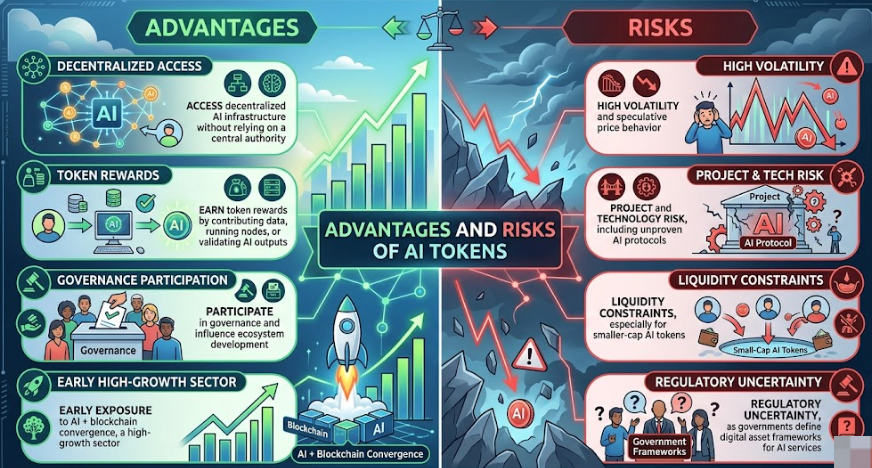
Advantages:
- Access decentralized AI infrastructure without relying on a central authority
- Earn token rewards by contributing data, running nodes, or validating AI outputs
- Participate in governance and influence ecosystem development
- Early exposure to AI + blockchain convergence, a high-growth sector
Risks:
- High volatility and speculative price behavior
- Project and technology risk, including unproven AI protocols
- Liquidity constraints, especially for smaller-cap AI tokens
- Regulatory uncertainty, as governments define digital asset frameworks for AI services
2026 AI Token Market Trends
- Integration with DeFi and NFT ecosystems – AI tokens increasingly provide utility for NFT minting, AI-generated content, and algorithmic trading.
- Tokenized AI services – Platforms like SingularityNET allow AI models to be purchased and monetized directly via blockchain payments.
- Cross-chain AI adoption – Solana, Arbitrum, and Polygon support lightweight, edge-deployed AI agents, reducing costs and latency.
- Community-driven development – Governance tokens ensure developers and contributors are incentivized to maintain robust AI networks.
AI Token Investment Strategies 2026
- Diversification: Avoid concentrating on a single AI token; spread risk across multiple projects.
- Research Ecosystem Adoption: Evaluate developer activity, user base, and real-world AI usage.
- Check Tokenomics: Review circulating supply, staking rewards, and governance incentives.
- Monitor Market Sentiment: AI tokens are highly sensitive to hype cycles and social media narratives.
- Consider Long-term Potential: Focus on projects with strong utility and growing adoption rather than short-term speculative pumps.
FAQ: AI Tokens in Crypto
What are AI tokens in crypto?
AI tokens are blockchain-based assets that power decentralized AI platforms and applications, enabling access to models, data processing, and ecosystem governance.
How do AI tokens generate value?
Through utility within AI ecosystems, governance participation, staking rewards, and incentivizing contributions to AI protocols.
Are AI tokens a good investment in 2026?
They are high-risk, high-reward. Investors should evaluate project credibility, adoption metrics, and market liquidity.
Which blockchains support AI tokens?
Ethereum, Solana, Arbitrum, Polygon, and other EVM-compatible networks.
Can AI tokens be traded like regular cryptocurrencies?
Yes, most AI tokens are listed on both centralized exchanges (CEXs) and decentralized exchanges (DEXs), allowing market access and liquidity.
What future trends should investors watch?
AI token adoption in DeFi, NFT marketplaces, enterprise AI, cross-chain AI deployment, and regulatory developments in AI + blockchain integration.


