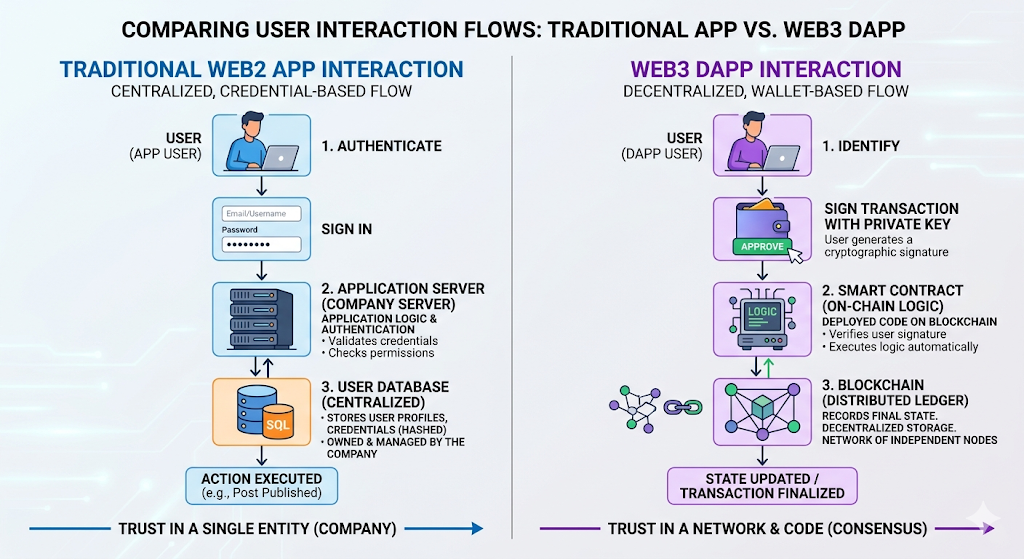
Web3 is often described as a new version of the internet built on blockchain technology. Instead of relying on company servers, core parts of web3 apps run on decentralized networks of computers — and you interact with them by connecting a crypto wallet, not by creating an account.
A dApp, short for decentralized application, is a specific type of web3 app that runs on a blockchain and minimizes central points of control. All dApps are web3 apps, but not all web3 apps are fully decentralized. In many cases, changes to a true dApp are managed collectively through on-chain governance or community voting rather than by a single development team.
Never share your recovery phrase or private keys with any web3 app, website, or individual. If a service asks for this information, it is attempting to access your funds.
How Do DApps and Web3 Apps Work?
Most dApps are powered by smart contracts — pieces of code deployed on a blockchain that define an application's rules and execute transactions automatically when those rules are met. Because the code runs on-chain, it's transparent and resistant to unilateral changes after deployment.
Instead of logging in with an email and password, you connect with a crypto wallet. When you approve a transaction, your wallet signs it cryptographically and broadcasts it to the network. The blockchain processes it according to the smart contract logic — no middleman involved.
Web3 apps cover a wide range of use cases: trading, lending and borrowing, NFT marketplaces, blockchain gaming, and community governance. Some rely almost entirely on smart contracts; others combine on-chain logic with traditional web infrastructure for the front-end interface.
Where Can You Find Web3 Apps?
Web3 apps exist across many different blockchain networks, each with its own ecosystem of tools, tokens, and communities. Common environments include major smart contract platforms, Layer 2 networks, and sidechains designed to improve speed and reduce transaction costs.
Getting started typically involves three steps:
-
Choose a network you want to use
-
Set up a compatible wallet or exchange account that supports that network
-
Connect your wallet to the web3 app through a browser extension, mobile in-app browser, or QR-based connection tool
Understanding network fees and exchange costs before you move assets between a centralized platform and an on-chain dApp will save you from surprises. Reviewing supported networks and trading fees on your exchange of choice is a practical first step.
What Are the Benefits?
You control your own data. Web3 apps connect directly to your wallet and read only what's already on the blockchain — no name, no email, no personal profile stored in a company database. The websites hosting these interfaces may still collect basic usage data, so privacy practices vary, but the core model is fundamentally different from traditional platforms.
Pseudonymity by default. On-chain activity is tied to a wallet address, not your real-world identity. Anyone can view an address's transaction history, but linking it to a specific individual requires additional off-chain information. This is pseudonymity, not full anonymity — worth understanding the distinction before assuming complete privacy.
No single point of failure. Traditional apps go down when their servers do. dApps run across decentralized networks where copies of the blockchain are maintained across many machines simultaneously. If one node drops off, the others keep the network running.
Censorship resistance. Because public blockchains are append-only ledgers maintained by many participants, no single entity can delete on-chain data or block smart contract execution. Access to web interfaces and domain names can still be restricted, but the underlying protocol layer is significantly harder to censor.
Value flows to participants. Traditional platforms capture most of the economic value their users generate. Web3 apps can be designed so that liquidity providers, governance voters, content contributors, and early supporters receive token-based rewards tied directly to the protocol's growth.
How to Connect Safely
The basic connection process is consistent across most web3 apps:
-
Set up a wallet that supports the network you want to use
-
Fund it with the native token needed to cover transaction fees
-
Navigate to the web3 app's official website — verify the URL before proceeding
-
Click Connect Wallet and approve the connection from your wallet interface
-
Review every transaction carefully before signing
That last step is the most important one. A wallet connection alone doesn't give an app permission to move your funds — but approving a malicious transaction does. Read what you're signing.
Key Safety Tips
-
Keep your recovery phrase and private keys offline — never enter them into any app or website
-
Bookmark the dApps you use regularly; don't navigate to them through links in messages or social posts
-
Start with small amounts when testing a new app or network for the first time
-
Regularly review which apps have active wallet connections and revoke access you no longer need
-
Use platforms with transparent fees, clear documentation, and verifiable proof of reserves for any on-ramp or off-ramp activity
Start Exploring
Understanding how dApps and web3 apps work — and how they handle your data — makes your activity in this space meaningfully safer. When you're ready to trade the tokens that power the web3 ecosystem, you can create an account on Tapbit, take advantage of current welcome rewards, and build a setup that works across both centralized and decentralized finance.
FAQ
What is a dApp in Web3?
A dApp (decentralized application) is a type of Web3 app that runs on a blockchain like Ethereum. It uses smart contracts to operate without centralized control, allowing users to interact directly through their crypto wallets instead of traditional accounts.
What is the difference between Web3 apps and dApps?
All dApps are Web3 apps, but not all Web3 apps are fully decentralized. dApps rely primarily on blockchain-based smart contracts, while some Web3 apps may still use centralized components, such as front-end servers or partial data storage.
How do dApps work?
dApps run on smart contracts deployed on blockchains such as Solana. Users connect via a crypto wallet, sign transactions, and interact directly with on-chain logic—without intermediaries like banks or centralized platforms.
Are dApps safe to use?
dApps can be secure, but risks exist. Users must protect their private keys, verify official websites, and carefully review transactions before signing. Malicious smart contracts or phishing sites can lead to loss of funds.
How do I start using a dApp?
To get started:
-
Fund it with tokens for transaction fees
-
Connect it to a dApp
-
Approve transactions carefully
Always start with small amounts and ensure you understand network fees and risks before interacting with new platforms.


