In Q1 2026, the on-chain tokenized stock market surpassed $1 billion in total value, up from just $35 million a year earlier. Most of that growth came from capital rotating out of low-yield tokenized Treasuries into equities. Ondo Finance now holds about 58% of that market, largely due to its compliance setup and institutional partnerships in Europe.
However, beneath the surface of explosive platform growth lies a complex valuation trap for secondary market investors. A surging Total Value Locked (TVL) does not automatically translate to token price appreciation. This Tapbit Research deep dive explores Ondo's infrastructural monopoly, the implications of the new 21Shares ONDOO ETP, and the critical "value capture disconnect" that is currently suppressing the ONDO governance token.
The $1 Billion Threshold: Moving from Debt to Equity
Capital flows in the digital asset space are undergoing a fundamental rotation. Over the past twelve months, the Real World Asset (RWA) narrative has aggressively expanded horizontally. Yield-starved capital is moving out of low-yield tokenized U.S. Treasuries and into high-volatility, on-chain equities.
According to RWAxyz on-chain analytics, the total market value of tokenized stocks officially breached the $1 billion mark in Q1 2026. This represents a staggering 29-fold expansion from a baseline of just $35 million a year prior. This is no longer an experimental niche; it is the early-stage migration of traditional securities settlement onto decentralized ledgers.
How Ondo Finance Captured 58% of the Market
In this trillion-dollar infrastructure race, Ondo Finance has established an absolute monopoly, capturing roughly 58% of the tokenized stock sector. This dominance was not built on token liquidity mining or aggressive retail marketing. It was engineered through compliance moats and institutional product depth that native DeFi competitors cannot easily replicate.
While most RWA protocols issue a single asset class, Ondo operates a comprehensive suite: OUSG (tokenized Treasuries), USDY (a yield-bearing stablecoin), and Ondo Global Markets (tokenized equities). The equities division alone supports 265 underlying traditional assets, ranging from Nvidia to the S&P 500 index.
The Automated Portfolio Catalyst
Liquidity infrastructure is the true battleground for RWAs. In late March 2026, Ondo announced a strategic integration with Glider to launch on-chain "Automated Portfolios."
Investors are no longer restricted to trading single tokenized shares. Through smart contracts, capital allocators can instantly construct custom, index-like portfolios of U.S. equities directly on-chain, complete with automated rebalancing protocols. Coupled with its integration into the 1inch aggregator—which has routed over $2.5 billion in tokenized asset volume—Ondo has effectively positioned itself as the underlying settlement layer for Web3 equities.
The TradFi Gateway: 21Shares ONDOO ETP in Europe
Market dominance is ultimately validated by traditional order books. While retail attention remained fixated on pending U.S. SEC applications, traditional finance bypassed the regulatory gridlock via Europe.
The 21Shares Ondo Exchange Traded Product (Ticker: ONDOO) is now live and actively trading on Euronext Amsterdam. Carrying a 2.50% fee structure, this ETP places ONDO into an institutional vetting sequence previously reserved only for Bitcoin and Ethereum. European pension funds, family offices, and retail investors can now acquire direct ONDO exposure through standard brokerage accounts—entirely eliminating the friction of private key management.
The Valuation Trap: Platform TVL vs. Token Utility
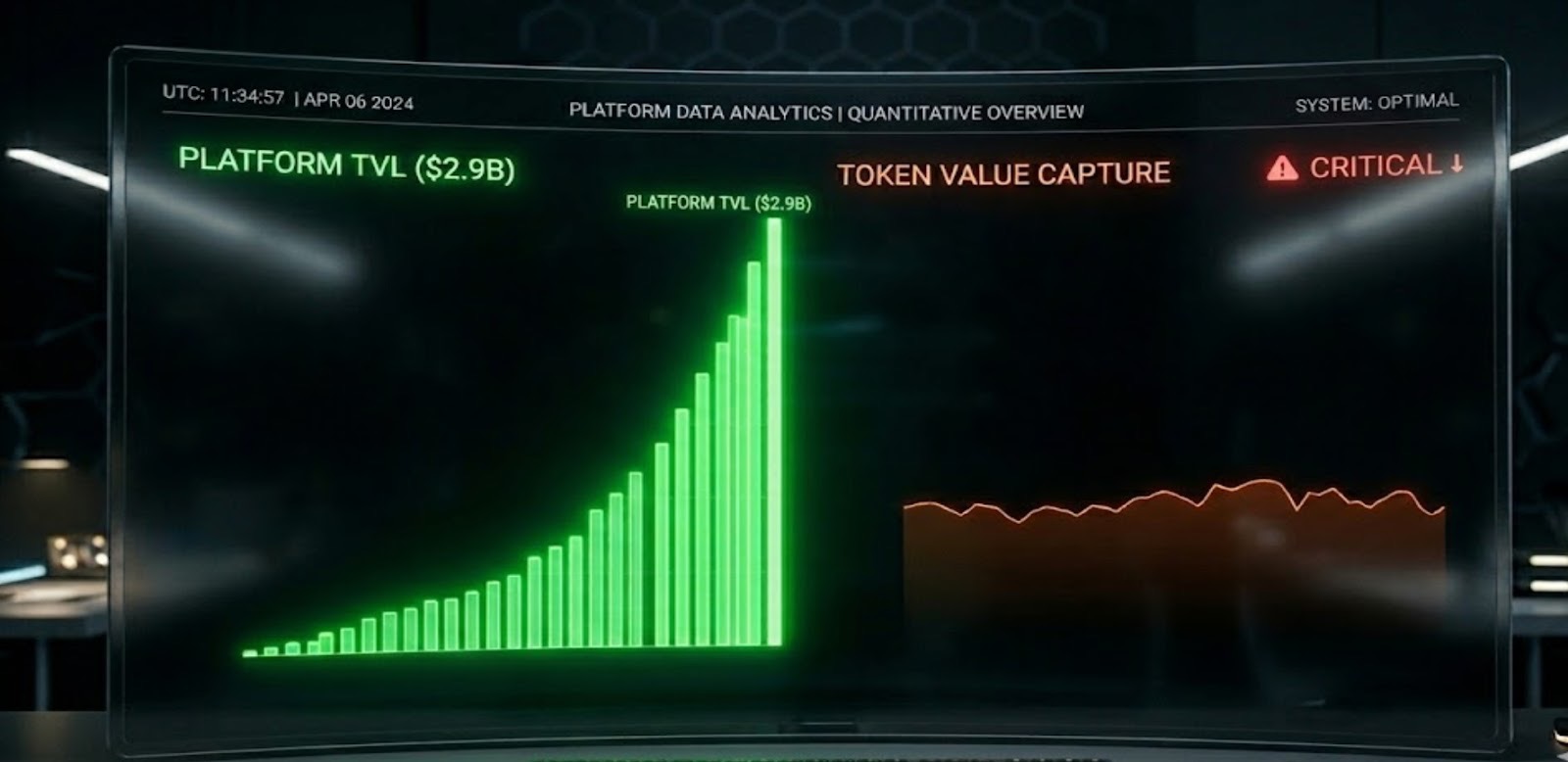
Despite executing a flawless corporate expansion, the reality for secondary market holders of the ONDO token is structurally compromised. This divergence highlights the most significant fundamental flaw in the current RWA investment thesis.
As of April 2026, Ondo’s platform TVL sits at approximately $2.9 billion. However, its Market Cap-to-TVL ratio remains suppressed at 0.45. In the broader DeFi landscape, a valuation multiplier this compressed indicates a severe market hesitation.
The "Value Capture Disconnect" Explained
Why does the protocol thrive while the token stagnates? The root cause is the absence of a value capture mechanism.
Traditional DeFi tokens (such as UNI or MKR) often bake in fee-sharing, staking dividends, or buyback-and-burn mechanics. Ondo’s compliance architecture explicitly avoids this.
-
Zero Utility Requirement: Users purchasing tokenized Treasuries or equities via Ondo do not need to hold or consume ONDO tokens.
-
Regulatory Caution: To avoid classification as an unregistered security by the U.S. SEC, the team has abstained from embedding dividend mechanics into the token.
-
Supply Overhang: A massive unlock event in January 2026 released 1.94 billion tokens (roughly 40% of the circulating supply), creating a heavy, persistent sell-wall maintained by market makers.
Ondo Finance, the corporate entity, is generating substantial management fees from real-world assets. ONDO, the governance token, currently has no economic model to absorb or reflect those revenues.
Strategic Takeaways for Traders
For traders operating on Tapbit, Ondo provides a masterclass in separating company fundamentals from token fundamentals.
-
Do Not Trade TVL Linearly: A surging platform TVL does not equate to buy-pressure on the token when utility is disconnected. Do not buy spot ONDO simply because tokenized stock volumes are increasing.
-
Monitor for Tokenomic Revisions: The ultimate bullish catalyst for ONDO will not be another asset listing; it will be the introduction of a compliant protocol fee-capture mechanism. Until that structural upgrade is announced, ONDO will likely remain a range-bound asset.
-
Play the Range: In the current tug-of-war between institutional inflows (via the ONDOO ETP) and the heavy circulating supply inflation, swing trading established support and resistance bands offers a significantly higher expected value than passive holding.
Log in to the Tapbit Trading Terminal to leverage deep liquidity and execute precision trades within the RWA sector's ongoing volatility.
Frequently Asked Questions (FAQ)
What are tokenized stocks?
Tokenized stocks are blockchain-based digital tokens that represent price exposure to traditional equities, such as Tesla or the S&P 500. The tokens themselves are not direct shares; price parity is maintained through compliant broker-dealers and institutional custodians holding the underlying traditional assets.
How can traditional investors buy ONDO?
In addition to native crypto exchanges, European investors can now purchase the 21Shares Ondo Exchange Traded Product (Ticker: ONDOO) directly on Euronext Amsterdam using standard fiat brokerage accounts.
Why is the ONDO token price struggling while the platform grows?
This is caused by a "value capture disconnect." Clients using Ondo’s core financial products are not required to purchase or hold the ONDO governance token. Therefore, billions of dollars in platform growth do not create organic buying pressure for the token. Additionally, the token faces significant overhead resistance due to large-scale supply unlocks that occurred in early 2026.


