
Ripple and XRP are frequently mentioned together in crypto discussions, leading many newcomers to assume they refer to the same thing. While the two are closely connected historically, they actually play very different roles within the blockchain industry.
Ripple operates as a financial technology company focused on payment infrastructure, whereas XRP functions as a cryptocurrency designed for liquidity movement and blockchain-based settlement. The confusion mainly exists because Ripple was heavily involved in XRP’s early ecosystem development and still remains strongly associated with the token.
As global interest in blockchain-powered payments continues expanding, both Ripple and XRP remain central topics in conversations surrounding cross-border finance and digital settlement systems.
What Ripple Actually Does
Ripple is a fintech company that develops payment technologies aimed at improving international money transfers.
Traditional cross-border banking systems often rely on multiple intermediaries, creating delays and increasing transaction costs. Ripple’s products were designed to help financial institutions process transfers more efficiently through blockchain-inspired infrastructure.
Rather than positioning itself as a decentralized cryptocurrency project, Ripple focuses primarily on enterprise payment solutions.
| Ripple Service | Primary Purpose |
|---|---|
| RippleNet | Global payment infrastructure |
| xCurrent | Bank settlement coordination |
| xVia | Payment integration interface |
| xRapid | Liquidity system connected to XRP |
The company’s broader objective revolves around reducing settlement friction for international payments and modernizing outdated banking processes.
Unlike Bitcoin or Ethereum, Ripple itself functions as a centralized corporate entity rather than an open decentralized network.
Understanding XRP
XRP is a digital asset that operates on the XRP Ledger, a blockchain network built for fast and low-cost value transfers.
The token was created to support liquidity movement between currencies during international transactions. Instead of requiring several banking intermediaries, XRP can theoretically help facilitate faster settlement between different fiat currencies.

Several characteristics separate XRP from older cryptocurrencies.
| XRP Attribute | Details |
|---|---|
| Blockchain | XRP Ledger |
| Token Category | Cryptocurrency |
| Supply Structure | Fixed supply |
| Mining Process | Not mineable |
| Main Utility | Liquidity and settlement |
Unlike Bitcoin, XRP does not rely on proof-of-work mining. Transactions are validated through a consensus mechanism involving network validators.
Because transfers settle quickly and transaction costs remain relatively low, XRP gained significant visibility among traders and blockchain payment enthusiasts.
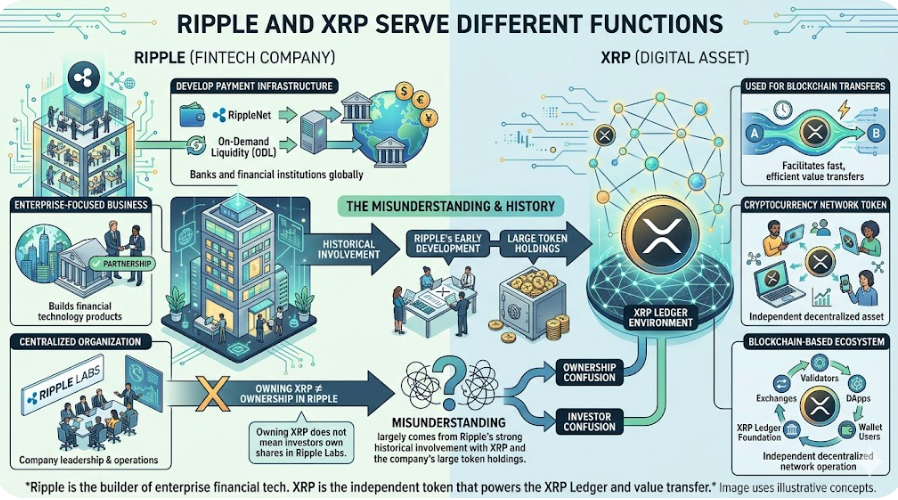
Ripple and XRP Serve Different Functions
The easiest way to understand the difference is to separate the company from the token.
| Ripple | XRP |
|---|---|
| Fintech company | Digital asset |
| Develops payment infrastructure | Used for blockchain transfers |
| Enterprise-focused business | Cryptocurrency network token |
| Centralized organization | Blockchain-based ecosystem |
Ripple builds financial technology products, while XRP operates independently as a cryptocurrency within the XRP Ledger environment.
This distinction is important because owning XRP does not mean investors own shares in Ripple Labs.
The misunderstanding largely comes from Ripple’s strong historical involvement with XRP and the company’s large token holdings.
Why Ripple and XRP Remain Closely Connected
Even though Ripple and XRP are technically separate, the two still maintain a strong relationship.
Ripple played a major role in the XRP ecosystem’s early growth and received a substantial amount of XRP when the token supply was created.
To address market concerns regarding token concentration, Ripple later placed large portions of XRP into escrow accounts intended to control supply release schedules.
| Connection Area | Explanation |
|---|---|
| Early Development | Ripple supported XRP ecosystem growth |
| XRP Holdings | Ripple historically controlled large reserves |
| Liquidity Products | Some Ripple services utilize XRP |
| Market Sentiment | Ripple news can influence XRP pricing |
Because Ripple still holds significant XRP reserves, announcements involving Ripple partnerships or institutional activity often affect XRP market sentiment.
However, XRP itself continues operating independently on the XRP Ledger.
Does Ripple Need XRP?
Not necessarily.
Several Ripple products can operate without direct XRP usage.
| Ripple Product | XRP Required |
|---|---|
| xCurrent | No |
| xVia | No |
| xRapid | Yes |
Solutions such as xCurrent mainly focus on payment messaging and settlement coordination between institutions. xRapid, however, was specifically designed to use XRP for liquidity transfers.
This means Ripple’s business infrastructure can continue functioning even if some institutional clients choose not to use XRP directly.
Can XRP Continue Without Ripple?
Yes.
The XRP Ledger functions as an open blockchain network supported by validators and ecosystem participants beyond Ripple itself.
Even if Ripple no longer existed as a company, the XRP Ledger could theoretically continue processing transactions and supporting blockchain activity independently.
This separation matters because many blockchain ecosystems eventually evolve beyond the organizations originally involved in their creation.
Why XRP Became Popular
XRP attracted major market attention because it focused heavily on financial settlement and payment efficiency rather than decentralized ideology alone.
While Bitcoin positioned itself as digital money and Ethereum became associated with smart contracts, XRP developed a reputation as a blockchain asset connected to payment infrastructure.
Several factors contributed to XRP’s popularity.
| Market Driver | Impact |
|---|---|
| Fast Transfers | Faster transaction settlement |
| Low Fees | Reduced transfer costs |
| Banking Narrative | Institutional finance discussions |
| Exchange Listings | Wider retail accessibility |
| Established Ecosystem | Long-term community support |
As blockchain payment systems became an important industry narrative, XRP attracted both institutional curiosity and strong retail participation.
Many users following XRP also monitor broader latest coin price activity and payment-focused blockchain trends to evaluate sentiment surrounding digital settlement assets.
Why Ripple and XRP Continue Generating Debate
Ripple and XRP remain controversial partly because the ecosystem sits between traditional finance and decentralized crypto infrastructure.
Supporters believe Ripple’s technology could improve global payment systems by making international settlement faster and more efficient.
Critics often point to concerns involving:
- Centralization
- Ripple’s XRP reserves
- Regulatory uncertainty
- Institutional adoption challenges
These debates have remained closely tied to XRP’s market identity for years.
Despite ongoing criticism, XRP continues ranking among the most recognized cryptocurrencies globally because of its long history and strong association with cross-border payment technology.
Users interested in broader XRP market developments often follow professional market trend analysis and blockchain infrastructure research to track evolving financial technology adoption trends.
Conclusion
Ripple and XRP are related, but they are fundamentally different.
Ripple functions as a fintech company building payment infrastructure for financial institutions, while XRP operates as a cryptocurrency designed to support blockchain-based liquidity and settlement systems.
Understanding the distinction helps clarify how Ripple’s enterprise business, XRP’s blockchain functionality, and the broader digital payments narrative interact within the crypto industry.
As blockchain adoption within global finance continues expanding, both Ripple and XRP are likely to remain important parts of conversations surrounding international payments and digital asset infrastructure.
FAQ
Is Ripple the same as XRP?
No. Ripple is a financial technology company, while XRP is a cryptocurrency operating on the XRP Ledger.
Does owning XRP mean owning Ripple stock?
No. XRP holders do not own equity in Ripple Labs.
What is XRP mainly used for?
XRP was designed to help facilitate fast and efficient cross-border liquidity transfers.
Can XRP survive without Ripple?
Yes. The XRP Ledger can continue operating independently from Ripple the company.
Why is XRP important in crypto markets?
XRP gained attention because of its fast transaction speed, low fees, and association with blockchain-based payment systems.


