

XRP has always had a strange place in the market.
It is one of the most recognized crypto assets in the world, but the investment case has never been only about retail trading. For years, XRP supporters have argued that the real story sits somewhere deeper: institutional payments, liquidity, settlement, tokenized assets, and the infrastructure that connects crypto markets with traditional finance.
Ripple Prime’s integration with EDX Markets fits neatly into that story. It does not suddenly prove that institutions are buying XRP in size. It does not make RLUSD an active collateral asset on EDX overnight. But it does add another piece to the institutional infrastructure around Ripple’s ecosystem.
And for XRP, that matters.
The Real Change Is the Trading Route
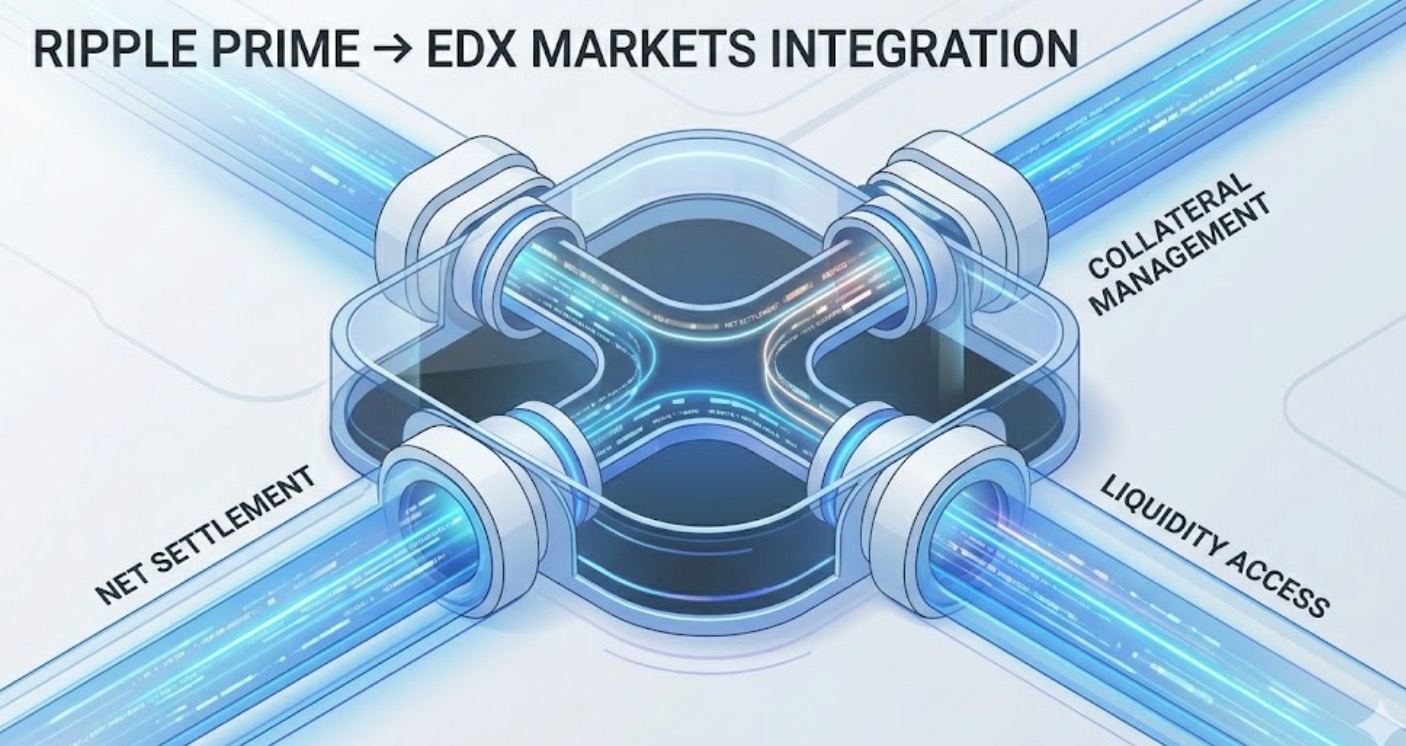
The headline is simple: Ripple Prime has integrated with EDX Markets and EDXM International, allowing Ripple Prime clients to access EDX spot and perpetual futures liquidity through a prime brokerage framework.
That may sound like back-office plumbing, but in institutional markets, plumbing is often the product.
Large funds and professional trading firms do not usually want to move capital across disconnected venues, manage collateral separately on every platform, and deal with fragmented settlement workflows. They want something closer to the structure they already know: prime brokerage, net settlement, collateral management, and cleaner access to liquidity.
That is the part of the deal worth paying attention to.
XRP was already part of EDX’s broader asset expansion before this integration. So the new development is not simply “XRP is now on EDX.” The more important point is that Ripple Prime clients now have a more institutional path into that liquidity.
For retail traders, this may not feel dramatic. For professional desks, it can be meaningful.
RLUSD Is Part of the Setup, But Not Yet the Payoff

The stablecoin angle is just as important, but it needs to be read carefully.
Ripple has said the EDX integration lays the groundwork for RLUSD to potentially become a future settlement and collateral asset on the platform. That is useful language, but it is not the same as saying RLUSD is already live as margin collateral on EDX.
This distinction matters.
If RLUSD eventually becomes part of the settlement or collateral workflow, Ripple’s role could expand beyond XRP market access. Stablecoins are increasingly becoming the operating layer of crypto trading. They move collateral, settle transactions, and connect exchanges, brokers, and liquidity venues.
For Ripple, RLUSD could become a practical bridge between institutional trading infrastructure and digital asset settlement. But at this stage, it is still a setup. The market will need to see actual usage before treating it as a proven driver.
XRP Is Being Pulled Into a Bigger Tokenization Story
The EDX integration is not happening in isolation.
Across traditional finance, tokenization is becoming more serious. Clearing houses, banks, exchanges, asset managers, and regulators are all exploring how securities, bonds, deposits, funds, and settlement assets might move onto digital infrastructure.
Ripple Prime’s participation in broader tokenization discussions matters because it places the company inside that institutional conversation. But this also needs discipline from the market. Being part of a working group or pilot does not mean XRP has been formally adopted as a settlement asset by major institutions.
That is where some XRP narratives get ahead of the facts.
There have also been pilots and experiments involving the XRP Ledger and RLUSD in tokenized asset contexts. These are worth watching. They show that the technology is being tested in real-world institutional environments. But a pilot is not the same as production adoption, and a test does not automatically translate into recurring transaction demand.
The signal is constructive. It is not conclusive.
Why the Market Cares Anyway
The reason traders still care is that infrastructure usually develops before volume shows up.
A better institutional route does not move price by itself. But it can make future activity easier. If more professional firms can access XRP and related products through a prime brokerage framework, then the market structure around XRP becomes more mature.
That is the bullish interpretation.
The cautious interpretation is also fair. XRP has seen plenty of infrastructure headlines over the years, and not all of them have translated into sustained price performance. Traders have learned to ask a harder question: where is the volume?
That is the right question to ask again here.
The Ripple Prime and EDX integration improves the route. Now the market needs evidence that institutions are actually using it.
What Would Make This More Important?
The next phase is about measurable activity.
The first thing to watch is liquidity. If XRP trading depth improves on EDX-connected venues, the integration becomes more than a headline.
The second is institutional volume. Prime brokerage access is useful only if professional clients actually trade through it.
The third is RLUSD adoption. If RLUSD becomes accepted as collateral or settlement infrastructure in practice, that would give Ripple’s stablecoin strategy more weight.
The fourth is tokenized asset activity. Ripple-related pilots are interesting, but recurring production use would matter far more.
In other words, the story now needs numbers.
Bottom Line
Ripple Prime’s EDX integration is not a magic switch for XRP. It does not prove that institutions are suddenly entering the asset in size, and it does not mean RLUSD is already functioning as a live settlement asset on EDX.
What it does show is that Ripple is continuing to build institutional market infrastructure around trading, collateral, settlement, and liquidity access.
That is a real development, but it is still early. For XRP, the most important question is no longer whether another institutional route exists. It does. The real question is whether that route produces visible trading volume, stablecoin usage, and tokenized settlement activity over time.
Until that happens, this is best understood as infrastructure progress rather than an immediate price catalyst.
XRP’s institutional story is getting more credible, but the market will need proof in the form of volume, liquidity, and real usage.
Traders can follow more market updates on Tapbit, log in to explore market tools, or register to stay connected with global crypto opportunities.
Frequently Asked Questions
What is Ripple Prime?
Ripple Prime is Ripple’s institutional prime brokerage business. It is designed to help professional clients access digital asset liquidity through services such as trading access, credit intermediation, net settlement, and collateral management.
What is EDX Markets?
EDX Markets is an institutional digital asset exchange backed by major traditional finance firms. It focuses on a market structure that is more familiar to professional traders, including separation between trading, custody, and clearing.
What does Ripple Prime’s EDX integration mean?
The integration allows Ripple Prime clients to access EDX spot and perpetual futures liquidity through a prime brokerage framework. In simple terms, it gives institutional clients a cleaner and more familiar route into digital asset trading.


