
Russian Oil Asset Reserve (ROAR) has recently attracted attention among crypto traders looking for emerging narrative-driven tokens on the Solana blockchain. The project’s name naturally creates curiosity because it appears to be connected to the global energy sector and Russian oil reserves.
However, before considering where to buy ROAR, investors should first understand what the token actually represents and how it differs from traditional oil-related investments.
Unlike commodity funds, energy stocks, or oil futures contracts, ROAR operates as a cryptocurrency token within the Solana ecosystem. Its market value is primarily influenced by community interest, trading activity, and market sentiment rather than direct ownership of physical oil assets.
What Is Russian Oil Asset Reserve (ROAR)?
ROAR is a Solana-based cryptocurrency project built around an oil reserve narrative. The token has gained visibility because its branding references strategic oil assets, a theme that has become increasingly popular among speculative crypto communities.
While the name may suggest a connection to physical petroleum reserves, investors should note that publicly available information does not verify ownership of actual oil reserves or government-backed energy assets.
Instead, ROAR functions as a tradable digital asset whose price is determined by supply, demand, liquidity, and market participation.
| Feature | Description |
|---|---|
| Blockchain | Solana |
| Token Type | Cryptocurrency |
| Main Narrative | Oil reserve theme |
| Trading Method | Decentralized exchanges |
| Asset Backing | No publicly verified oil backing |
As with many narrative-based crypto projects, understanding the difference between branding and verified fundamentals is essential before making investment decisions.
Where Can You Buy ROAR?
ROAR is primarily available through Solana decentralized exchanges (DEXs).
Most traders access the token through liquidity pools connected to Solana trading platforms. Rather than using a traditional centralized exchange account, users typically interact directly through a crypto wallet.
The general process includes:
- Creating a Solana-compatible wallet.
- Funding the wallet with SOL or USDC.
- Connecting to a Solana DEX aggregator.
- Verifying the token contract address.
- Swapping supported assets for ROAR.
Because decentralized exchanges do not provide the same level of screening as centralized platforms, verifying the correct token address before trading is especially important.
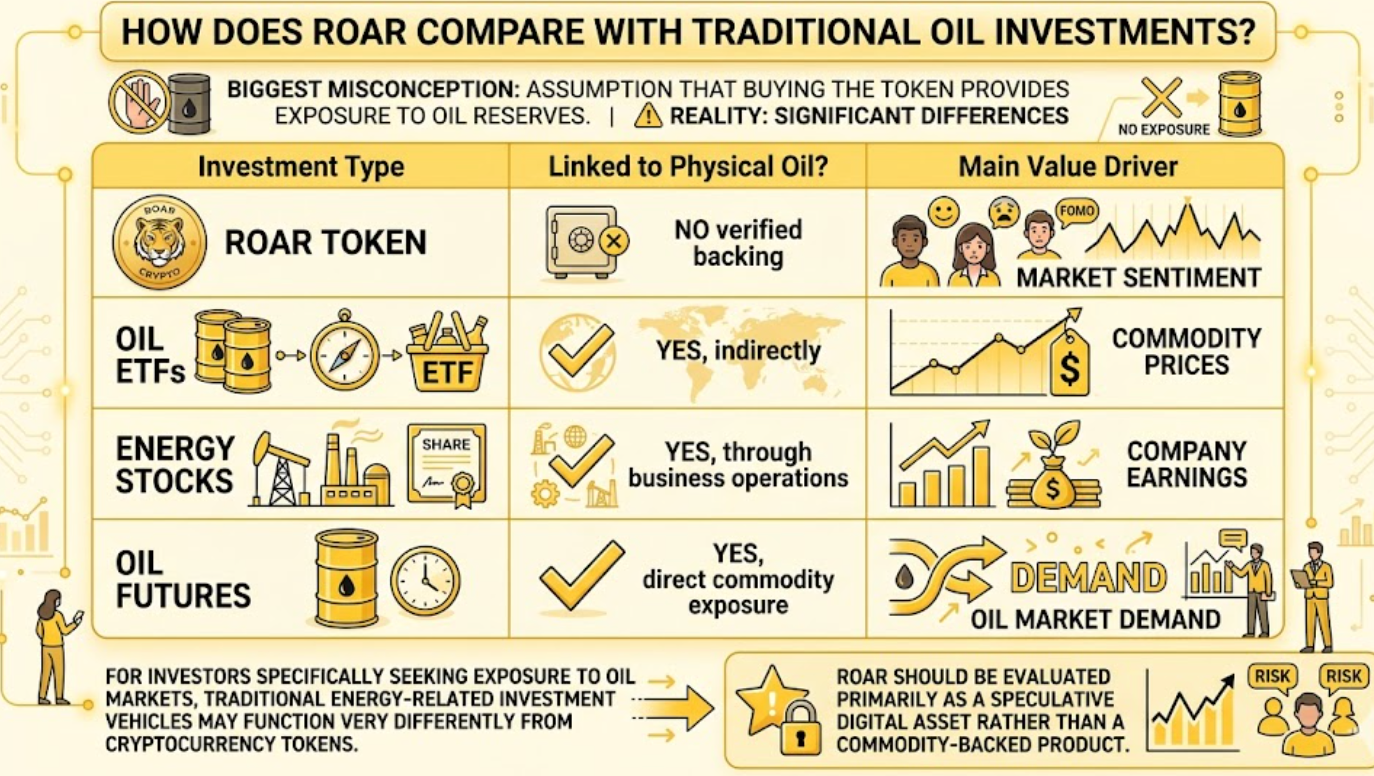
How Does ROAR Compare With Traditional Oil Investments?
One of the biggest misconceptions surrounding ROAR is the assumption that buying the token provides exposure to oil reserves.
In reality, there are significant differences.
| Investment Type | Linked to Physical Oil? | Main Value Driver |
| ROAR Token | No verified backing | Market sentiment |
| Oil ETFs | Yes, indirectly | Commodity prices |
| Energy Stocks | Yes, through business operations | Company earnings |
| Oil Futures | Direct commodity exposure | Oil market demand |
For investors specifically seeking exposure to oil markets, traditional energy-related investment vehicles may function very differently from cryptocurrency tokens.
ROAR should be evaluated primarily as a speculative digital asset rather than a commodity-backed product.
Is ROAR a Good Investment?
The answer depends largely on an investor's risk tolerance and investment objectives.
Supporters argue that narrative-driven tokens can generate significant attention and trading activity when market conditions become favorable. Smaller-cap cryptocurrencies occasionally experience rapid growth when communities expand and liquidity increases.
Several factors may contribute to bullish sentiment surrounding ROAR.
| Potential Strength | Why It Matters |
| Solana Ecosystem Exposure | Access to active crypto traders |
| Small Market Capitalization | Higher volatility potential |
| Unique Energy Narrative | Distinct market positioning |
| Community Growth | Increased visibility |
However, investors should also recognize the risks.
Because the project does not currently have publicly verified oil backing, its valuation depends heavily on market sentiment and speculative demand. Narrative-based cryptocurrencies can experience sharp price swings in both directions.
Risks Investors Should Understand
Before buying ROAR, investors should carefully evaluate several important risk factors.
| Risk Factor | Impact |
| High Volatility | Large price fluctuations |
| Narrative Dependence | Sentiment-driven valuation |
| Limited Public Information | Greater uncertainty |
| Liquidity Risk | Potential trading instability |
| Speculative Nature | Higher investment risk |
These risks are common among emerging cryptocurrency projects, particularly those built around trending narratives rather than established utility.
As a result, proper risk management remains essential.
How to Research ROAR Before Buying
Before purchasing any cryptocurrency, investors should perform independent research.
Areas worth reviewing include:
- Project documentation
- Community activity
- Liquidity levels
- Token distribution
- Contract verification
- Trading volume trends
Investors interested in exploring broader cryptocurrency markets can also access digital asset trading tools through the official Tapbit registration page.
Conclusion
Russian Oil Asset Reserve (ROAR) is a Solana-based cryptocurrency that has gained attention because of its oil-themed branding and growing community interest.
While the token may appeal to traders looking for speculative opportunities within emerging narratives, there is currently no publicly verified evidence that ROAR is backed by physical oil reserves or government-owned energy assets.
As a result, investors should view ROAR as a high-risk cryptocurrency rather than a traditional commodity investment.
Understanding the difference between narrative-driven tokens and real-world asset exposure is essential before deciding whether ROAR aligns with your investment strategy.
FAQ
Where can I buy Russian Oil Asset Reserve (ROAR)?
ROAR is mainly traded on Solana-based decentralized exchanges through supported liquidity pools.
Is ROAR backed by real oil reserves?
There is currently no publicly verified evidence that ROAR is backed by physical oil assets.
Do I need a Solana wallet to buy ROAR?
Yes. Most users access ROAR through a Solana-compatible wallet connected to a decentralized exchange.
Is ROAR a good investment?
ROAR may appeal to speculative traders, but it remains a high-risk cryptocurrency whose value depends largely on market sentiment.
Is buying ROAR the same as investing in oil?
No. ROAR is a cryptocurrency token and should not be considered equivalent to owning oil reserves, oil stocks, or oil futures.


