
The Internet Computer is a public blockchain that wants to do more than just move tokens around. It lets developers build full‑stack web applications directly on‑chain – no Amazon Web Services, no Cloudflare, no traditional databases. Smart contracts on this network (they’re called canisters) run at web speed and can serve web pages to users straight from the blockchain.
The idea is to create a decentralized “World Computer” that’s fast enough to replace big chunks of the traditional cloud, while being resistant to censorship and single points of failure.
The ICP token powers everything. You use it to pay for computation and storage, you stake it to participate in governance, and node providers earn it for running the network.
ICP Price Today, History and Volatility
Like most liquid crypto assets, ICP trades 24/7 on global exchanges. Live prices update continuously as traders buy and sell ICP against stablecoins, BTC, ETH and other assets.
Since launch, ICP has seen wide price swings. The token recorded its all-time high shortly after mainnet went live in May 2021, when speculative interest around the project was at its peak. It later retraced sharply during the broader crypto market downturn, eventually printing an all-time low in the low single digits, before attempting recoveries alongside renewed ecosystem activity.
Several factors can influence ICP price over time, including:
-
overall crypto market sentiment and liquidity conditions
-
network usage and growth of active canisters and users
-
major roadmap deliveries, upgrades and AI integrations
-
exchange listings and access to derivatives or structured products
ICP has been characterized by high volatility, particularly in its early trading period. This is common for ambitious infrastructure projects that launch with significant attention, then establish a more organic price based on actual usage and adoption.
As of April 2026, it is priced around $2.47–$2.70, with a market cap of about $1.3B+.
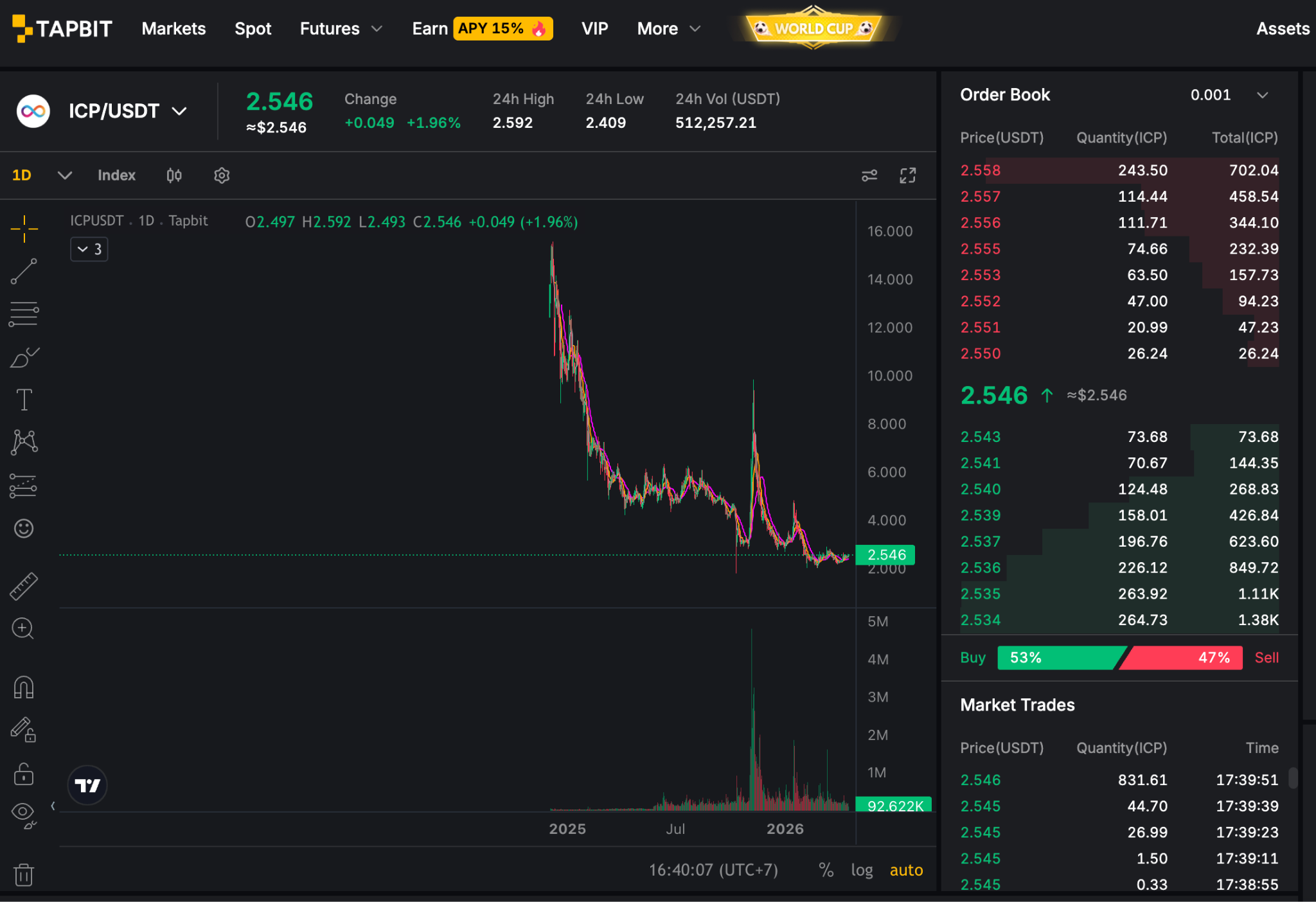
If you are considering trading ICP, it is important to recognize that sharp price movements — both up and down — are possible over short time frames. Always do your own research, size positions appropriately and consider using risk management tools such as stop orders where available.
ICP Tokenomics: Supply, Utility and Governance
Internet Computer’s tokenomics are designed to balance network growth, decentralization and long-term sustainability.
The total supply of ICP is capped at roughly 469 million tokens. Circulating supply changes over time as new tokens are released according to the protocol’s emission schedule, with allocations to:
-
early contributors and the foundation
-
node providers and other network participants
-
ecosystem development funds and community programs
ICP has three core functions within the network:
-
Utility token: ICP is converted into “cycles” that power canisters, paying for computation, storage and bandwidth directly on-chain.
-
Governance: ICP holders can stake tokens within the Network Nervous System (NNS), Internet Computer’s on-chain governance system. Staked positions, called neurons, receive voting power to approve or reject proposals that impact protocol upgrades, economic parameters and other key decisions.
-
Node incentives: Node providers are compensated for running the infrastructure that powers the network, helping to maintain decentralization and uptime.
The NNS is central to how Internet Computer evolves. By locking ICP into neurons, participants align with the network’s long-term health and receive governance rewards for voting actively. The structure encourages informed, engaged decision-making rather than short-term speculation alone.
Before committing ICP to long lock-up periods, it is wise to understand how neuron configuration, voting behavior and dissolution timelines work. Reading official documentation and community resources can help you gauge whether governance participation fits your time horizon and risk tolerance.
The ICP Ecosystem – What’s Actually Being Built?
The ecosystem has grown slowly but steadily. Unlike many chains that are dominated by DeFi forks, Internet Computer developers are exploring more unusual use cases:
-
Decentralized social networks where your profile, posts, and feed live entirely on‑chain.
-
On‑chain messaging with end‑to‑end encryption.
-
Native DeFi – exchanges and lending protocols built directly on ICP without bridging.
-
NFT projects where the image and metadata are stored fully on‑chain, not on IPFS or a private server.
-
AI experiments – canisters that run small models or coordinate with off‑chain agents.
Hackathons and grant programs have brought in more developers. The number of active canisters and users is a key metric to watch if you care about fundamentals rather than hype.
Some notable projects include DSCVR (a decentralized social platform) and OpenChat (an on‑chain messaging app). Both demonstrate that canisters can serve real user interfaces without traditional web hosting.
How to Buy ICP – A Realistic Step‑by‑Step
If you decide to buy ICP, here’s how it usually works on a centralized exchange:
-
Create an account on a platform that lists ICP (Binance, Coinbase, Kraken, Tapbit, etc.). Complete email verification.
-
Complete KYC (identity verification). Most regulated exchanges require this for withdrawals.
-
Deposit funds – either via bank transfer, card, or by depositing another crypto like USDT.
-
Find the ICP trading pair. ICP/USDT is the most liquid.
-
Place an order. A market order buys at current price. A limit order lets you set your price.
-
After execution, decide: leave ICP on the exchange for active trading, or withdraw it to a wallet you control.
If you withdraw to self‑custody, triple‑check the address. ICP is on its own network, not ERC‑20. Sending to the wrong chain will lose your funds.
ICP Trading Pairs, Liquidity and Fees
ICP is listed on a range of centralized exchanges and is commonly paired with major base currencies. The most liquid markets tend to involve stablecoins or leading crypto assets, such as:
-
ICP/USDT or other dollar-pegged stablecoins
-
ICP/BTC
-
ICP/ETH
High-liquidity markets are important because they help traders execute larger orders with lower slippage and tighter spreads. Many exchanges also offer features such as advanced charting, margin products or derivatives tied to ICP, which more experienced traders can use to express long or short views.
Trading fees vary by platform and user tier but are typically charged as a percentage of each trade’s notional value. Maker fees apply when you add liquidity to the order book, while taker fees apply when you remove it by matching against an existing order. Before you trade, it is sensible to review a platform’s trading fees and tier structure so you understand your costs.
Some exchanges also provide proof of reserves or similar transparency measures. These are independent attestations that client assets are held 1:1, which can help users assess the safety of funds held on-platform.
Where to Store ICP Safely
Your storage choice depends on what you plan to do.
|
Option |
Best for |
Risk |
|
Exchange wallet |
Active trading |
Platform risk – not your keys |
|
Hardware wallet (Ledger) |
Long‑term holding |
Very safe if you keep seed offline |
|
NNS dApp (Internet Computer’s governance app) |
Staking and voting |
Safe, but requires learning the neuron system |
|
Browser extension wallets (e.g., Plug, Infinity Wallet) |
Using dApps |
Good for daily use, but seed phrase must be secured |
Never share your seed phrase. Enable 2FA on exchanges. Bookmark official sites – phishing is common.
ICP on Different Platforms: Features and Comparisons
ICP’s listing across multiple exchanges gives traders a range of choices. When deciding where to trade, it is useful to look beyond headline fees and consider a platform’s overall feature set, liquidity profile and security practices.
Key factors to compare include:
-
Fee structure: maker/taker rates, volume-based discounts and promotional tiers
-
Liquidity: order book depth and average spreads on main ICP pairs
-
Product coverage: availability of spot, margin, futures, staking or other yield features
-
Security and transparency: track record, audits, proof-of-reserves reports and customer protection policies
-
User experience: quality of the mobile app, charting tools, APIs and educational materials
High-volume or professional traders often pay particular attention to VIP tiers and institutional features, as these can significantly lower costs and improve execution quality. If you trade frequently, reviewing a platform’s VIP tier and liquidity metrics may be especially relevant.
FAQ
What is ICP in crypto?
ICP is the native token of Internet Computer, a blockchain network that aims to host fast, scalable and secure internet applications directly on-chain. ICP is used to pay for computation, incentivize node providers and participate in on-chain governance via the Network Nervous System.
What powers ICP’s value?
Over the long term, ICP’s value is closely tied to fundamentals such as network usage, number of active canisters and dApps, developer activity, governance participation and overall ecosystem growth. In the short term, macro market conditions and speculative flows can also play a significant role.
Where can I buy ICP?
ICP is available on multiple centralized exchanges that support spot trading against stablecoins and other major assets. When you choose a venue, consider liquidity, fees, security track record and ease of use, and ensure the platform is available in your jurisdiction.
How do I store ICP safely?
Safe storage involves selecting the right type of wallet for your needs and following strict security practices. Many users combine exchange wallets for active trading with hardware or ICP-specific wallets for long-term holding and governance. Enabling 2FA, protecting seed phrases offline and staying alert to phishing attempts are critical steps.
Is there an ICP price prediction I should rely on?
Many analysts and community members publish ICP forecasts, but all price predictions are speculative. Crypto markets are volatile and influenced by numerous unpredictable factors. You should never base investment decisions solely on predictions and should only trade or invest amounts you can afford to lose.


