
For the past few years, Ethereum and Bitcoin have practically been synonymous with "blockchain." But as DeFi, NFTs, and on-chain applications exploded in popularity, the cracks in these legacy networks became harder to ignore — slow transactions, expensive fees, and near-gridlock during peak demand.
That's the environment Avalanche launched into in 2020, and it quickly drew serious attention from developers and users alike. Its native token is AVAX.
What Is Avalanche? How Is It Different from Ethereum?
At its core, Avalanche is a smart contract blockchain — it does the same job as Ethereum, giving developers a platform to build decentralized applications (dApps). The difference is in the architecture.
The most obvious gap is speed and cost. Avalanche typically confirms transactions in seconds, with fees often just a few cents or less. Compare that to Ethereum during congestion, where gas fees can easily run into the tens of dollars.
The other big feature is EVM compatibility. The EVM is the runtime environment for Ethereum smart contracts, and most DeFi projects are written in Solidity for it. Avalanche fully supports the EVM, meaning Ethereum projects can migrate over with minimal changes and developers don't need to learn a new toolchain from scratch.
Current AVAX Price & Market Data
|
Metric |
Value |
|
Current price (approx.) |
$9 – $45 USD (highly volatile) |
|
All‑time high |
~$145 (Nov 2021) |
|
All‑time low |
~$2.5 (Dec 2020) |
|
Market cap rank |
Typically #15 – #25 |
|
24h trading volume |
Varies with market conditions |
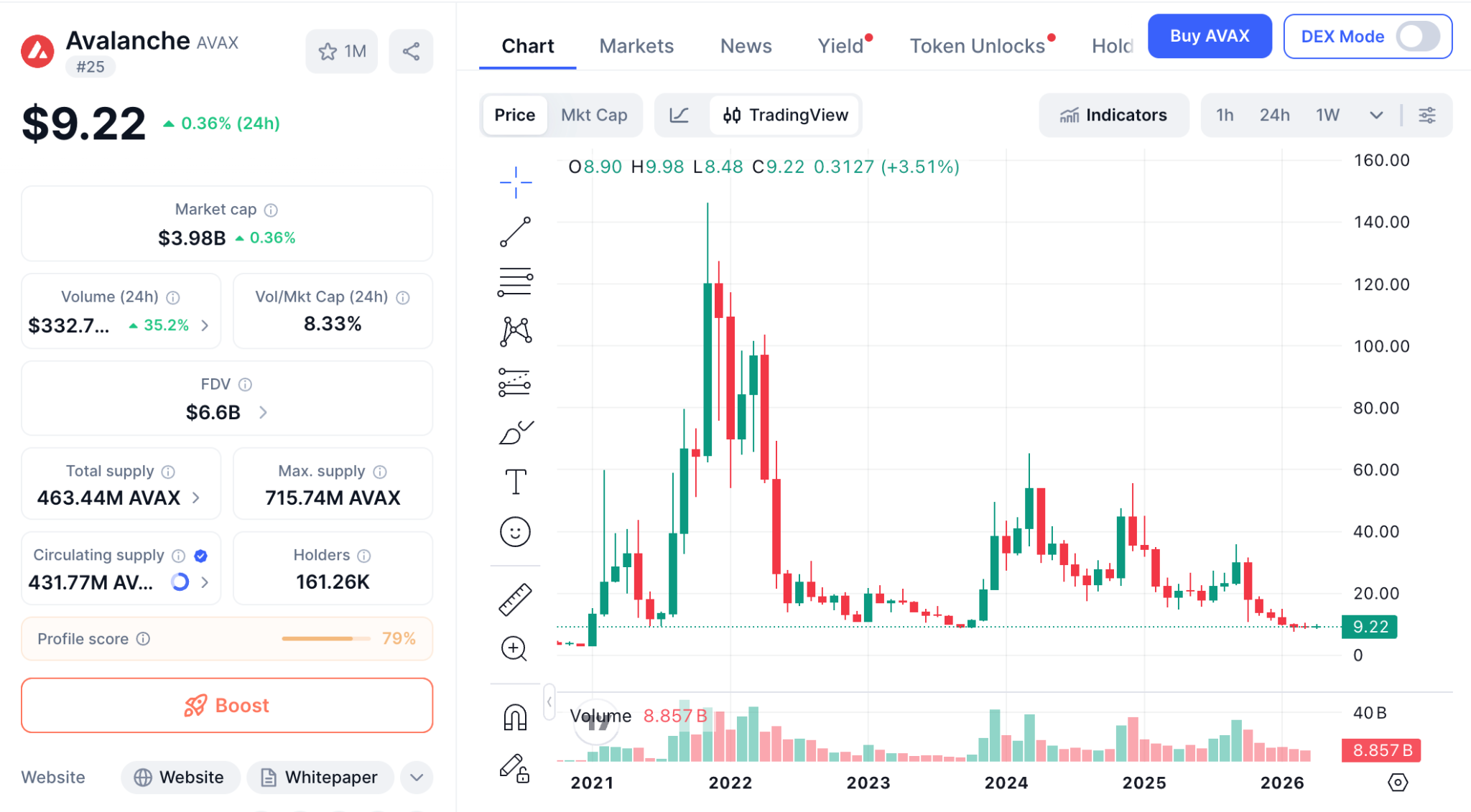
AVAX long‑term price chart (2020 – today)
How Does Avalanche Work Under the Hood? Three Chains, One Network
This is where Avalanche gets interesting. Instead of cramming everything onto a single chain, it splits the network into three specialized chains that each handle a specific job:
X-Chain (Exchange Chain): Handles asset creation and transfers, including AVAX itself. It uses a DAG (Directed Acyclic Graph) data structure, which processes transactions in parallel rather than sequentially — hence the high throughput.
C-Chain (Contract Chain): This is where smart contracts and dApps live. It's the EVM-compatible chain, and where virtually all DeFi protocols and NFT projects are deployed.
P-Chain (Platform Chain): Manages validators, staking, and coordinates the "subnets" described below. Think of it as the network's control center.
The three chains run in parallel and communicate with each other, avoiding single-chain bottlenecks while keeping the system flexible.
Consensus Mechanism: How Does the Snowball Protocol Reach Agreement?
Avalanche uses a Proof-of-Stake (PoS) model, where validator nodes stake AVAX to participate in network security. Regular users can also delegate their AVAX to validators and earn a share of the staking rewards.
The consensus algorithm has an apt name — Snowball. Unlike traditional blockchains that broadcast every transaction to the entire network, Avalanche validators randomly sample a small subset of peers and ask: is this transaction valid? After multiple rounds of random sampling, the network converges on a single answer with very high probability, and does so extremely fast.
One notable design choice: Avalanche has no slashing mechanism. Many PoS chains penalize misbehaving validators by confiscating part of their staked tokens. Avalanche's approach is simpler — bad actors just don't earn rewards. This makes the risk profile more predictable for validators and has attracted operators who value that kind of stability.
Subnets: Custom Blockchains Built on Avalanche
One of Avalanche's most distinctive features is subnets.
The concept is straightforward: any team can launch their own blockchain on top of Avalanche, with their own rules — which virtual machine to use, whether transactions require KYC, how validators are selected, and so on. Highly customizable.
A gaming project could use a subnet to build a low-latency on-chain world. A financial institution could run a permissioned, compliance-friendly chain. A regional platform could operate under local regulations — all while staying connected to the Avalanche mainnet and sharing its liquidity and infrastructure.
Similar concepts exist elsewhere (Polkadot's parachains, for instance), but Avalanche's implementation is notably flexible, and real-world deployments are already at meaningful scale.
What Is AVAX Used For?
AVAX is the base currency of the entire Avalanche ecosystem, with four primary functions:
-
Transaction fees: Every transaction, contract call, or on-chain operation across Avalanche's chains and subnets requires AVAX.
-
Staking and validation: Validators must stake AVAX to participate. Regular users can delegate their tokens to earn staking rewards.
-
Incentive distribution: The protocol distributes rewards to validators and delegators who help secure the network.
-
Governance voting: AVAX holders can vote on protocol parameters — fee levels, staking rules, and other network decisions.
Beyond the protocol itself, AVAX trades on most major centralized and decentralized exchanges and is one of the more liquid Layer-1 assets on the market.
Avalanche at a Glance
|
Feature |
Performance |
|
Transaction speed |
Sub-second finality, thousands of TPS in theory |
|
Fees |
Typically a few cents, far below Ethereum peak |
|
EVM compatibility |
Full support, Solidity deployable as-is |
|
Energy efficiency |
PoS-based, orders of magnitude below PoW |
|
Scalability |
Subnet architecture enables horizontal scaling |
Final Thoughts
Avalanche didn't appear out of nowhere — it's a direct response to the pain points of first-generation smart contract platforms. The three-chain architecture, Snowball consensus, and subnet customization each target a specific, real problem.
That said, the Layer-1 space is brutally competitive. Avalanche faces serious challengers from Solana, Polygon, Arbitrum, and others. But measured by technical completeness and ecosystem activity, it remains one of the more credible players in the current landscape.
If you're considering getting involved with AVAX — whether through trading or investing — do your own research first. Crypto assets are highly volatile, and any decision should reflect your personal risk tolerance and comply with the regulations in your jurisdiction.
Frequently Asked Questions
Q: What's the core difference between AVAX and Ethereum (ETH)?
A: Both support smart contracts, but the architecture differs. Ethereum uses a single-chain structure where all transactions share the same pipeline — which gets congested at peak times. Avalanche splits the network into three parallel specialized chains, which means faster throughput and lower fees. Its Snowball consensus also reaches finality faster than Ethereum's PoS.
Q: What kind of staking yield can I expect from AVAX?
A: Returns vary with network conditions and market dynamics, but typically fall in the 5–10% annual range. Validators and delegators earn slightly different rates — delegation involves a commission fee paid to the validator. Always check official sources for current figures.
Q: How does a regular user participate in Avalanche staking?
A: AVAX holders can delegate their tokens to existing validators through the official Core wallet — no need to run your own node. The barrier to entry is low. Running your own validator node requires staking at least 2,000 AVAX and keeping the node reliably online.
Q: How are Avalanche subnets different from Ethereum Layer 2s?
A: Ethereum Layer 2s (like Arbitrum or Optimism) scale on top of Ethereum and inherit its security. Avalanche subnets are independent blockchains with their own validator sets and custom rules. Their security comes from those validators rather than the main network — more flexible, but also more self-contained.
Q: Is there a supply cap on AVAX?
A: Yes. The maximum supply is 720 million AVAX. The design is deflationary — transaction fees are burned rather than redistributed, so as network usage grows, the circulating supply gradually decreases.


