Spend enough time in the crypto market, and you will eventually hit a wall. On one end of the spectrum, you have the aggressive day traders staring at 1-minute charts, trying to scalp fractions of a percent while fighting trading fees and burnout. On the exact opposite end, you have long-term investors holding assets for years, enduring massive drawdowns and hoping the macro cycle eventually plays out in their favor.
If neither of those approaches fits your lifestyle, you need to understand swing trading.
Swing trading is a short- to medium-term strategy. Instead of closing positions before you go to sleep, you hold them for a few days, a few weeks, or sometimes a few months. The goal isn't to catch every minor price tick. The goal is to identify a broader market trend—a "swing"—and ride the meat of that move. It is highly practical for people who can't watch the order book all day but still want to actively capitalize on crypto volatility.
Day Trading vs. Swing Trading: The Reality Check
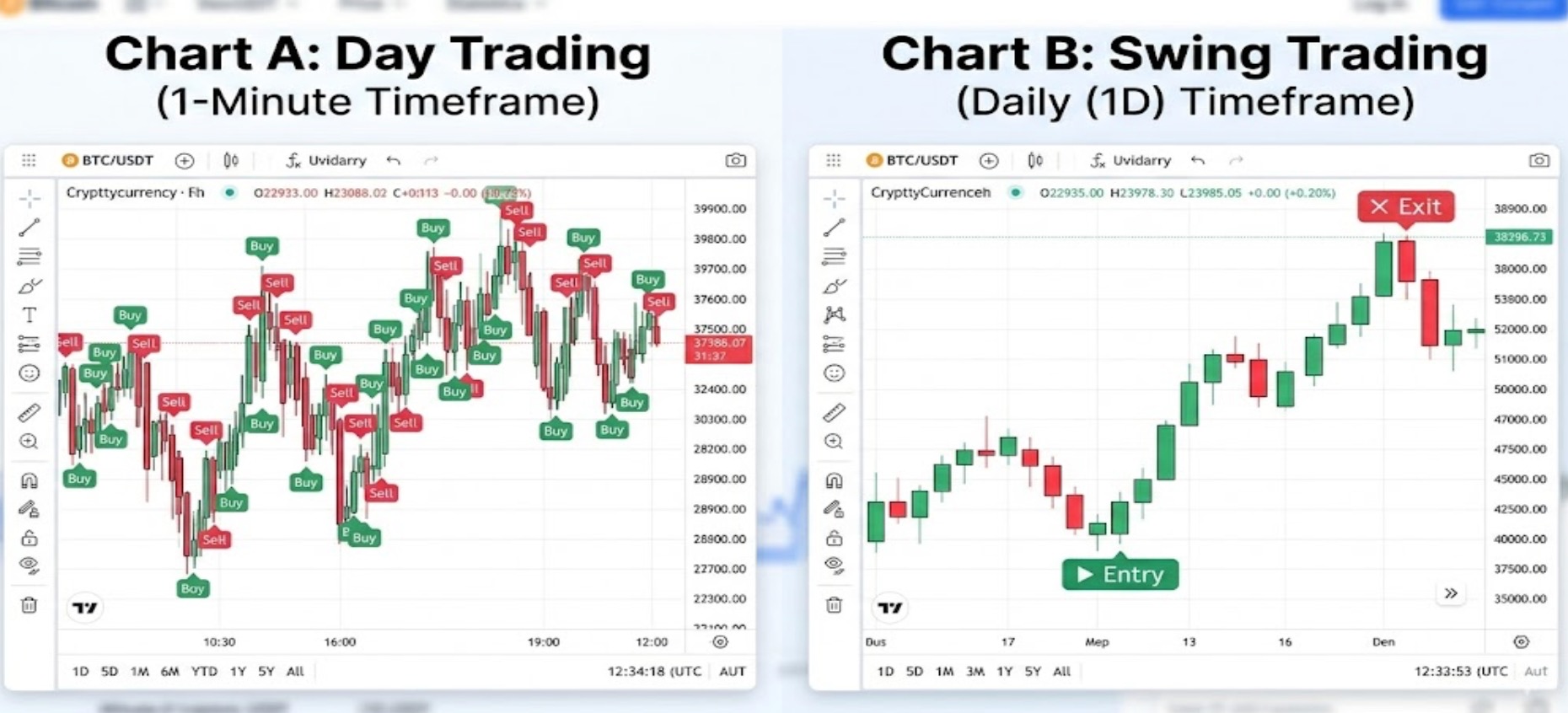
The biggest difference between these strategies comes down to time, stress, and capital requirements.
Day trading is a full-time job. You are entering and exiting the market within hours or minutes. The pace is exhausting, the transaction costs pile up, and a sudden intraday spike can trigger your stop-loss before you even have time to react.
Swing trading gives you room to breathe. Because you are targeting larger price movements over days or weeks, your entry doesn't have to be perfect down to the millisecond. However, because you are keeping positions open longer, you do need enough account margin to absorb normal, daily price fluctuations without getting liquidated. It requires patience and the discipline to let a trade develop, rather than cutting it just because the daily candle turned red.
Trading the Chart: Four Market Structures
You cannot swing trade on gut feeling or Twitter sentiment. You have to trade market structure. To do this, traders look for four specific phases in price action:
Breakouts and Consolidations: Markets spend most of their time doing nothing. During a consolidation phase, the price simply chops sideways, bouncing between a defined support floor and a resistance ceiling. You can swing trade this by buying the floor and selling the ceiling, but the real money is usually in the breakout. A breakout happens when the price finally smashes through that resistance with heavy trading volume. For a swing trader, a confirmed breakout is the signal that a new, prolonged trend is starting.
Reversals and Retracements: Even in a raging bull market, prices never go straight up. They pull back. These temporary dips are called retracements. Smart swing traders wait for these pullbacks to hit a known support level before entering a long position, essentially buying the dip before the broader trend resumes. A reversal, on the other hand, is a complete change in direction—from a bear market to a bull market, or vice versa. Catching a reversal is highly profitable but dangerous, as it requires confirming that the old trend is actually dead, often by looking for specific candlestick patterns indicating buyer or seller exhaustion.
The Math of Survival: Risk Management
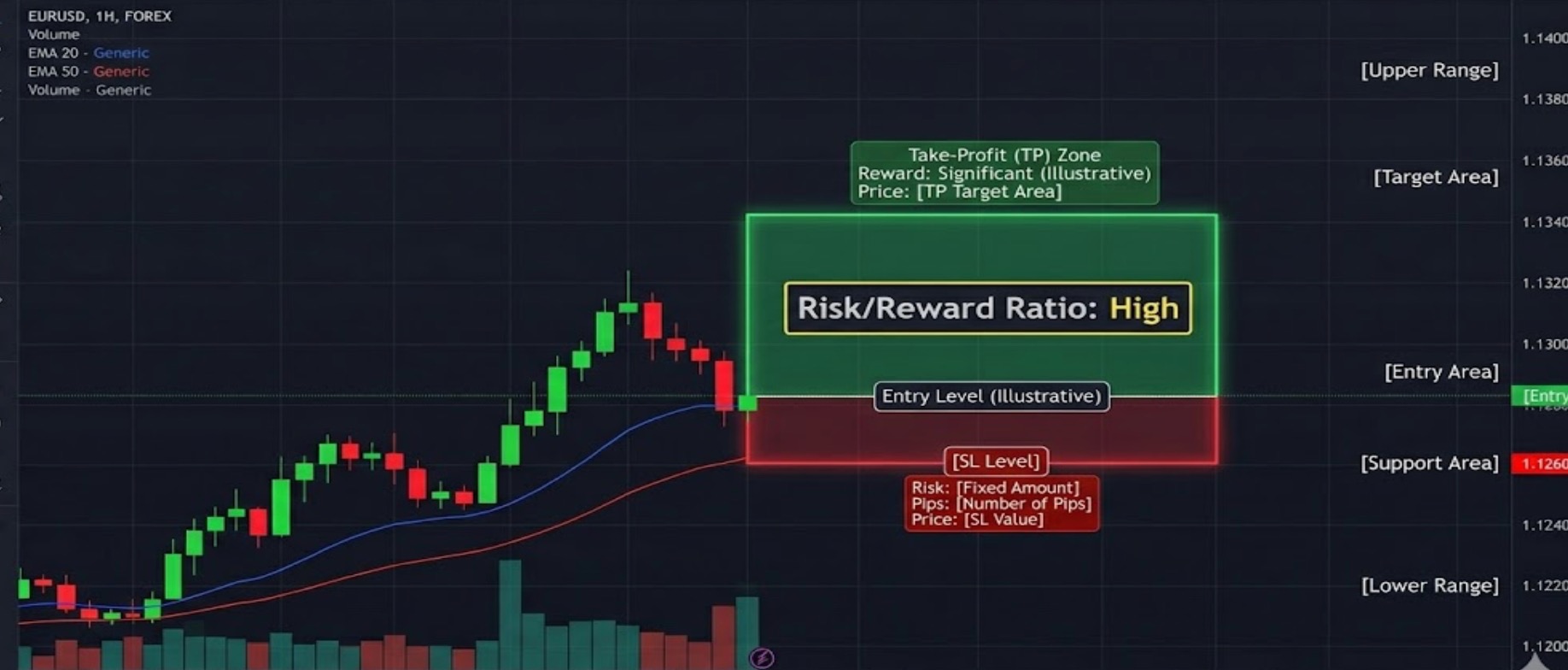
If you only take one concept away from swing trading, it should be risk management. Without it, you are just gambling with a chart open.
The foundation of a sustainable strategy is the 1:3 risk-reward ratio. Before you ever click buy, you need to know exactly where you are wrong (your stop-loss) and where you take profit. If you are risking $100 on a trade setup, your target needs to be set to make at least $300. If the chart structure doesn't support that math, you don't take the trade. By sticking to this ratio, you can actually be wrong more than half the time and still grow your account.
Professional desk traders also cap their exposure. A standard rule is to allocate only 2% to 5% of your total trading capital to a single setup. If a trade goes completely against you, your portfolio easily survives.
The Crypto Advantage: No Gap Risk
It is worth noting that swing trading in crypto has a massive advantage over traditional equities: the market never closes. In the stock market, "gap risk" is a nightmare for swing traders. Major news can break over the weekend, causing a stock to open on Monday 20% lower than Friday's close, completely bypassing your stop-loss order. Because crypto trades 24/7, that weekend gap risk does not exist. Your stop-loss triggers exactly when the price hits it.
The Basic Toolkit
You don't need a cluttered chart with 15 different indicators to swing trade. The most reliable tool is often the Exponential Moving Average (EMA). By plotting the EMA10 and EMA20 on a daily chart, you get a clear, smoothed-out view of the trend. When the short-term average crosses above the long-term average, you have a visual, mathematical confirmation that momentum is shifting upward. Keep it simple, trust the structure, and manage your risk.
Ready to start trading market structure?
-
Analyze the Charts: Log in to Tapbit to apply EMA tools and map out your next swing trade on our high-liquidity markets.
-
Build Your Capital: Register on Tapbit today to claim up to 5000 USDT in welcome rewards.
-
Track the Trends: Keep an eye on market breakouts and daily volume changes live on the Tapbit Homepage.
Frequently Asked Questions (FAQ)
How long do swing traders typically hold their positions?
Swing trading is a short- to medium-term strategy. Traders typically hold positions for a few days, a few weeks, or occasionally a few months. The objective is to ride the "meat" of a broader market trend rather than catching every minor intraday price fluctuation.
Why is swing trading considered less stressful than day trading?
Day trading is a fast-paced, full-time commitment that requires executing trades within hours or minutes, often leading to burnout from fighting transaction costs and intraday spikes. Swing trading targets larger price movements over longer timeframes, meaning your entry timing does not need to be perfect down to the millisecond. This approach gives you room to breathe and allows trades to develop naturally.
What is the 1:3 risk-reward ratio?
This is the foundational math of swing trading survival. Before entering a trade, you set a strict ratio where your profit target is three times the amount you are willing to lose. For example, if your stop-loss risks $100, your take-profit must be set for at least $300. By adhering strictly to this math, you can be wrong more than half the time and still remain profitable.


