

The tech hype phase for MegaETH is officially over. We spent months listening to the narrative: a high-performance Ethereum Layer 2 pushing sub-10-millisecond block times and 100,000 TPS. But on April 30, when the $MEGA token simultaneously dropped across 13+ centralized exchanges (including Binance, Coinbase, and KuCoin), the narrative collided with market reality.
If you bought the top on launch day, you’ve had a brutal 72 hours. But if you are only looking at the spot price bleed, you are entirely missing the structural trade setup that is forming underneath.
The Brutal Math of a $1.8B FDV Launch
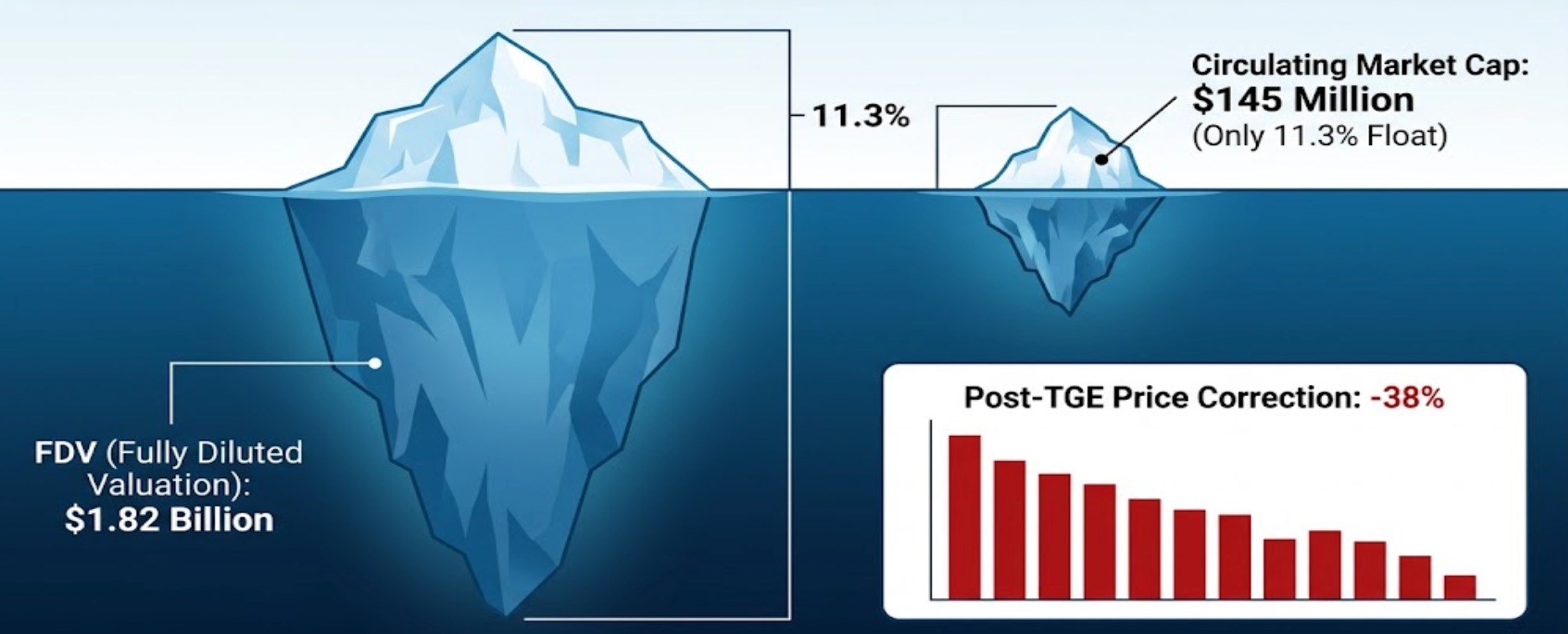
Let’s look at the tape. $MEGA opened trading near $0.183, handing it a massive Fully Diluted Valuation (FDV) of roughly $1.82 billion. Since then, we've watched a textbook post-TGE recalibration.
The token bled out by about 38%, trading down to the $0.128 range by early May. With only 11.3% of the 10 billion total supply currently floating, the circulating market cap sits at a relatively modest $145 million. Retail sees a 38% drop and calls it a failed launch. On the desk, we see a predictable repricing of a low-float, high-FDV asset.
However, the real story isn't the spot dump—it’s the massive divergence between token price and on-chain capital flow.
The TVL Divergence: Why We Aren't Fading the Drop
While retail speculators dumped the token, smart capital aggressively bridged over. In a single day, MegaETH’s Total Value Locked (TVL) spiked over 70%, surging past $580 million.
This move instantly flipped Monad and shoved MegaETH into the top 15 Layer-2 chains globally by TVL. Where exactly is this money going?
-
The "Aave Effect": Aave alone vacuumed up $388 million, representing roughly 80% of MegaETH's total TVL.
-
Native DEX Activity: The native decentralized exchanges printed a highly respectable $130 million in volume right out of the gate.
Capital isn't just buying the token to flip it; they are actually parking nine-figure sums on the network to farm yield.
Killing the Calendar: The KPI Tokenomics Play
What actually separates MegaETH from the typical VC "pump and dump" is how they structured their tokenomics. They completely threw out the standard calendar-based vesting schedule. Instead, a massive 53.3% of the $MEGA supply is strictly tied to performance-based KPI rewards.
In fact, the TGE wasn't even scheduled for a fixed date. It was only triggered on April 23 after 10 applications from their "Mega Mafia" incubator hit strict on-chain transaction thresholds, starting a mandatory 7-day countdown. Moving forward, insiders and the ecosystem cannot just wait out the clock to unlock their bags—they have to hit measurable growth targets.
The USDM Stablecoin Flywheel
If you want to know when the next supply shock is coming, you have to watch their native stablecoin, USDM.
The next major token release is hard-coded to trigger only when USDM hits a circulating supply of 500 million. Before the TGE, USDM was sitting around $62.9 million. Post-launch hype immediately boosted it past $300 million.
Crucially, the MegaETH Foundation plans to use the revenue generated by USDM to buy back $MEGA tokens. This creates a highly effective flywheel: network usage drives stablecoin minting, which generates yield, which buys back the governance token.
How the Desk is Trading It
The market is currently trying to figure out if that $580 million TVL is "sticky" capital or just mercenary farmers who will leave once the launch incentives dry up. We also have to respect the overhang: early Echo round investors who bought at $0.02 are still sitting on roughly 8.5x paper gains (even though only 20% of their allocation unlocked at launch).
Our strategy? We aren't rushing in to catch the falling knife on the spot chart. Instead, we are treating the USDM supply and the 30-day TVL retention as our primary leading indicators. If that USDM supply inches closer to the 500 million mark, expect volatility to spike violently as the market attempts to front-run the upcoming token unlock. Until the setup is fully validated, we are letting the initial price discovery run its course and monitoring the $MEGA order book dynamics and execution flows directly on Tapbit.
Frequently Asked Questions (FAQ)
What is MegaETH and when did the token launch?
MegaETH is a high-performance Ethereum Layer 2 designed for extreme speed, boasting sub-10-millisecond block times and 100,000 TPS. Its native token, $MEGA, officially launched on April 30, 2026, dropping simultaneously across more than 13 major exchanges including Binance, Coinbase, and KuCoin.
Why did the $MEGA price drop almost 40% right after the launch?
This is a classic post-TGE market recalibration. $MEGA opened at roughly $0.183, giving it a massive Fully Diluted Valuation (FDV) of $1.82 billion, but with a very tight initial circulating float of just 11.3%. Additionally, early "Echo round" investors who bought in at $0.02 had 20% of their allocation unlocked at launch. The combination of high FDV, low float, and early investor profit-taking naturally drove the price down to the $0.128 range as the market searched for a fundamental floor.
How do the token unlocks work? Are VCs just going to dump on retail every month?
Unlike most Layer 2 networks that use rigid calendar-based vesting schedules, MegaETH is using a KPI-driven unlock model. A massive 53.3% of the total $MEGA supply is strictly locked and will only be released when the network hits specific, verifiable growth metrics. Insiders can't just wait out the clock to sell; they are economically forced to grow the network's actual usage.


