
The Bitcoin Stock-to-Flow model is one of the most talked-about valuation tools in crypto. It became popular because it explains Bitcoin through a very simple idea: scarcity.
That simplicity is exactly why traders like it. It is also why the model is often misused.
Stock-to-Flow, or S2F, can help traders understand why Bitcoin’s fixed supply matters. It can also help explain why halving cycles attract so much attention. But it should not be treated as a price guarantee, and it should never be the only reason to enter a trade.
Used properly, S2F is a useful long-term framework. Used blindly, it can create false confidence.
What Does Stock-to-Flow Mean?
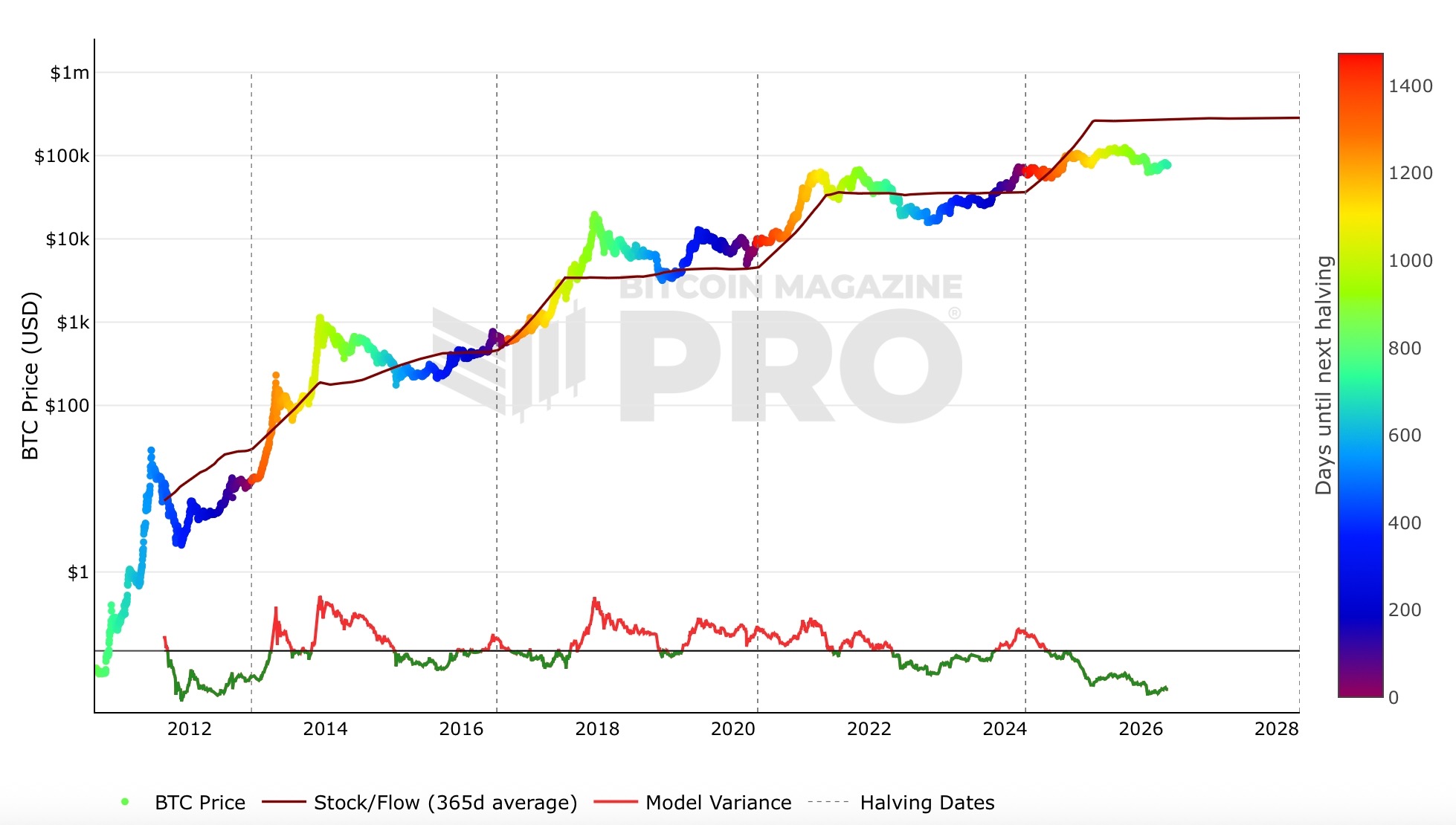
Stock-to-Flow compares the amount of an asset that already exists with the amount of new supply created each year.
For Bitcoin, “stock” means the BTC already mined and in circulation. “Flow” means the new BTC issued to miners each year.
The formula is simple:
Stock-to-Flow Ratio = Existing Supply / Annual New Supply
A higher ratio means new supply is small compared with existing supply. That is why the model has often been used to analyze scarce assets such as gold.
Bitcoin fits this framework because its supply schedule is transparent. There will only ever be 21 million BTC, and new issuance is reduced roughly every four years through Bitcoin halving events. After the 2024 halving, the block reward dropped from 6.25 BTC to 3.125 BTC, reducing the amount of new Bitcoin entering the market.
That is the core reason S2F became popular: Bitcoin’s scarcity is not based on a company policy or a central bank decision. It is written into the protocol.
Why Traders Still Watch S2F
The model gives traders a clean way to understand Bitcoin’s supply side.
Every halving reduces the flow of new BTC. If demand remains steady or increases while new supply falls, the long-term price argument becomes stronger. That is the basic logic behind the model.
This does not mean Bitcoin must rise immediately after a halving. Markets rarely move that neatly. But halvings do change the supply structure, and S2F helps traders visualize that change.
For long-term investors, this can be useful. It keeps the focus on Bitcoin’s fixed issuance schedule instead of short-term market noise.
Where S2F Can Mislead Traders
The biggest weakness of Stock-to-Flow is that it looks mostly at supply.
But price is not driven by supply alone.
Bitcoin can become scarcer and still fall if demand weakens. ETF outflows, rising interest rates, a stronger dollar, regulatory pressure, miner selling, or a broader risk-off market can all push BTC lower, even when the supply story looks bullish.
That is why S2F should not be used as a short-term trading signal. It does not tell you whether buyers are active today. It does not measure liquidity. It does not show leverage in the market. It does not know whether institutions are adding or cutting exposure.
The model answers one important question: Is Bitcoin becoming scarcer over time?
It does not answer another equally important question: Is the market willing to pay more for that scarcity right now?
How to Use S2F in a Real Trading Plan
The best way to use S2F is to treat it as background context, not a buy or sell button.
For example, a trader may use S2F to understand where Bitcoin sits in its broader halving cycle. Then they can use technical analysis to decide whether the current market structure supports a trade.
That might include watching moving averages, support and resistance levels, trading volume, RSI, or broader trend direction.
A long-term investor may use S2F differently. They may use it to support a long-term Bitcoin thesis, while still managing entries through dollar-cost averaging or position sizing.
The key is to separate the model’s role from the trade decision.
S2F helps explain Bitcoin’s scarcity cycle. It does not choose your entry, your stop loss, or your position size.
What Else Should Traders Watch?
If you are using S2F, it is worth combining it with market data that captures demand and liquidity.
ETF flows are one of the most important signals in the current Bitcoin market. Strong inflows can support demand. Outflows can weaken momentum, even when the long-term scarcity story remains intact.
Miner behavior also matters. After a halving, miners receive fewer BTC per block. If mining costs rise or margins tighten, some miners may sell more Bitcoin to cover expenses. That can create short-term pressure.
Macro conditions are another key factor. Bitcoin often reacts to interest-rate expectations, Treasury yields, dollar strength, and global risk appetite. When liquidity is tight, scarce assets can still struggle.
In other words, S2F gives you the supply picture. You still need demand, liquidity, and timing before making a trading decision.
Common Mistakes to Avoid
One common mistake is treating S2F as a guaranteed price target. The model may suggest that Bitcoin is undervalued, but markets do not have to follow a model on schedule.
Another mistake is using it for short-term trades. S2F is not built for day trading or weekly setups. It works better as a long-term lens.
Traders also need to avoid ignoring demand. Scarcity matters only when buyers care about it. A limited supply does not automatically create higher prices.
The final mistake is overconfidence. No model removes risk. Even a strong long-term thesis can experience deep drawdowns along the way.
Final Takeaway
The Bitcoin Stock-to-Flow model is not useless, but it is often given too much power.
It is a good way to understand Bitcoin’s scarcity. It is a helpful tool for thinking about halvings and long-term supply pressure. But it is not a complete trading system.
A better approach is to use S2F as one layer of analysis, then combine it with technical levels, ETF flows, miner data, macro conditions, and proper risk management.
Stock-to-Flow can explain why Bitcoin scarcity matters. Good trading still depends on timing, liquidity, demand, and discipline.
Start exploring Bitcoin and other crypto markets on Tapbit, log in to access trading tools, or register to begin your crypto trading journey.
Frequently Asked Questions
What is the Bitcoin Stock-to-Flow model?
The Bitcoin Stock-to-Flow model, or S2F, is a way to measure Bitcoin’s scarcity. It compares the amount of BTC already in circulation with the amount of new BTC created each year. A higher S2F ratio means new supply is becoming smaller relative to existing supply.
Why is S2F often used for Bitcoin?
S2F is commonly used for Bitcoin because BTC has a fixed supply schedule. Only 21 million BTC will ever exist, and the amount of new Bitcoin issued to miners is reduced roughly every four years through halving events. This makes Bitcoin easier to analyze from a scarcity perspective than many other assets.
Does the S2F model predict Bitcoin’s price accurately?
Not always. S2F can help explain Bitcoin’s long-term scarcity, but it should not be treated as a precise price prediction tool. Bitcoin’s price also depends on demand, liquidity, ETF flows, interest rates, regulation, market sentiment, and broader macro conditions.


