
For seasoned cryptocurrency traders, the market cycle used to follow a predictable, almost mechanical rhythm. Bitcoin (BTC) would break its all-time high, consolidate, and then that profit would predictably bleed down the risk curve into Ethereum (ETH), large-cap altcoins, and eventually micro-caps. This was the legendary "Altseason."
But in 2026, the charts are telling a fundamentally different story. While Bitcoin and Ethereum enjoy massive institutional inflows, the broader altcoin market—tracked by the TOTAL3 index (Total Crypto Market Cap excluding BTC and ETH)—is heavily lagging.
Many retail investors are left wondering: Why is Bitcoin near its highs, but my altcoin portfolio is bleeding? The answer lies in a massive structural shift in how capital enters the market today. As detailed in recent institutional analyses by Bitwise and 21Shares, Wall Street's spot ETFs have successfully institutionalized crypto, but in doing so, they created "Walled Gardens" that permanently altered the crypto capital rotation cycle.
Here is a breakdown of why the traditional altseason is failing, and how Tapbit traders need to adjust their strategies for this new paradigm.
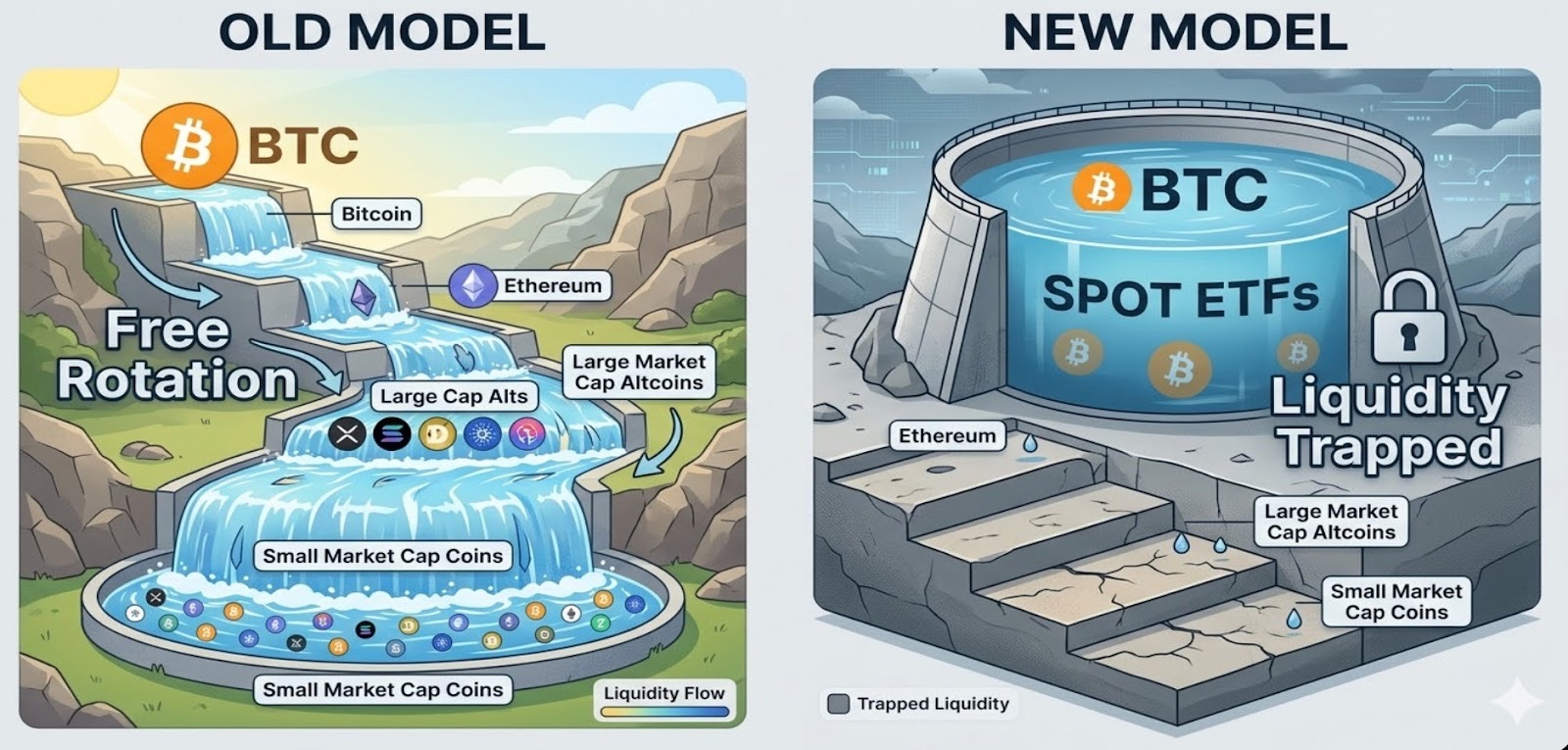
1. The Old Playbook: The Waterfall Effect
To understand what broke, we must understand how the market used to function. Before the approval of spot ETFs, the only way to buy Bitcoin was through crypto-native exchanges or peer-to-peer networks.
When traders made massive profits on Bitcoin during the 2017 or 2021 bull runs, their capital was already sitting in a Web3 ecosystem. To maximize yields, they would simply swap their BTC profits for smaller, high-beta altcoins directly on-chain or via exchange order books.
The friction to move from Bitcoin to an obscure altcoin was near zero. Liquidity flowed like a waterfall from the top of the market cap down to the bottom, driven by a retail frenzy and the "wealth effect" of early crypto adopters.
2. The "Walled Garden" Effect: Why ETF Liquidity is Trapped
The introduction of spot Bitcoin and Ethereum ETFs fundamentally severed this waterfall. Today, billions of dollars of fresh capital are flowing into the crypto asset class, but this money is not interacting with the crypto ecosystem.
When a registered investment advisor (RIA), a pension fund, or a retail investor buys BlackRock's IBIT or Fidelity's FBTC ETF, they are not buying raw Bitcoin. They are buying a traditional financial security representing Bitcoin, held inside a legacy brokerage account like Charles Schwab or Vanguard.
This creates the ETF Walled Garden:
-
No On-Chain Extraction: Wall Street investors cannot withdraw their ETF shares to a MetaMask wallet or a cold storage device.
-
Zero Altcoin Interoperability: An institutional investor cannot take their profits from a Bitcoin ETF and directly swap them for Cardano (ADA), Solana (SOL), or a new DeFi token. To buy an altcoin, they would have to trigger a taxable event by selling their ETF, transferring the fiat to a crypto exchange, and buying the altcoin there.
Because traditional finance players view Bitcoin strictly as a macro-hedge or a portfolio diversifier—not as a technological ecosystem to participate in—that friction is too high. The capital stays locked within the walled gardens of Wall Street brokerages, indefinitely starving the broader altcoin market of historical trickle-down liquidity.
3. The New Altcoin Reality: Utility Over Rotation
Does this mean altcoins are dead? No. But it means the days of every altcoin rising simply because Bitcoin rose are over. In 2026, the absence of newbie retail FOMO and the extreme oversupply of tokens mean that liquidity is highly selective.
Instead of waiting for an automatic capital rotation that will never come, smart money is targeting specific altcoin sectors that draw their own independent liquidity based on fundamentals:
-
Real World Assets (RWA): Tokens that tokenize Treasury bills, real estate, and private credit are attracting capital because they offer traditional financial utility and yield on-chain.
-
AI Agentic Finance: Infrastructure built for machine-to-machine payments (like high-throughput, low-fee networks) are drawing venture capital independently of Bitcoin's price action.
-
Stablecoin Issuers: As traditional banking faces pressure, the protocols powering global digital dollar settlements are seeing massive fundamental revenue growth.
Adjust Your Trading Strategy on Tapbit
The ETF era requires a more sophisticated approach. You can no longer buy a random basket of altcoins and expect the rising tide of Bitcoin to lift them all. You must trade the sectors with actual utility and independent catalysts.
As the market structure evolves, your execution platform must keep pace. Tapbit provides the professional-grade matching engine and deep liquidity required to trade this bifurcated market. Whether you are trading core institutional assets like BTC and ETH or hunting for the specific altcoin sectors outperforming the broader market, Tapbit offers the exact tools you need.
-
➡️ Ready to pivot your strategy? Register a free Tapbit account today to access top-tier crypto liquidity.
-
➡️ Already have an account? Log in to Tapbit to analyze the TOTAL3 charts and execute your trades.
-
➡️ Explore the platform: Visit the Tapbit Homepage to discover our latest Earn products and trading infrastructure.
Frequently Asked Questions (FAQ)
Why is Bitcoin near its highs while my altcoin portfolio bleeds?
The market structure has fundamentally changed. In past cycles, retail profits from Bitcoin naturally trickled down into altcoins on crypto-native exchanges. Today, the massive capital driving Bitcoin's price is coming from institutional spot ETFs. That money stays locked in traditional brokerage accounts and does not rotate into the broader Web3 ecosystem.
What exactly is an "ETF Walled Garden"?
When traditional investors buy a Bitcoin or Ethereum ETF (like BlackRock's IBIT), they are buying a traditional financial security, not the underlying crypto asset. They cannot withdraw this ETF to a Web3 wallet or easily swap it on a crypto exchange for altcoins like Solana or Cardano. The capital is trapped inside the "walls" of legacy brokerages, cutting off the historical liquidity pipeline to the rest of the market.
Does this mean the traditional "Altseason" is permanently over?
The historical "spray and pray" altseason—where every micro-cap token pumps simply because Bitcoin broke its all-time high—is likely dead. However, altcoins themselves are not. Capital has just become hyper-selective. Smart money is now ignoring hollow narratives and targeting specific sectors with actual utility, such as Real World Assets (RWA), AI infrastructure, and stablecoin networks.
How should I adjust my crypto trading strategy for this new cycle?
You can no longer rely on blind capital rotation. You must treat altcoins more like individual tech stocks. Focus your research on sectors with independent catalysts, strong fundamentals, and real-world revenue. Stop holding a random basket of outdated tokens hoping for a cyclical pump, and start trading the specific narratives that are actually attracting fresh capital today.
Disclaimer: This article is for educational and informational purposes only and does not constitute financial advice. Cryptocurrency markets are highly volatile. Always conduct your own research before executing trades on Tapbit or any other platform.


