
A smart contract is a piece of executable code deployed on a blockchain that automatically carries out predefined operations when specific conditions are met — with no third-party involvement required.
The term was first coined by cryptographer Nick Szabo in 1994. His vision was straightforward: replace legal language with code, replace lawyers with programs, and make contract execution objective and tamper-proof. The idea lacked the technical foundation to become reality until Ethereum launched in 2015.
The underlying logic is elegantly simple: "if this, then that."
-
If a buyer's payment is confirmed, the seller's asset ownership transfers automatically.
-
If a loan is fully repaid, the collateral is automatically released.
-
If a crowdfunding target is not reached, all funds are automatically returned.
No gray areas. No "let's wait and see." Once the code runs, the outcome is final.
How Smart Contracts Work
A smart contract moves through several stages from creation to execution:
Step 1 — Logic is written as code. Developers use a programming language (Solidity is the most common on Ethereum) to encode the contract's conditions and actions.
Step 2 — Deployment on-chain. The contract is submitted to the blockchain network, confirmed by miners or validators, and assigned a permanent contract address. From that point on, anyone can inspect its contents at that address.
Step 3 — Continuous condition monitoring. Blockchain nodes monitor on-chain state in real time and automatically trigger the contract logic when the predefined conditions are satisfied.
Step 4 — Automatic execution and immutable recording. Fund transfers, permission changes, and data updates are executed and permanently written to the blockchain — unalterable and undeletable.
There is no room for human intervention in this process. The network executes exactly what the contract says — regardless of whether any participant "agrees" after the fact.
Smart Contracts vs. Traditional Contracts
These two approaches are not in competition — they serve fundamentally different use cases.
Traditional contracts rely on natural language, which inherently introduces interpretive ambiguity. Their enforcement depends on the judicial system: disputes require litigation that can take months to resolve, at significant cost, with cross-border cases adding the complexity of multiple legal jurisdictions.
Smart contracts require no goodwill from any party and no intermediary. Code is law. Conditions are the judge. Execution cost approaches zero.
|
Dimension |
Traditional Contract |
Smart Contract |
|
Form |
Natural language (legal text) |
Code (programmatic logic) |
|
Execution |
Manual enforcement + judicial system |
Automatic (on-chain trigger) |
|
Trust model |
Relies on counterparty trust and intermediaries |
Trustless |
|
Speed |
Slow (weeks to months) |
Fast (seconds to minutes) |
|
Cost |
High (legal fees, litigation costs) |
Low (gas fees only) |
|
Flexibility |
High (interpretable, negotiable) |
Low (strictly code-bound) |
|
Key risks |
Complex disputes, long resolution cycles |
Code vulnerabilities, immutability, oracle dependency |
The Major Blockchains Running Smart Contracts
Ethereum was the starting point and remains the platform with the most complete ecosystem — but it is far from the only option.
-
Ethereum: The largest developer community, the most mature tooling, relatively high gas fees. Best suited for high-security financial contracts.
-
BNB Chain: Low transaction fees, fast throughput, EVM-compatible. Widely used in retail and GameFi applications.
-
Solana: Known for exceptional throughput. In 2024, Solana's share of DeFi total value locked (TVL) grew from 2.5% to 7.3%, making it the second-largest chain by locked assets.
-
Avalanche, Polygon, Arbitrum: Each takes a different approach — Layer-2 scalability, low fees, or cross-chain interoperability — serving distinct developer and user needs.
-
Market Size and Industry Trends
Smart contracts are not just a technical conversation — they represent real capital flows.
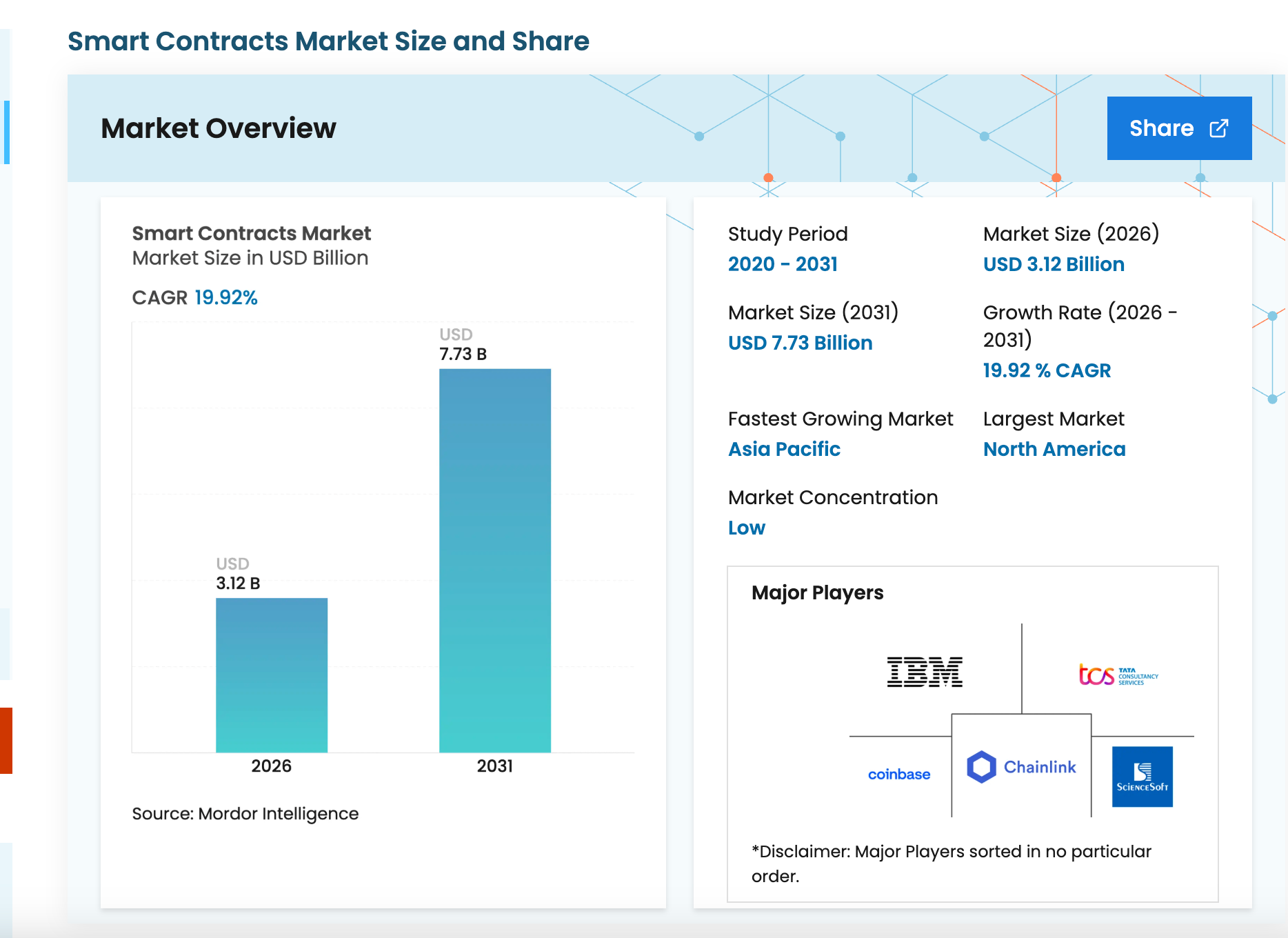
According to market research firm SkyQuest, the global smart contract market reached approximately $2.72 billion in 2024 and is projected to grow to $18.18 billion by 2033, at a compound annual growth rate (CAGR) of roughly 23.5%.
Ethereum currently holds more than 65% of the smart contract platform market, driven by its mature developer toolchain, an expanding dApp ecosystem, and continued institutional investment in Ethereum infrastructure. Chainlink
Banking, financial services, and insurance (BFSI) is the largest application sector, accounting for approximately 27% of 2024 revenues. Gaming and entertainment is projected to be the fastest-growing segment, with a CAGR of 29% through 2030.
Where Smart Contracts Are Already Deployed
Decentralized Finance (DeFi)
This is currently the largest application arena for smart contracts. According to DappRadar, DeFi's total value locked (TVL) reached an all-time high of $237 billion in Q3 2025. Every dollar of that is held by smart contracts — no bank, no institution.
Protocols like Uniswap, Aave, and Compound are, at their core, collections of smart contracts. Users interact directly with those contracts to borrow, swap, and deposit — no account registration, no identity verification, no approval from any financial institution required.
NFTs and Digital Rights
The minting, transfer, and royalty distribution of NFTs are all handled by smart contracts. Creators encode their royalty percentage into the contract at deployment. Every time a work is resold, royalties flow automatically to the creator's wallet — no platform needed as an intermediary, and no platform can unilaterally change the split.
Supply Chain and Trade Finance
IBM and trade finance platform We.Trade collaborated to use blockchain smart contracts to help European SMEs process cross-border trade payments, compressing letter-of-credit settlements that traditionally took days down to a matter of hours.
In Q1 2025, BNP Paribas completed the first tokenized bond settlement on a public blockchain, using smart contracts to automate the entire clearing process. This marked a decisive shift for traditional financial institutions — from cautious observation to active deployment.
Insurance Claims
Parametric insurance is one of the most natural fits for smart contracts. A flight delay policy connected to aviation data feeds automatically pays out once a delay exceeds the agreed threshold. A crop insurance policy connected to weather data triggers compensation when rainfall drops below the contracted level. No claim filing, no manual review required.
The Bottom Line
Smart contracts represent the leap that transformed blockchain from "digital gold" into programmable financial infrastructure. Their significance is not simply speed or cost savings — it is that they redefine trust itself. No reliance on people. No reliance on institutions. Only mathematics and logic.
This sector is at an inflection point, moving from early adoption toward large-scale deployment. Whether you want to participate in DeFi, trade native assets on major blockchains, or simply understand the foundational logic of this industry, smart contracts are the place to start.
Frequently Asked Questions (FAQ)
Q: Are smart contracts legally binding?
A: This depends on the jurisdiction. In most countries, smart contracts do not automatically carry the same legal standing as traditional contracts — they are code, not signed legal documents. However, several jurisdictions, including certain U.S. states and the EU under its MiCA framework, are developing legal recognition for blockchain-based agreements. In practice, many projects pair smart contracts with off-chain legal wrappers to ensure enforceability in both worlds.
Q: What happens if there is a bug in a smart contract?
A: This is one of the most serious risks in the space. Because deployed contracts are immutable, a bug cannot simply be patched. If the vulnerability is exploited before anyone catches it, the funds involved may be permanently lost. Reputable projects address this through rigorous third-party security audits before deployment, and some use upgradeable proxy patterns — though those introduce their own trust trade-offs.
Q: Do you need to know how to code to use smart contracts?
A: No. Most users interact with smart contracts through front-end interfaces — wallets like MetaMask, DeFi platforms like Uniswap, or NFT marketplaces — without ever reading a line of code. However, if you are deploying your own contracts or evaluating a protocol's security, understanding Solidity or at least being able to read audit reports is valuable.


