

MON may appeal to investors who want exposure to a high-performance, Ethereum-compatible Layer-1, but it is not automatically a good investment at every price. The token has real network utility, while the investment case still depends on whether Monad attracts sustained users, developers, liquidity and fee-generating applications. Supply growth and competition from established chains also deserve close attention.
Readers researching emerging crypto infrastructure can create a Tapbit account to follow major digital-asset markets and compare broader market conditions. Availability varies by asset and region, so always check the platform before attempting to trade MON.
What Is Monad and MON?
Monad is a Layer-1 blockchain designed to improve execution speed without abandoning the Ethereum development model. Its public mainnet launched in November 2025. The network supports EVM bytecode and the Ethereum JSON-RPC interface, allowing many Ethereum tools, wallets and smart contracts to work with relatively limited changes.
MON is the network’s native asset. According to the Monad Foundation, its primary functions are paying transaction fees and securing the chain through staking. This creates a direct link between demand for block space, validator participation and use of the token.
How Does Monad Work?
Monad approaches performance through software architecture rather than simply requiring unusually powerful validator hardware. Its design includes parallel execution, which processes independent transactions concurrently; asynchronous execution, which pipelines consensus and execution; MonadBFT for consensus; and MonadDb for Ethereum-state storage.
The official documentation describes a target of 10,000 transactions per second, 400-millisecond block frequency and 800-millisecond finality. These are protocol capabilities, not guarantees of adoption. A fast chain only creates durable value if developers deploy useful applications and users return to them.
What Gives MON Utility?
MON is used to pay gas fees, delegate stake to validators and receive staking rewards. Base transaction fees are burned, while block rewards add new MON to supply. This creates competing forces: higher network use can increase fee demand and burns, while validator rewards introduce ongoing inflation.

The initial supply was 100 billion MON. The Foundation said roughly 10.8% was expected to enter public circulation at launch through the public sale and airdrop, while a much larger ecosystem allocation was unlocked but Foundation-controlled. Team and investor allocations were locked for at least one year after mainnet launch, making the release schedule an important factor for late 2026 and beyond.
MON Price and Chart Structure
In the supplied weekly chart, MON trades near $0.02064. The visible range extends from lows around $0.016 to peaks near $0.037–$0.038, while $0.02957 appears as a notable reference level. Recent candles have narrowed around $0.020–$0.022, and displayed weekly volume is about 101.9 million units. These figures are a snapshot from the provided chart, not live market data.
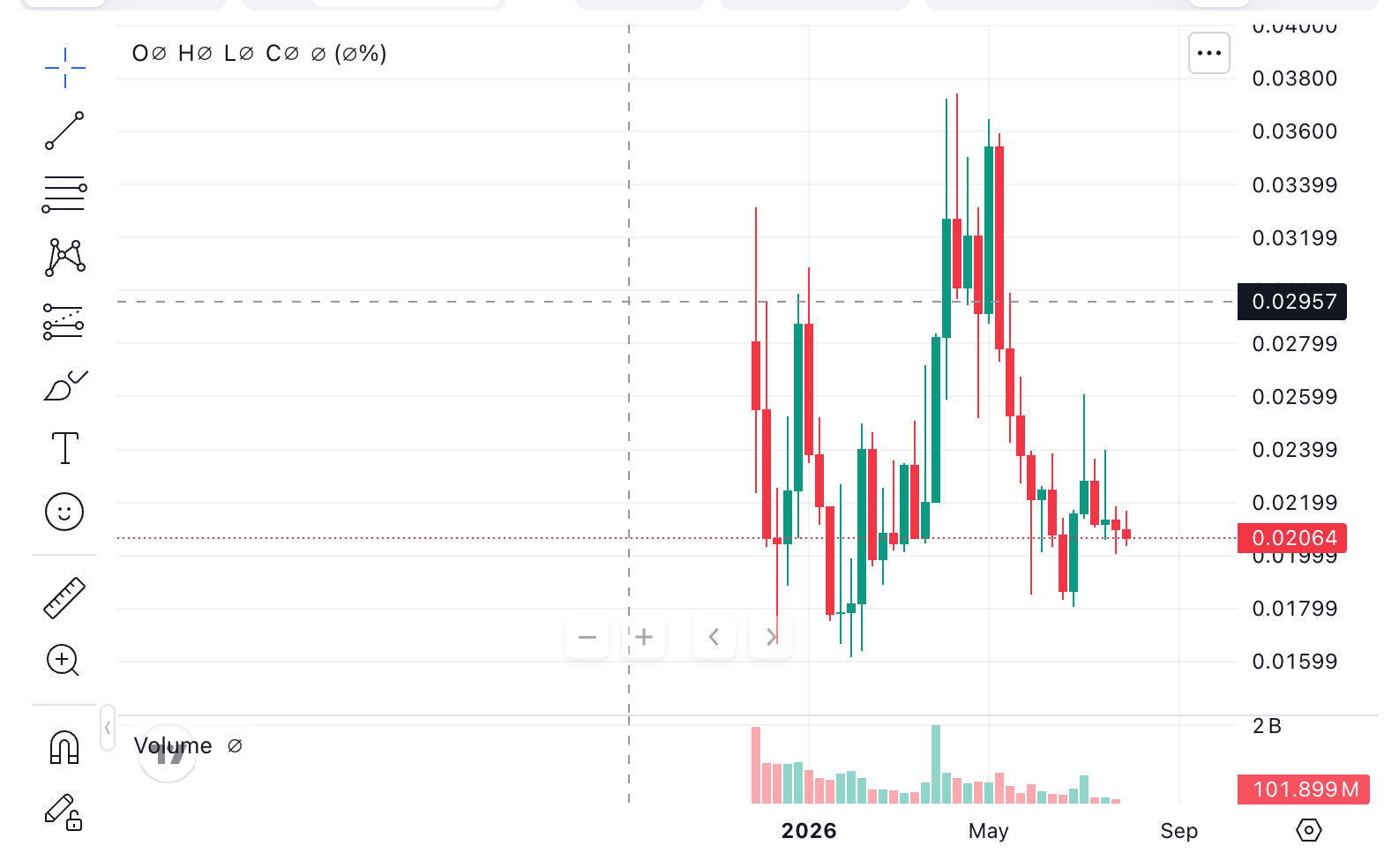
Technically, holding above the $0.018–$0.020 area would help preserve the current base. A recovery toward $0.024 and then $0.02957 could indicate improving demand, but repeated rejection below those levels would keep the structure weak. A break below the visible lows would invalidate the base-building view. Volume confirmation matters because thin liquidity can exaggerate both rallies and declines.
The Bull Case for MON
The strongest argument for MON is that Monad offers familiar Ethereum tooling with higher throughput and fast finality. If developers can move Solidity applications easily, Monad may lower the cost of launching DeFi, gaming, consumer and payment products. More activity could increase gas demand, expand staking participation and strengthen the network effect around MON.
Another advantage is that MON is not merely a governance label attached to an unrelated product. It is required for core network functions. Successful applications, active validators and deeper liquidity could therefore support a clearer utility-driven demand story.
Key Risks to Consider
Adoption risk: Technical performance does not guarantee users or revenue. Monad must compete with Ethereum Layer-2 networks, Solana and other high-throughput chains.
Supply risk: Validator rewards increase supply, and team and investor releases begin after their initial lockups. Even scheduled unlocks can pressure price if demand does not grow at the same pace.
Valuation risk: A low unit price does not mean a token is cheap. With a 100 billion initial supply, market capitalization and fully diluted value are more useful than the price of one MON.
Execution and security risk: A newer mainnet has less operating history than mature networks. Smart-contract vulnerabilities, client bugs, validator concentration or ecosystem exploits could damage confidence.
Liquidity risk: Sharp weekly wicks in the supplied chart suggest that volatility can be extreme. Slippage and liquidation risk may rise during fast moves.
What Should Investors Monitor?
Before forming a view, track active addresses, transaction fees, stablecoin liquidity, decentralized-exchange volume, deployed applications and the share of stake controlled by major validators. Compare those indicators with the circulating-supply schedule. Price appreciation supported by rising usage is generally more credible than a move driven only by social attention.
Investors should also distinguish network success from token performance. Monad could gain developers while MON underperforms if token emissions and unlocks exceed new demand. Conversely, a speculative rally can occur before fundamentals improve. Position sizing and a clear invalidation level are therefore more useful than a single price target.
Conclusion
MON has a credible utility case because it powers gas payments and staking on an EVM-compatible Layer-1 with differentiated execution technology. That gives it more substance than a token with no necessary role. However, whether MON is a good investment depends on entry price, ecosystem growth, fee demand and how the market absorbs future supply. The current chart suggests consolidation after substantial volatility, so evidence of adoption and a confirmed break above resistance would strengthen the case more than hype alone.
FAQ
What is MON used for?
MON pays transaction fees on Monad and can be staked or delegated to help secure the network and earn protocol rewards.
Is Monad compatible with Ethereum?
Yes. Monad supports EVM bytecode and Ethereum JSON-RPC compatibility, which helps developers use familiar Solidity tooling and infrastructure.
Does MON have a maximum supply?
The initial supply was 100 billion MON, but supply can expand through validator rewards. Base transaction fees are burned, creating a partial offset.
What price levels matter for MON?
Based on the supplied weekly chart, traders may watch support around $0.018–$0.020 and resistance near $0.024 and $0.02957. These levels can change with new market data.
Can MON rise if Monad adoption grows?
Greater activity could increase gas demand and staking participation, but token unlocks, inflation, competition and valuation still influence price performance.


