

Situational Awareness, the AI-focused investment firm founded by former OpenAI researcher Leopold Aschenbrenner, has reportedly made a roughly $500 million total commitment to Source Foundry. The figure includes a new $400 million infusion into the stealth semiconductor-equipment startup, according to reporting cited by The Wall Street Journal. The move comes soon after the firm was forced to unwind a heavily leveraged public-stock portfolio during a sharp AI-market correction.
That sequence makes the deal look like an immediate return to risk. Yet it is more accurately a change in the type of risk being taken: from liquid, leveraged bets on listed AI beneficiaries to an illiquid wager on the machinery needed to manufacture advanced chips.
Readers following how AI investment narratives spill into crypto and other risk markets can create a Tapbit account to track major digital assets and broader market sentiment. AI-related headlines can influence speculative positioning, but a private startup investment does not create a direct trading signal for Bitcoin or any listed token.
What Happened to the Situational Awareness Fund?
Reports describe a steep fall in Situational Awareness’s public-equity book after leveraged AI trades moved against it. The fund had expanded rapidly during the AI rally, but leverage magnified the damage when technology shares corrected. It reportedly sold or transferred much of its public portfolio after margin pressure, leaving a far smaller pool centered on private holdings.
Calling the event an “AI fund crash” therefore requires context. It refers primarily to the collapse and forced unwinding of the leveraged public portfolio, not necessarily the disappearance of the investment firm. Private positions—whose values are not continuously marked in public markets—appear to remain central to its strategy.
What Is Source Foundry?
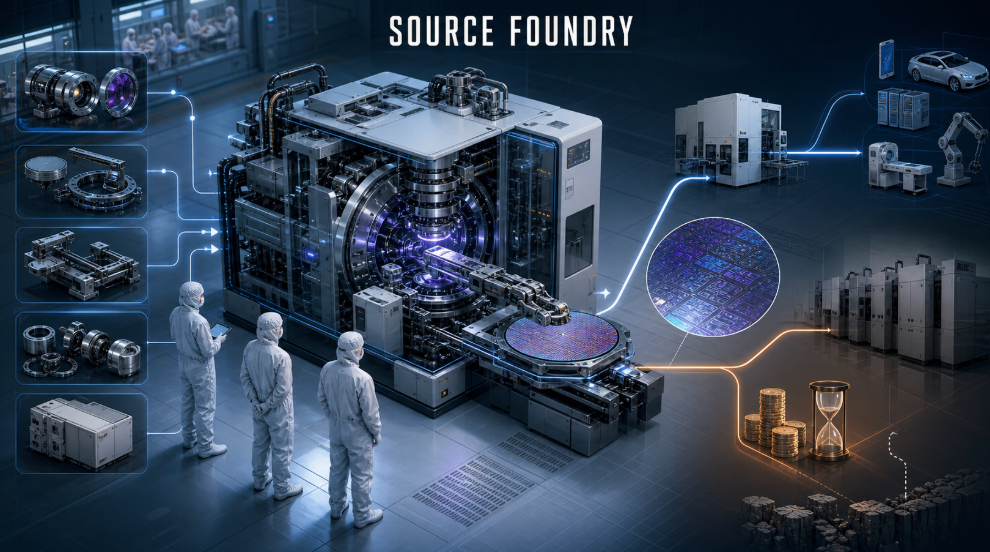
Source Foundry is a young, closely held company developing equipment for cutting-edge semiconductor manufacturing. Public information is limited, but reports say its ambition is to build machines used in the production of advanced AI chips and ultimately challenge entrenched equipment providers.
This is not the same business as designing a new GPU. Semiconductor-equipment companies build the precision systems that chip manufacturers need to pattern, inspect or process wafers. The barriers include years of research, complex supply chains, exacting tolerances and deep customer qualification. Success could create an important new supplier; failure could consume large amounts of capital before commercial revenue arrives.

What Does the $500 Million Figure Mean?
| Reported detail | Why it matters |
|---|---|
| About $500 million total commitment | This appears to include earlier capital plus a fresh investment, rather than one new $500 million check. |
| Fresh infusion of roughly $400 million | The latest financing significantly increases Situational Awareness’s exposure after its public-market losses. |
| Reported valuation near $5 billion | A high private valuation sets demanding expectations for technical progress and future commercialization. |
| Previous backing from Sequoia | Institutional participation adds credibility, but it does not remove execution or valuation risk. |
The distinction between a total position and a new cash injection matters. Headlines often compress the numbers, while investors need to know whether they describe cumulative exposure, a financing round or a company valuation.
Why Bet on Chipmaking Equipment After a Crash?
The thesis is straightforward: if AI computing demand continues to grow, the bottleneck may move deeper into the semiconductor supply chain. Model developers and cloud platforms need accelerators, while chipmakers depend on highly specialized manufacturing tools. A successful new equipment supplier could capture value regardless of which AI model wins.
There is also a portfolio logic. Public AI stocks are liquid and reprice instantly; private infrastructure assets can be held through market volatility and valued at periodic funding rounds. That can reduce visible day-to-day swings, although it does not eliminate economic losses. It may instead delay price discovery.
Why Source Foundry Is a High-Risk Bet
The opportunity is large because the challenge is unusually hard. Advanced semiconductor tools require scientific breakthroughs, reliable manufacturing and close cooperation with chip foundries. Incumbents benefit from decades of intellectual property, supplier relationships and installed equipment.
- Technology risk: prototypes may not reach the precision or throughput required for high-volume production.
- Capital risk: development can require repeated funding before meaningful sales emerge.
- Customer risk: chipmakers are cautious about qualifying new tools in expensive production lines.
- Valuation risk: a multibillion-dollar private valuation may assume progress that has not yet been demonstrated publicly.
- Concentration risk: a large position following a leveraged loss can make portfolio outcomes depend on a small number of private companies.
What the Deal Says About the AI Investment Cycle
The investment highlights a broader split in AI finance. Liquid markets can punish crowded trades quickly, while private capital continues to fund long-duration infrastructure projects. Strong demand for computing does not mean every AI-linked asset will rise together. Returns increasingly depend on where scarcity actually exists—chips, equipment, power, networking or software distribution.
For market watchers, the central question is not whether AI remains important. It is whether the price paid for exposure leaves room for technical delays, funding needs and competition. Situational Awareness’s move suggests conviction in the infrastructure thesis remains strong even after leverage exposed the fragility of its public-market strategy.
Conclusion
Situational Awareness’s reported $500 million Source Foundry commitment is a dramatic post-crash pivot, but it is not simply another leveraged AI trade. The firm is exchanging liquid market risk for concentrated private-company risk in one of technology’s most difficult industrial categories. Source Foundry could benefit if advanced chipmaking equipment becomes the next major AI bottleneck, yet its valuation and commercial prospects remain difficult for outsiders to verify. The next meaningful evidence will be technical milestones, customer validation and additional financing terms—not the size of the headline alone.
FAQ
How much did Situational Awareness invest in Source Foundry?
Reports put the firm’s total commitment at about $500 million, including a fresh infusion of roughly $400 million.
Did the Situational Awareness fund completely collapse?
Reports indicate that its leveraged public-equity portfolio suffered a major crash and was unwound. The firm reportedly retained valuable private AI holdings, so the event should not be described as a complete disappearance of the fund.
What does Source Foundry build?
Source Foundry is reportedly developing advanced semiconductor-manufacturing equipment intended for producing leading-edge AI chips. The company remains in stealth, so detailed technical and commercial information is limited.
Is Source Foundry publicly traded?
No. Source Foundry is a private startup, and ordinary public-market investors cannot directly buy its shares on an exchange.
Why is the Source Foundry investment important?
It shows that major AI investors are looking beyond model developers and chip designers toward the specialized equipment that enables advanced semiconductor production.


