
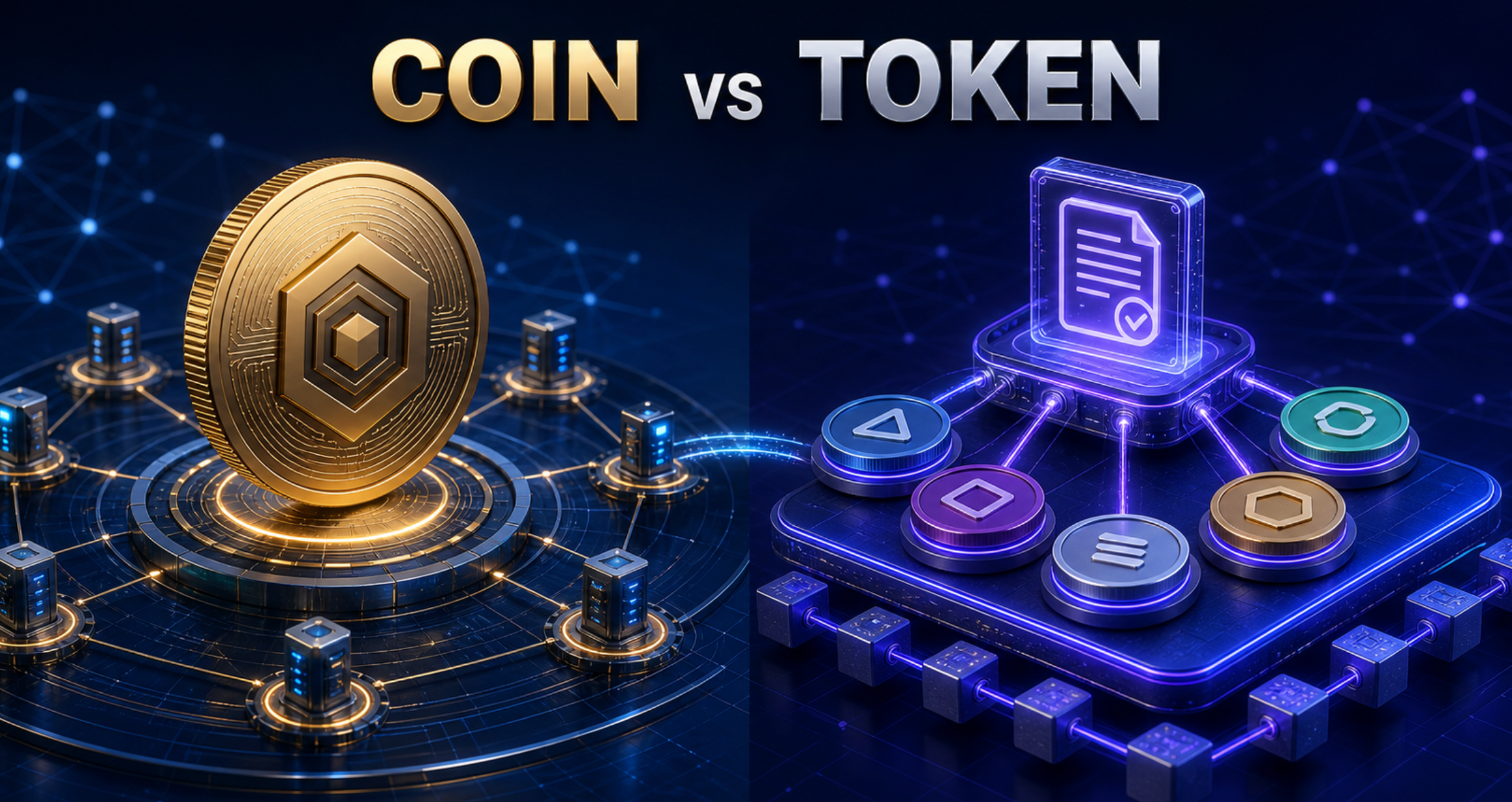
The terms coin and token are often used as if they mean the same thing. In everyday crypto conversation, that is understandable. People may say “crypto coin” when they are talking about any digital asset. Technically, however, coins and tokens are different.
A coin usually belongs to its own blockchain. A token is usually created on top of an existing blockchain. That single distinction explains why Bitcoin, Ethereum, and Solana are usually called coins, while assets such as USDT, UNI, LINK, and many meme coins are usually called tokens.
For beginners comparing digital assets, the Tapbit registration page can provide access to market tools and broader crypto categories, but users should still understand what type of asset they are researching before trading or transferring funds.
Coin vs Token Meaning in Crypto
A coin is the native asset of a blockchain network. BTC is native to Bitcoin. ETH is native to Ethereum. SOL is native to Solana. These assets exist at the base layer of their own networks and are usually needed for transaction fees, security incentives, or validator rewards.
A token is issued through a smart contract or token standard on a blockchain that already exists. Instead of building a new chain from scratch, a project can issue a token on Ethereum, Solana, BNB Chain, Tron, or another network.
What Is a Coin in Cryptocurrency?
A coin is closely tied to the operation of its own blockchain. Bitcoin is the cleanest example because BTC is used to transfer value on the Bitcoin network and reward miners for securing the chain.
Ethereum is slightly more complex because ETH supports smart contracts, decentralized applications, NFTs, and DeFi activity. But ETH is still a coin because it is native to Ethereum and is used to pay gas fees across the network.
Coins often have infrastructure-level importance. If the underlying blockchain grows, the native coin may become more important because users need it to interact with the network.
What Is a Token in Cryptocurrency?
A token is a digital asset built on another blockchain. Many tokens are created using common standards such as ERC-20 on Ethereum, SPL on Solana, BEP-20 on BNB Chain, or TRC-20 on Tron.
Tokens can have many roles. Some are stablecoins. Some are governance assets. Some represent DeFi protocol access, gaming rewards, NFT ecosystems, loyalty points, or speculative community-driven assets.
The flexibility of tokens is one reason crypto grew so quickly. A project can launch a token without building a full blockchain. The tradeoff is that token quality varies widely, and low-quality tokens are easy to create.
Coin vs Token: Main Differences
| Feature | Coin | Token |
|---|---|---|
| Blockchain | Runs on its own blockchain | Built on an existing blockchain |
| Examples | BTC, ETH, SOL, BNB | USDT, UNI, LINK, SHIB |
| Main Function | Gas fees, transfers, staking, security | Utility, governance, DeFi, stablecoins, NFTs |
| Creation | Requires blockchain development | Created through smart contracts or token standards |
| Network Dependence | Native to its own network | Depends on another blockchain for settlement |
Why the Coin vs Token Difference Matters
The difference matters most when users transfer assets. A token may exist on several networks, and choosing the wrong network can cause serious problems. USDT, for example, can exist on Ethereum, Tron, BNB Chain, and other networks. The name may look familiar, but the network route matters.
The distinction also helps with research. A native coin may be tied to validator activity, gas demand, staking rewards, and network adoption. A token may depend more on a single application, protocol, community, or issuer.
Are Tokens Less Valuable Than Coins?
No. A token is not automatically less valuable than a coin. Some tokens have deep liquidity, strong use cases, and large market caps. Stablecoins such as USDT and USDC are tokens, yet they are among the most widely used assets in crypto.
That said, tokens are easier to create. This means the token market contains many speculative, low-liquidity, or poorly documented projects. Before buying a token, users should review the contract address, liquidity, holder concentration, project documentation, and whether the token can actually be sold.
Can a Token Become a Coin?
Yes. Some projects start as tokens and later launch their own mainnet. When that happens, users may need to swap the old token for a new native coin. This type of migration should only be done through official project channels, because fake swap links are common in crypto scams.
A token-to-coin migration can signal that a project is becoming more independent, but it does not automatically make the asset safer or more valuable. The new blockchain still needs users, developers, security, liquidity, and real demand.
How Beginners Should Research Coins and Tokens
Beginners should first identify whether the asset is a coin or a token. Then they should check which blockchain it uses, what it is used for, whether liquidity is sufficient, and whether the project has credible documentation.
For coins, look at network activity, validator or miner participation, transaction fees, ecosystem growth, and developer adoption. For tokens, look at the contract, tokenomics, unlock schedule, utility, holder distribution, and smart contract risks.
Conclusion
The simplest coin vs token definition is this: a coin runs on its own blockchain, while a token is built on top of another blockchain. Coins usually support network fees and security. Tokens can represent utility, governance, stablecoins, NFTs, DeFi assets, or speculative community assets.
Understanding this difference helps users read crypto market data more clearly, avoid transfer mistakes, and evaluate digital assets with better context.
FAQ
What is the difference between a coin and a token?
A coin runs on its own blockchain, while a token is built on an existing blockchain.
Is Bitcoin a coin or token?
Bitcoin is a coin because BTC is native to the Bitcoin blockchain.
Is Ethereum a coin or token?
ETH is a coin because it is the native asset of the Ethereum blockchain.
Is USDT a coin or token?
USDT is a token. It can exist on multiple blockchains, including Ethereum, Tron, BNB Chain, and others.
Are meme coins really coins?
Many so-called meme coins are technically tokens because they are issued on existing blockchains such as Solana, Ethereum, or BNB Chain.
Which is better, coin or token?
Neither is automatically better. Coins may have deeper network roles, while tokens can still have strong utility, liquidity, or market demand.


