

Stock tokenization is one of the most discussed ideas in the real-world asset market. It promises to bring traditional equities onto blockchain rails, allowing investors to trade stock-linked tokens with faster settlement, broader access, and potentially longer trading hours.
But tokenized stocks are not all the same. Some may be backed by real shares held by a regulated custodian. Others may offer synthetic price exposure without direct shareholder rights. For investors, the key question is not only whether a token tracks a stock price, but what legal and economic rights the token actually provides.
What Is Stock Tokenization?
Stock tokenization is the process of creating blockchain-based tokens that represent exposure to shares of a company. These tokens may track public stocks such as technology, banking, or consumer companies, or they may represent private-market equity in limited settings.
In a simple model, a provider holds real shares through a custodian and issues tokens that represent claims linked to those shares. In a more complex model, the token may be a derivative or synthetic product that mirrors the price of a stock without giving direct ownership of the underlying equity.
| Element | Description |
|---|---|
| Underlying asset | A traditional stock or equity-linked exposure |
| Token format | A blockchain-based representation of that exposure |
| Custody model | May involve real shares held by a regulated custodian |
| Investor rights | Depend on the issuer, jurisdiction, and product structure |
| Market category | Real-world asset and tokenized securities infrastructure |
How Tokenized Stocks Work
The basic idea is that traditional equity exposure is wrapped into a digital token. The token can then move across supported platforms, wallets, or trading venues, depending on compliance rules.
However, the real structure behind the token matters. Investors should ask whether the token is backed one-to-one by actual shares, whether the custodian is regulated, whether redemption is possible, and whether holders receive dividends or corporate-action benefits.
| Model | What Investors Should Ask |
|---|---|
| Share-backed token | Who holds the shares, and can holders redeem? |
| Synthetic token | What creates the price exposure? |
| Derivative product | Is it regulated as a security or derivative? |
| Private equity token | Are transfers restricted to eligible investors? |
| Exchange-issued token | What happens if the issuer or platform fails? |
Why Stock Tokenization Is Growing
Stock tokenization sits at the intersection of traditional finance and crypto infrastructure. Supporters argue that tokenized stocks could make markets more flexible by enabling faster settlement, fractional access, programmable compliance, and potentially 24/7 trading.
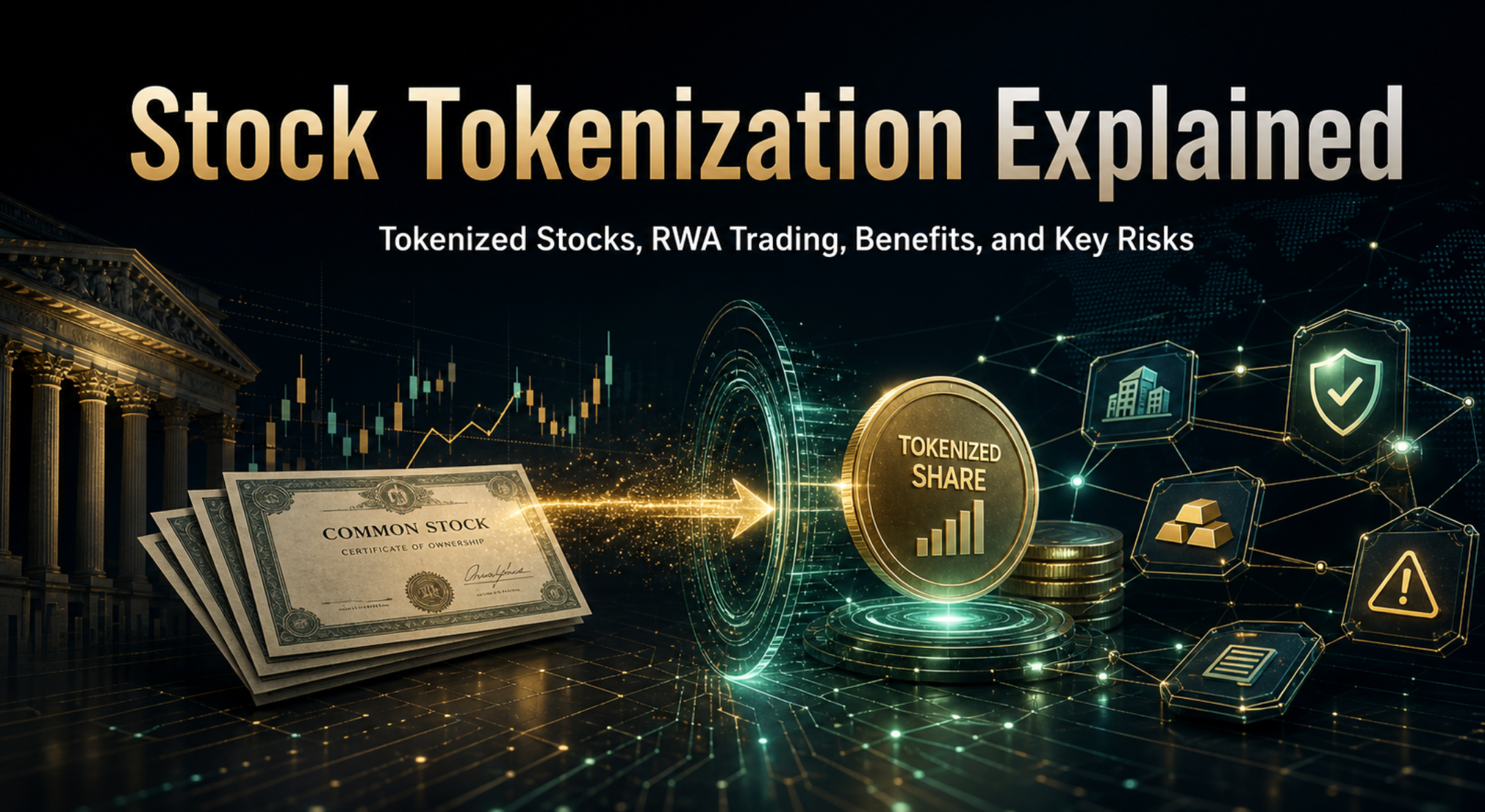
The growth of tokenized treasuries, tokenized funds, and other RWA products has also encouraged investors to ask whether listed equities could move onto similar rails.
- Potentially faster settlement than legacy market systems.
- Broader access for global investors where legally supported.
- Fractional exposure to expensive shares.
- Programmable compliance and transfer restrictions.
- Possible integration with DeFi collateral and settlement systems.
Tokenized Stocks vs Traditional Stocks
A traditional stock usually gives legal ownership rights defined by securities law and the company’s shareholder framework. A tokenized stock may or may not provide the same rights.
This distinction is critical. If a token only tracks price, the holder may not have voting rights, direct dividend rights, shareholder communications, or legal recourse equal to a direct shareholder.
| Feature | Traditional Stock | Tokenized Stock |
|---|---|---|
| Ownership | Direct or broker-held shareholder interest | Depends on token structure |
| Voting rights | Usually available to shareholders | May be limited or unavailable |
| Dividends | Paid according to company policy | Depends on issuer rules |
| Trading hours | Exchange schedule | May support extended or 24/7 trading |
| Regulation | Established securities framework | Still developing across jurisdictions |
Key Benefits of Stock Tokenization
The appeal of tokenized stocks is not only crypto speculation. The deeper idea is market infrastructure modernization. If built with proper compliance, tokenized equities could reduce settlement friction, increase transparency, and make financial products more programmable.
For investors, the most visible benefit may be access. Tokenized stocks can potentially allow fractional participation and longer trading windows, although this depends on the platform and local regulation.
| Benefit | Why It Matters |
|---|---|
| Fractional access | Investors can gain smaller-sized exposure |
| Faster settlement | Blockchain rails may reduce settlement delays |
| Transparency | Transfers may be visible on-chain |
| Programmability | Compliance and transfers can be automated |
| Global market access | Availability may expand where legally permitted |
Key Risks Investors Should Understand
Stock tokenization also introduces serious risks. The token may not represent actual ownership of the company. Liquidity can be thin. Prices can diverge from the underlying stock. Corporate actions may be handled differently from traditional brokerage accounts.
There is also platform risk. If the issuing platform fails, suspends redemptions, or loses access to the underlying shares, token holders may face uncertainty.
| Risk | Potential Impact |
|---|---|
| Unclear ownership rights | Token holders may not be true shareholders |
| Custody risk | Underlying shares may depend on a third-party custodian |
| Liquidity risk | Tokens may be hard to sell at fair prices |
| Price fragmentation | Token prices may diverge from stock exchange prices |
| Regulatory risk | Rules can change across jurisdictions |
| Platform risk | Issuer failure can affect access and redemption |
What to Check Before Trading Tokenized Stocks
Before using any tokenized stock product, investors should read the product documents carefully. The most important question is what the token legally represents.
- Is the token backed by real shares?
- Who is the custodian?
- Can investors redeem the token for shares or cash?
- Are dividends or corporate actions passed through?
- Does the holder receive voting rights?
- Is the product available legally in the investor’s jurisdiction?
- How deep is liquidity?
- What happens if the platform shuts down?
Where Tapbit Fits In
Tokenized stock markets are still developing, and availability can vary by asset, jurisdiction, and product structure. Users who want to explore broader digital asset opportunities can create a Tapbit account while researching market access and risk management tools.
This does not mean every tokenized stock is available on Tapbit. Investors should always verify the exact product, market, and trading rules before committing funds.
Final Thoughts
Stock tokenization could become an important part of RWA adoption because it connects traditional equities with blockchain settlement infrastructure. The long-term opportunity is real, especially if regulated platforms can combine legal clarity with efficient trading.
At the same time, tokenized stocks require careful analysis. Investors should not assume that a tokenized stock is identical to a traditional share. The structure, rights, custody, liquidity, and regulation determine whether the product is useful, risky, or unsuitable.
FAQ
What is stock tokenization?
Stock tokenization is the creation of blockchain-based tokens that represent exposure to traditional equities or equity-linked products.
Do tokenized stocks give real share ownership?
Not always. Some products may be backed by real shares, while others may only provide synthetic price exposure. Investors must verify the structure.
Can tokenized stocks pay dividends?
Some tokenized stock products may pass through dividend-related benefits, but this depends on the issuer and product terms.
Are tokenized stocks regulated?
Tokenized stocks are generally connected to securities law, but rules vary by jurisdiction and product structure.
What is the biggest risk of tokenized stocks?
The biggest risk is assuming that a token provides the same legal rights as a traditional share when it may not.


