

The tokenization of Real World Assets (RWAs) is growing rapidly, but the sector faces a significant bottleneck: the gap between expanding market size and lagging compliance infrastructure. The RWA tokenization market cap has climbed significantly, yet many on-chain protocols still operate in regulatory gray areas, relying on non-binding legal opinions from external law firms. This lack of clear, institutional-grade compliance has kept conservative institutional capital—such as sovereign wealth funds and pension funds—from allocating meaningful capital on-chain.
Plume Network recently introduced a regulatory approach designed to bridge this gap: a dual regulatory framework combining a Bermuda BMA license with a US SEC registration. This moves beyond standard industry marketing, establishing a regulated Onchain Vault Manager framework. For digital asset platforms working to connect Web3 liquidity with traditional finance (TradFi), understanding the mechanics of this setup offers a clear look at how institutional capital is likely to interface with on-chain assets moving forward.
Deconstructing the Dual Framework: SEC Transfer Capabilities Meet Bermuda Statutory Remoteness
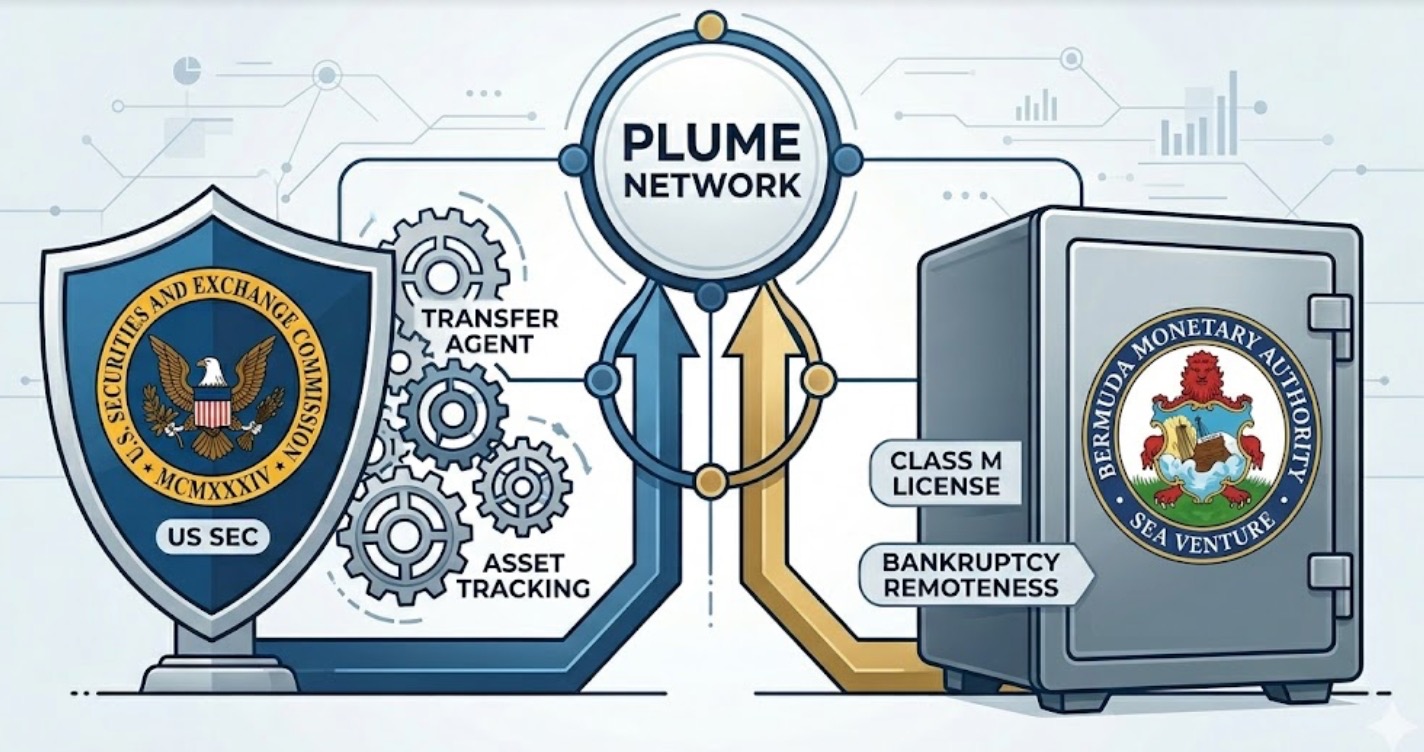
Plume’s regulatory setup relies on two distinct compliance mechanisms designed to fit into existing financial structures:
1. Connecting to US Securities Infrastructure: SEC Transfer Agent Registration
Plume registered as a Transfer Agent with the US Securities and Exchange Commission (SEC). In traditional markets, transfer agents manage ownership records and handle asset transfers.
-
The Structural Shift: By introducing this role to on-chain tokenized assets, the framework accounts for the security-like characteristics of specific RWAs and interfaces directly with US securities infrastructure. This gives institutional compliance teams a recognized, auditable pathway for tracking asset lifecycles.
2. Legal Asset Isolation: Bermuda BMA Class M License
Plume’s subsidiary, Kimber Digital Assets Bermuda ISAC Ltd. (KDAB), secured a Class M license from the Bermuda Monetary Authority (BMA) under the Digital Asset Business Act (DABA).
-
The Structural Shift: The Class M license requires physical substance, a $100,000 net asset threshold, and ongoing regulatory reporting regarding capital adequacy and Anti-Money Laundering (AML) standards. Crucially, by utilizing Bermuda’s Incorporated Segregated Accounts Companies (ISAC) Act, each on-chain vault functions as an independent legal entity. This provides statutory bankruptcy remoteness—meaning the assets in one vault are legally protected from liabilities elsewhere in the protocol.
|
Regulatory Component |
Standard DeFi Setups |
Plume's Dual Framework |
|
Legal Footing |
Relies on third-party legal opinions without direct regulatory oversight |
Supervised directly by a national financial regulator (BMA) |
|
Asset Isolation |
Dependent on smart contract code (vulnerable to exploits or governance bugs) |
Smart contracts backed by statutory legal isolation (ISAC) for bankruptcy remoteness |
|
Asset Transfer |
Unrestricted peer-to-peer transfers without centralized ownership anchors |
Registered as a US SEC Transfer Agent, allowing integration with traditional clearing structures |
Technical Risk Control: Meeting Fiduciary Standards

Institutional allocators operate under strict fiduciary duties. They require granular risk-control data before interfacing with any blockchain protocol. The operational data associated with Plume’s framework addresses several typical compliance hurdles:
-
0.000005% Illicit Transaction Interception Rate: This metric points to a highly strict transaction filtering environment. Instead of relying purely on post-trade analytics, compliance checks (KYC/KYB and AML/CFT rules) are hardcoded directly into the asset tokens and the vault architecture itself.
-
Network Distribution: The ecosystem has scaled to over 280,000 RWA holder addresses, creating a distribution footprint for compliant on-chain assets.
Currently, the protocol's asset yield architecture (encompassing vaults for private credit, real estate, and commodities) is designed to capture market share from the regulated asset management sector. By integrating compliance logic—including transaction restrictions—directly into the smart contract layer, the framework allows asset managers to distribute tokenized products globally without needing to establish complex, cross-border corporate structures for every single fund.
Market Implications for Digital Asset Platforms
As the multi-chain RWA race matures, pure technical throughput is no longer the primary differentiator for capturing institutional value. High-speed networks are competing aggressively for asset issuance, but capital allocation is heavily dependent on the underlying legal structure.
Plume’s dual-regulatory approach signals a broader shift in the market: compliance frameworks are moving from an optional feature to a fundamental requirement for institutional asset distribution.
For digital asset exchanges and platforms looking ahead, the tokenized assets with long-term liquidity and volume will likely come from infrastructures that successfully tie traditional financial clearing logic to blockchain immutability. Platforms that position themselves early to support and list these structurally compliant, high-liquidity assets will be well-positioned as institutional capital continues to move on-chain. To explore compliant trading options and stay ahead of institutional asset trends, visit Tapbit.
Frequently Asked Questions (FAQ)
What is the practical difference between Plume's SEC Transfer Agent status and its Bermuda BMA license?
The SEC Transfer Agent status connects the platform directly to the US traditional financial plumbing, allowing for legitimate tracking and transfer of security-like assets under US jurisdiction. The Bermuda BMA Class M license provides the overarching operational framework for on-chain asset management, ensuring the protocol adheres to strict, banking-grade AML/CFT standards and financial solvency rules outside the US.
Why is "bankruptcy remoteness" such a critical milestone for institutional investors?
In standard DeFi protocols, if the parent company or a specific pool faces an exploit or legal liquidation, all pooled assets could potentially be tied up in legal proceedings or drained. By using Bermuda's ISAC structure, each on-chain vault has its own distinct legal personality. If one asset pool or the core protocol encounters a crisis, the assets inside other isolated vaults remain legally untouchable and completely ring-fenced.
How does hardcoding compliance into smart contracts affect standard user transactions?
It shifts risk management from reactive to proactive. Instead of reviewing bad actors after a transaction has occurred, the protocol filters participants at the smart contract level using strict KYC/KYB white-listing. This is why the protocol reports an exceptionally low 0.000005% illicit transaction interception rate—malicious capital is blocked from interacting with the asset vaults in the first place.


