
Some stocks trade on current earnings. Others trade on future infrastructure.
AST SpaceMobile, known by its ticker ASTS, clearly belongs to the second group. The company is trying to build a space-based cellular broadband network that can connect directly to ordinary smartphones. If the model works at scale, it could become part of the next generation of global communications infrastructure.
That is why ASTS has attracted strong attention from traders. It sits at the intersection of satellites, telecom, mobile broadband, national connectivity, defense-related communications and frontier technology.
But this is also why the stock is volatile. The market is not simply pricing what AST SpaceMobile earns today. It is pricing what the company may become if satellite deployment, regulatory approvals, operator partnerships and commercial revenue all come together.
For traders, ASTS is a useful case study in speculative infrastructure investing.
Why AST SpaceMobile Has Become a Market Focus

AST SpaceMobile’s core idea is ambitious: provide cellular broadband from space directly to standard mobile phones.
That matters because traditional mobile networks still leave coverage gaps. Remote regions, oceans, disaster zones and rural areas often lack reliable terrestrial infrastructure. A direct-to-device satellite network could help fill those gaps without requiring users to buy a special satellite phone.
The story became more visible after AST SpaceMobile advanced its BlueBird satellite deployment. SpaceX confirmed that Falcon 9 launched AST SpaceMobile’s BlueBird 8-10 mission from Cape Canaveral on June 17, 2026. The mission placed three additional BlueBird satellites into orbit, supporting AST’s plan to expand its space-based cellular network.
This kind of milestone matters because ASTS is no longer only a concept story. It is moving through a capital-intensive execution phase where each launch, deployment and technical test can affect investor confidence.
The Bull Case: A New Layer of Mobile Infrastructure
The bullish argument for ASTS is simple but powerful.
If the company can connect ordinary smartphones to satellites at scale, it could create a new layer of global mobile infrastructure. This would not just be a space story. It would also be a telecom story.
AST SpaceMobile has reported nearly 60 mobile network operator partners covering more than 3 billion subscribers. The company also said it achieved a 98.9 Mbps peak data speed from an in-orbit Block 1 BlueBird satellite directly to an unmodified smartphone over international waters.
Those details are important because they show why the market is paying attention. ASTS is not only promising future satellites. It is trying to prove that direct-to-device broadband can become a commercial service through existing mobile ecosystems.
The Japan development added another layer to the story. Light Reading reported that Japan committed 150 billion yen, about $922 million, to Rakuten Mobile’s low-Earth-orbit satellite joint venture with AST SpaceMobile. The project is tied to Japan’s effort to strengthen domestic satellite communications and reduce reliance on Starlink.
This shifts part of the ASTS narrative from consumer connectivity to national communications infrastructure. When governments begin treating satellite networks as strategic assets, investor attention can rise quickly.
The Bear Case: Execution Still Matters
The risk is that infrastructure dreams are expensive.
AST SpaceMobile is still in the early commercial stage. Its first-quarter 2026 revenue was $14.7 million, while net loss attributable to common stockholders was $191.0 million. The company ended March 31, 2026 with about $3.5 billion in cash, cash equivalents and restricted cash, giving it funding capacity, but the business remains deeply loss-making as it scales.
This is the key tension.
ASTS has a large vision and meaningful liquidity, but the company must still prove that satellite launches can turn into recurring commercial revenue. The market is watching whether mobile network operator partnerships, government contracts and early service rollouts can support the company’s long-term valuation.
AST SpaceMobile is targeting approximately 45 BlueBird satellites in orbit during 2026, supported by launch agreements with multiple providers including SpaceX and Blue Origin. That target creates upside potential if execution goes well, but it also creates pressure. Delays, launch issues, regulatory obstacles or slower customer adoption could all affect the market’s view.
Why ASTS Trades Like a Speculative Infrastructure Stock
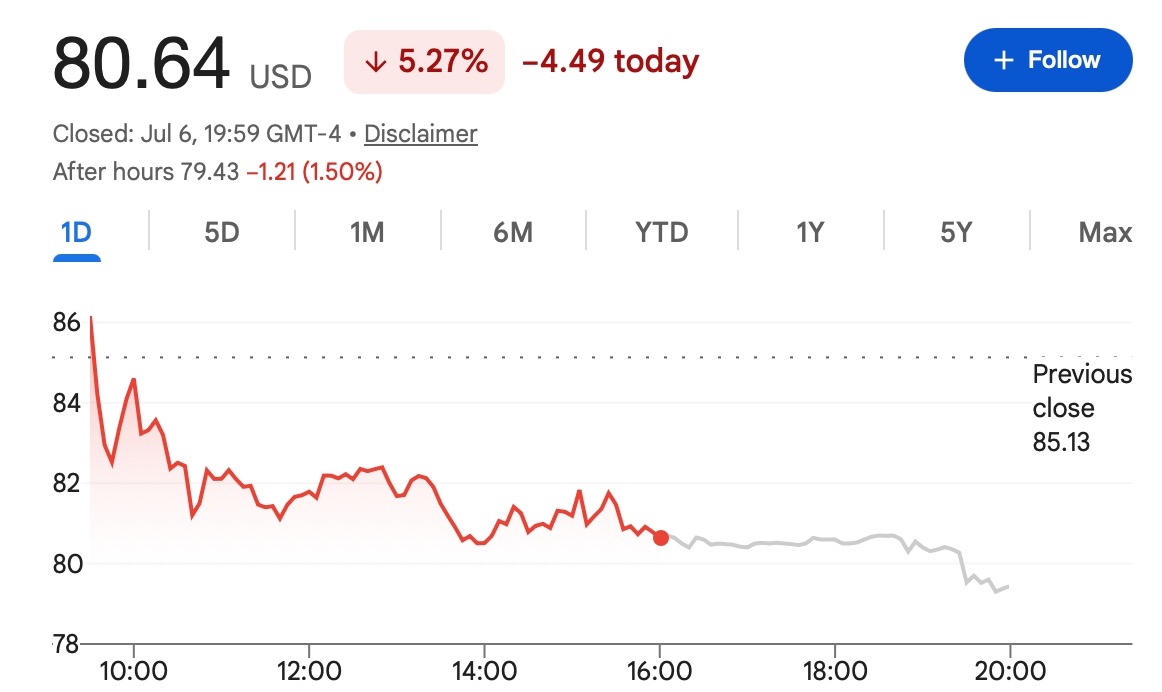
At the time of writing, ASTS traded around $80.64 with a market capitalization of about $23.4 billion and a negative price-to-earnings ratio, reflecting the fact that the company is still unprofitable.
That combination explains the stock’s behavior.
When investors believe the infrastructure rollout is progressing, the stock can respond strongly. When there are concerns about delays, losses or competition, the same future-focused valuation can become vulnerable.
This is common in speculative technology sectors. Markets often price future infrastructure before profits arrive. Investors did this with electric vehicles, cloud computing, AI infrastructure, space technology and parts of Web3. Sometimes the market is early. Sometimes it is too optimistic. The challenge is knowing how much future success is already priced in.
For ASTS, the stock is not only reacting to quarterly numbers. It is reacting to launch cadence, satellite capacity, government support, telecom partnerships, data speed milestones and the competitive landscape.
The Competitive Landscape
AST SpaceMobile is not building in an empty market.
SpaceX’s Starlink has already become a major force in satellite connectivity. Amazon’s satellite ambitions, telecom operator partnerships and national space programs also shape the competitive environment. Japan’s support for a Rakuten-AST satellite project was partly framed as a way to reduce reliance on Starlink, showing how satellite broadband is becoming part of broader economic security discussions.
This competition cuts both ways.
On one hand, it validates the market opportunity. Large companies and governments would not be investing in satellite connectivity if the use case were weak.
On the other hand, it increases execution pressure. AST SpaceMobile must show that its direct-to-device approach can compete on coverage, reliability, cost, spectrum access and partner integration.
What This Means for Crypto and Frontier-Tech Traders
ASTS is a stock, not a crypto asset. But the market lesson is familiar to crypto traders.
Crypto markets often price infrastructure before mainstream adoption is fully visible. Layer 1 networks, DeFi protocols, AI-related tokens, RWA projects and modular blockchain ecosystems can all rally on the expectation that they will become important infrastructure later.
The risk is similar too. A strong narrative can move prices before revenue, users or adoption fully arrive. When expectations are high, execution must be strong.
That is why ASTS is a useful comparison for crypto traders. It shows how markets behave when they are not just valuing a company’s current numbers, but also trying to price a possible future network.
In both stocks and crypto, the key question is not only whether the story is exciting. The better question is: how much of that future is already reflected in the price?
Tapbit View
AST SpaceMobile reflects a broader market pattern.
Investors are increasingly willing to price future infrastructure early, especially in sectors connected to communications, AI, space, energy and Web3. These themes can attract strong capital because they appear to solve large real-world problems.
But early infrastructure stories also carry high uncertainty.
A company may have the right vision, but still need years of execution. A technology may work in tests, but still need commercial scale. A market may be large, but competition can change quickly.
For Tapbit users, the lesson is to separate narrative from confirmation.
ASTS has real catalysts, including satellite launches, telecom partnerships, government-backed projects and a large cash position. It also has real risks, including losses, capital intensity, execution pressure and competition.
That is what makes it a powerful market case study.
When markets price the future, traders need to understand both sides: the size of the opportunity and the difficulty of turning that opportunity into sustainable results.
Conclusion
AST SpaceMobile shows how markets can price future infrastructure before profits arrive.
The company’s satellite launches, Japan-related catalyst and mobile network partnerships have strengthened the long-term story. At the same time, its current financials show that the business remains early, expensive and execution-dependent.
For traders, ASTS is not just a question of whether satellite broadband is exciting. It is a question of timing, valuation and delivery.
The market is already assigning value to a future communications network. The next test is whether AST SpaceMobile can build, launch and commercialize that network fast enough to justify investor expectations.
Users can visit Tapbit to explore supported crypto markets and educational resources. Existing users can log in, while new users can register here.
Frequently Asked Questions (FAQ)
What is AST SpaceMobile?
AST SpaceMobile is a company building a space-based cellular broadband network designed to connect directly to ordinary smartphones.
Why is ASTS considered speculative?
ASTS is speculative because the company has a large future opportunity but remains in an early commercial stage, with significant losses and heavy infrastructure investment.
What recent catalyst supported ASTS?
Recent catalysts include the launch of BlueBird 8, 9 and 10 satellites and Japan’s reported funding support for a Rakuten-AST SpaceMobile satellite communications project.


