
ASML stock closed near $1,655 on July 27, 2026, down about 5.8% after reports of progress in China’s domestic deep-ultraviolet lithography equipment triggered a broad sell-off in semiconductor equipment shares. The U.S.-listed ADR traded as low as roughly $1,613 during the session, while ASML’s Amsterdam shares fell more than 8%.
The drop created a sharp contrast. ASML remains the essential supplier of extreme-ultraviolet lithography systems used to manufacture the most advanced chips, and the company has been benefiting from strong AI-related capacity investment. Yet the market is now questioning whether China can reduce its dependence on foreign equipment faster than expected and whether ASML’s valuation leaves enough room for geopolitical surprises.
ASML Stock Price Today: Why Shares Fell 5.8%
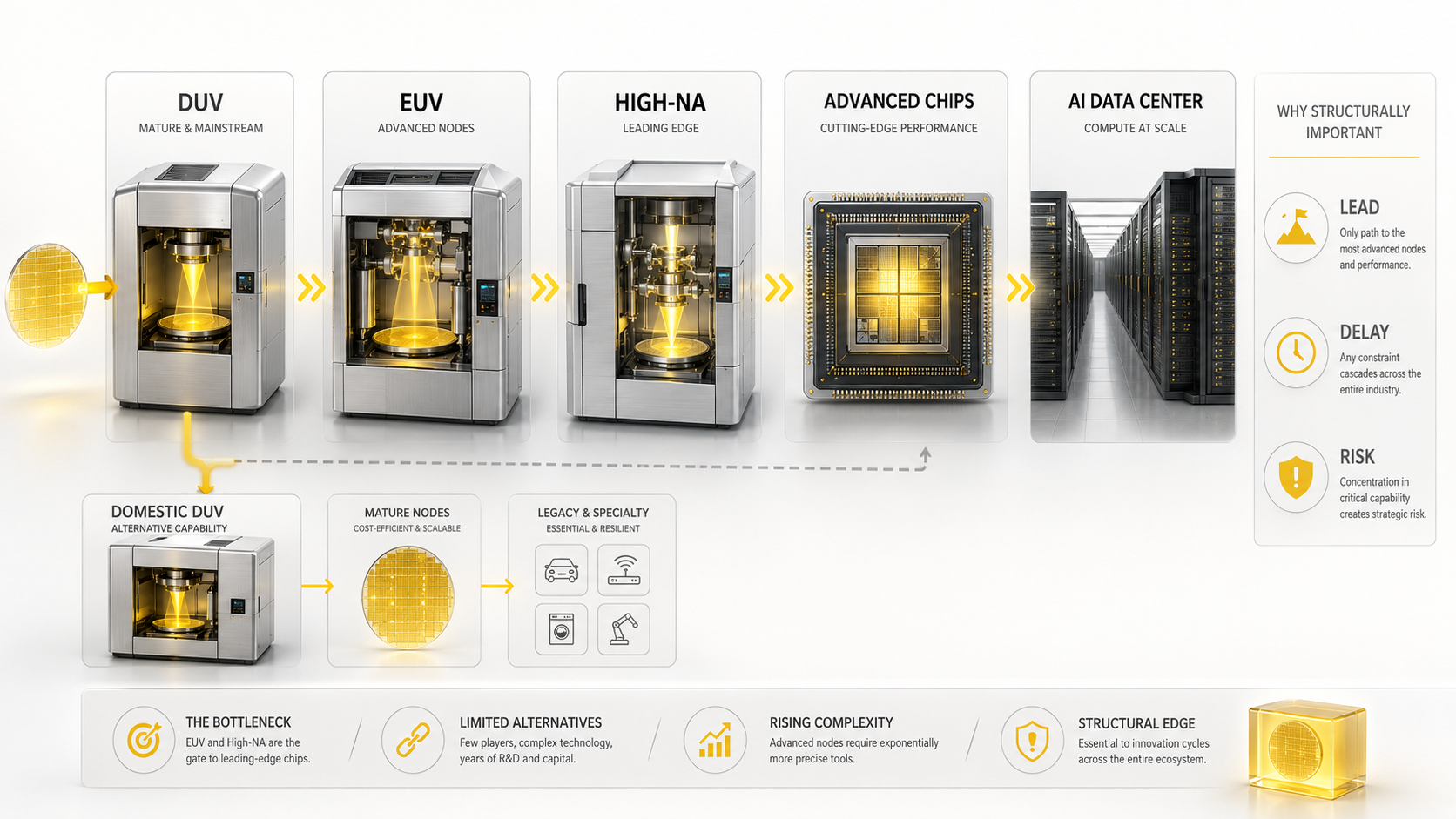
The immediate catalyst was a report that a Chinese state-backed company had begun producing immersion DUV lithography equipment. DUV is not equivalent to ASML’s most advanced EUV technology, but progress in domestic tools matters because China has been a major market for mature-node equipment and because investors treat lithography leadership as the foundation of ASML’s strategic value.
The sell-off also reflected broader weakness in AI and chip stocks. Investors were reassessing the financing of large data-center projects and the sustainability of high semiconductor valuations. ASML therefore faced both company-specific geopolitical pressure and a sector-wide reduction in risk appetite.
The July 27 ADR range provides the first technical framework. The stock closed near $1,655 after touching approximately $1,613. A recovery above $1,745–$1,760 would indicate that buyers have reclaimed the area around the prior close and session high. A move above $1,800 would provide stronger confirmation that the shock has been absorbed.
Is ASML a Buy or a Sell After the Decline?
The correct answer depends on whether the investor is evaluating ASML as a short-term momentum trade or as a long-term infrastructure company. The 5.8% drop improved the entry price, but it did not remove export-control, customer-cycle or valuation risk.
The Bull Case for ASML
ASML’s central advantage is that advanced semiconductor manufacturing depends on lithography systems with extraordinary precision. EUV equipment is required for leading-edge logic and increasingly important memory applications. Replicating the complete system requires expertise in light sources, optics, mechatronics, software, metrology and a global supplier network.
The company’s first-quarter 2026 results showed €8.8 billion in net sales and a 53% gross margin. Management raised the full-year sales outlook to €36 billion–€40 billion and said customer demand was being supported by AI infrastructure investment and accelerated capacity plans.
The bull case therefore assumes that AI chip demand continues driving foundry and memory capital expenditure, High-NA EUV adoption progresses and domestic Chinese equipment remains unable to replace ASML at the leading edge. In that scenario, the July decline may represent a valuation reset rather than a change in the long-term competitive position.
The Bear Case for ASML
The bear case does not require China to match EUV immediately. It only requires the market to believe that China can substitute more DUV tools, extend mature-node capability or reduce ASML’s future sales opportunity. Export controls can also change the mix of products ASML is allowed to ship.
Customer concentration is another risk. Semiconductor manufacturers make enormous capital-expenditure decisions in cycles. If foundries or memory producers delay new fabs, ASML’s order timing can become volatile even when the long-term technology roadmap remains intact.
Valuation amplifies both risks. A company trading at a premium multiple can fall even while revenue grows if investors decide that geopolitical or cyclical uncertainty deserves a lower valuation.
Should Investors Choose Nvidia or ASML?
Nvidia and ASML both benefit from AI, but they provide different forms of exposure.
| Factor | Nvidia | ASML |
|---|---|---|
| AI exposure | Direct exposure through accelerators, networking and software. | Infrastructure exposure through equipment needed to manufacture advanced chips. |
| Main advantage | Platform ecosystem and AI compute leadership. | Unique position in EUV lithography and advanced manufacturing tools. |
| Key risk | Customer spending, competition and AI financing sustainability. | Export controls, equipment cycles and progress in alternative lithography tools. |
| Shareholder return | Direct stock ownership may include voting and dividends through a broker. | Direct ASML shares or ADRs may include shareholder rights according to their structure. |
Nvidia offers more direct sensitivity to AI compute demand. ASML offers exposure to the manufacturing bottleneck behind multiple chip designers and foundries. Neither is automatically superior; the choice depends on whether an investor prefers platform demand or semiconductor infrastructure.
What Is the ASML Price Target for 2026?
A useful 2026 target should be connected to bookings, EUV shipments, gross margin and export controls rather than one analyst number.
Bull, Base and Bear Scenarios for 2026
| Scenario | Operating Assumption | Market Confirmation |
|---|---|---|
| Bull | AI capacity investment remains strong, EUV demand expands and China-related substitution stays limited. | ASML reclaims $1,745–$1,760 and then moves above $1,800. |
| Base | Sales continue growing, but the valuation multiple compresses because of policy and cycle uncertainty. | The ADR consolidates between roughly $1,610 and $1,800. |
| Bear | Export limits tighten, customer capex slows or investors price faster domestic Chinese progress. | A sustained break below approximately $1,610 invalidates the immediate stabilization case. |
Key Confirmation and Invalidation Levels
The $1,613 session low is the first downside reference. Holding above it would not guarantee a recovery, but it would show that the initial panic has not produced another lower low. The $1,745–$1,760 area is the first recovery barrier because it covers the session high and prior closing region. The $1,800 level is a stronger confirmation point.
Fundamental confirmation should come from net bookings, EUV and High-NA EUV progress, customer capital-expenditure plans and management’s treatment of export-control risk. Price and operating evidence should be evaluated together.
How Much Could ASML Be Worth in 2030?
Any 2030 estimate is highly sensitive to assumptions. ASML’s long-term opportunity depends on the number of advanced-node fabs, lithography intensity per wafer, High-NA adoption, service revenue and the company’s ability to preserve pricing power.
What Must Go Right for the Bull Case?
The strongest long-term outcome requires AI compute demand to keep expanding, leading-edge chip complexity to increase and customers to adopt more EUV exposures per process. High-NA systems must also move from early deployment toward wider commercial use. Under those conditions, ASML can grow not only through new systems but also through service, upgrades and its installed base.
What Could Break the Long-Term Growth Thesis?
The thesis would weaken if alternative patterning methods reduce lithography intensity, if Chinese tools substitute a meaningful part of ASML’s DUV opportunity, or if geopolitical restrictions permanently limit access to major markets. A prolonged semiconductor capital-spending downturn would also delay revenue even if ASML’s technology position remains strong.
For broader context, Tapbit Learn’s semiconductor stock guide compares ASML with memory and compute companies, while the AI chip stock analysis explains how sector sentiment spreads across the hardware chain.
How Tapbit Users Can Follow Semiconductor Market Exposure
Tapbit support for an ASML-specific stock-linked futures contract requires confirmation, so this article does not claim that ASML-USDT is available. Traders can instead review confirmed products linked to other semiconductor companies, including NVDA-USDT, SKHYNIX-USDT, MU-USDT and SNDK-USDT.
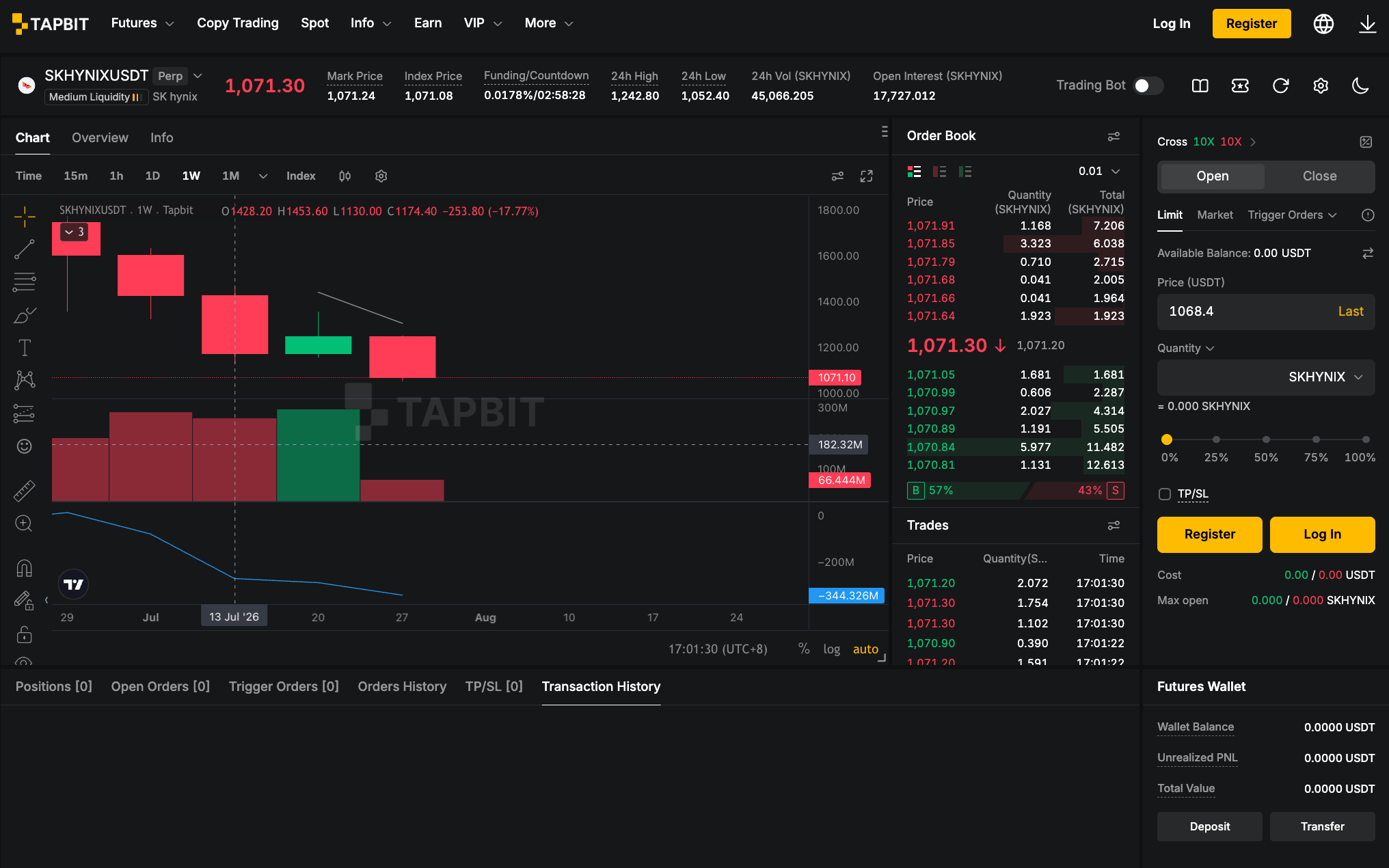
These contracts are not direct substitutes for ASML. Nvidia represents AI compute, SK Hynix emphasizes HBM, Micron spans HBM, DRAM and NAND, and SanDisk is more directly tied to NAND storage. Each is a derivative rather than direct share ownership and provides no voting rights, dividends or other shareholder benefits.
- Step 1: create an account and fund the futures account.
- Step 2: Select the supported semiconductor-linked contract that matches the market theme being analyzed.
- Step 3: Review the contract price, underlying reference, margin mode, funding, liquidity and leverage before entering.
- Step 4: Define the invalidation level and position size, then monitor U.S., Korean and European trading hours for price gaps and news risk.
ASML’s fall toward $1,655 is a reminder that strategic importance does not eliminate valuation or geopolitical risk. The long-term AI infrastructure case remains powerful, but the next recovery needs both price confirmation above the $1,745–$1,760 area and evidence that China-related developments do not materially weaken ASML’s order outlook.


