
If you want to know why Bitcoin is struggling to find its footing right now, step away from the crypto charts and pull up a chart of WTI Crude.
Global financial markets are currently caught in a geopolitical vice grip. A series of aggressive military operations across the world’s most critical energy chokepoints has sent shockwaves through the commodities market, and the ripple effects are directly hitting digital assets.
We are watching a textbook macro squeeze. When energy prices spike due to war, inflation expectations rebound. When inflation rebounds, the Federal Reserve refuses to cut interest rates. And when interest rates stay high, the U.S. Dollar becomes a wrecking ball for risk assets like cryptocurrency.
Here is what is actually happening on the ground, how it is driving the Dollar Index (DXY) to critical highs, and how traders should navigate this low-liquidity environment.
The Chokehold on Global Energy
The current panic in the oil markets isn't based on speculation; it is based on physical supply chain destruction. Within the span of a few weeks, two major geopolitical tectonic plates have shifted.
First came "Operation Absolute Resolve" in Venezuela, an unprecedented U.S. move that completely upended the leadership of a country holding roughly 20% of the world's proven oil reserves.
Before the market could even digest that shock, the focus violently pivoted to the Middle East. Massive airstrikes targeted military infrastructure on Iran's Kharg Island. Given that Kharg Island handles roughly 90% of Iranian oil exports, the attack essentially weaponized the region's energy output.
The immediate casualty of this escalation is the Strait of Hormuz. Roughly one-fifth of the world's daily oil consumption passes through this narrow maritime corridor. Right now, commercial shipping traffic through the strait has plummeted by a staggering 97%.
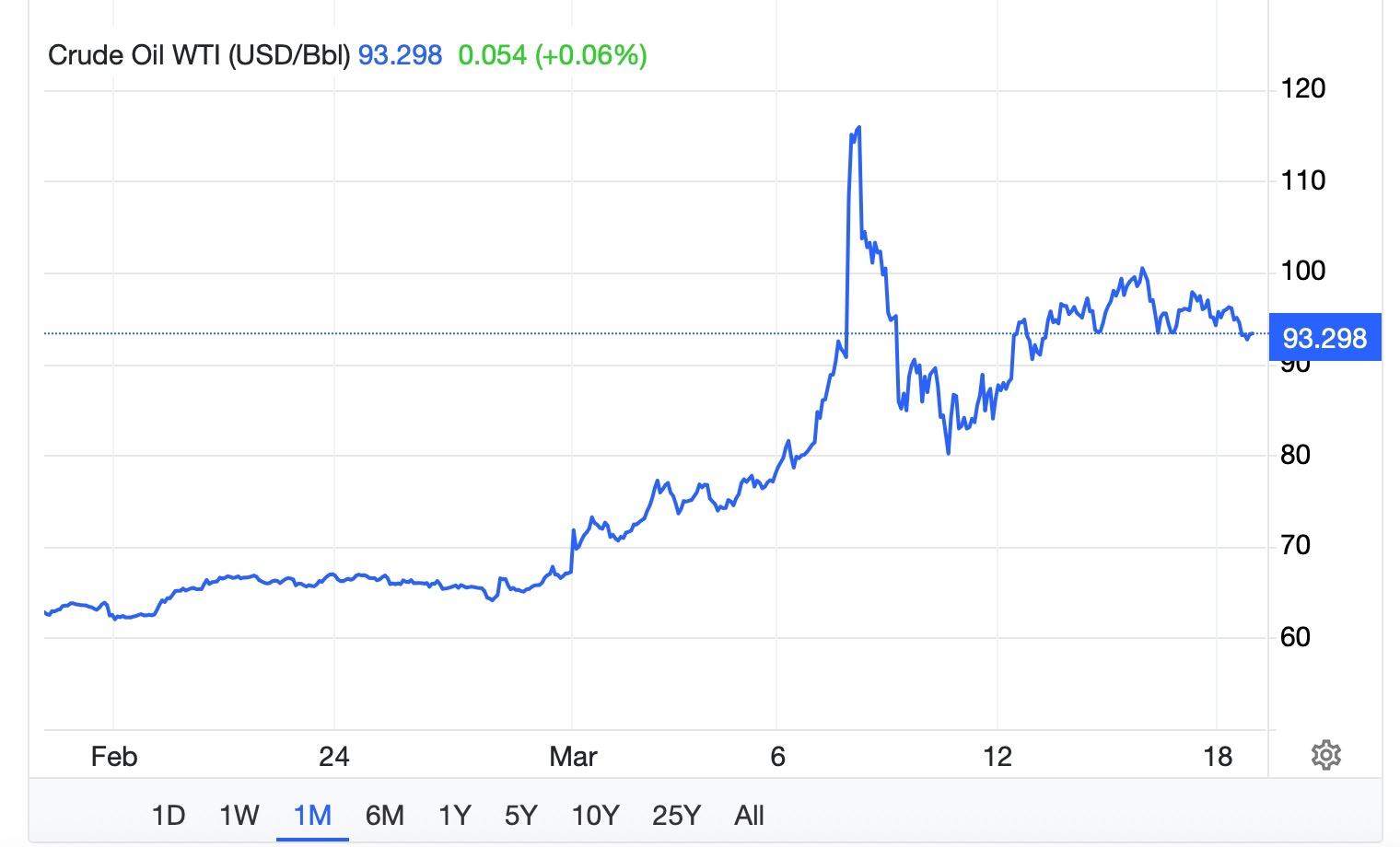
With supply effectively paralyzed, WTI Crude experienced a violent short squeeze, touching $119 per barrel before settling into a highly volatile trading range between $93 and $98.
The Petrodollar and the DXY Wrecking Ball
In a standard economic cycle, a rising U.S. Dollar makes commodities cheaper. But in a war-driven energy crisis, that inverse correlation breaks down. Right now, oil and the dollar are climbing together.
Why? It comes down to the mechanics of the petrodollar and global fear.
Because global oil trades are settled in USD, a massive spike in crude prices means the world suddenly needs a lot more physical dollars to pay for its energy. Furthermore, when bombs are dropping and shipping lanes are blocked, global capital abandons emerging markets and risk-on tech stocks, fleeing into the perceived safety of U.S. Treasuries and cash.
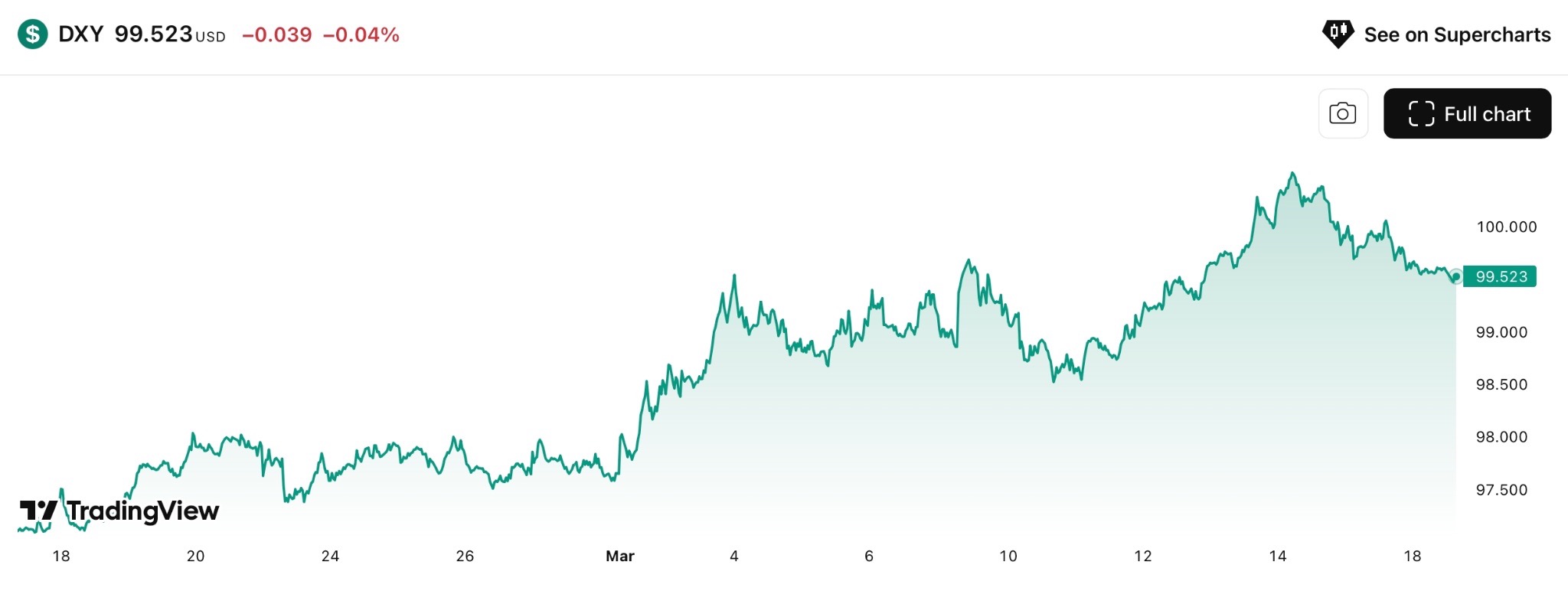
This dual demand has pushed the U.S. Dollar Index (DXY) relentlessly higher, establishing a strong foothold in the 99.5 to 100 range. For Bitcoin, which is priced against the dollar, a surging DXY acts like gravity. It is incredibly difficult for BTC to rally when the denominator in the BTC/USD pair is gaining this much strength.
The Fed’s Dilemma: Higher for Longer
For crypto traders, the ultimate boss battle is global liquidity, which is controlled by the Federal Reserve.
A few months ago, the market was pricing in aggressive interest rate cuts for 2026. That dream is completely dead. Because expensive oil makes manufacturing, shipping, and agriculture more expensive, U.S. inflation is refusing to drop. The February CPI data remained uncomfortably sticky at 2.4%.
Consequently, Wall Street has completely repriced tomorrow’s FOMC meeting as a guaranteed "hawkish hold." The market is now coming to terms with the reality that rate cuts might be pushed all the way back to 2027.
When risk-free interest rates stay high, institutional capital stays parked in government bonds. There is simply no incentive for traditional finance to deploy cheap liquidity into high-beta assets like cryptocurrency.
Trading the Macro Volatility on Tapbit
In an environment dictated by macro shocks, blindly holding spot assets and hoping for a breakout is a dangerous game. You have to adapt to the order flow.
-
Watch the Dollar: Keep a close eye on the DXY. If the Dollar Index breaks cleanly above 100 and holds, expect a wave of selling pressure across major crypto caps.
-
Trade the Range: With macro headwinds capping the upside, Bitcoin and major altcoins will likely chop within defined technical ranges. Use this environment to play the mean-reversion game—shorting resistance and longing solid support floors.
-
Execute on Tapbit: Log in to Tapbit to access our derivatives market. When spot liquidity dries up, utilizing perpetual futures allows you to hedge your long-term bags against sudden geopolitical market dumps.
Frequently Asked Questions (FAQ)
Why does a crypto trader need to care about oil prices?
It is a simple chain reaction. When oil prices spike because of conflict, the cost of moving goods globally goes up, causing inflation. To kill inflation, central banks keep interest rates high. When interest rates are high, borrowing money is expensive, so institutions stop buying high-risk assets like crypto and put their money in safe government bonds instead. Oil goes up, crypto liquidity dries up.
What is the DXY and why does it crash the crypto market?
The DXY is the U.S. Dollar Index—it measures how strong the dollar is compared to other major currencies. Since Bitcoin is priced in dollars, they operate on a seesaw. When global panic hits, investors hoard cash, making the dollar stronger (DXY goes up). A more valuable dollar naturally makes assets priced in that dollar look cheaper on the charts.
Why is the Strait of Hormuz such a big deal for financial markets?
Think of it as the main artery for global energy. About 20% of the world's daily oil supply is shipped through this narrow channel. Right now, military conflict has wiped out 97% of its commercial shipping traffic. That kind of bottleneck threatens to choke the global energy supply, triggering panic buying in oil, severe inflation fears, and massive volatility across both equities and crypto.
Disclaimer: This article is for educational and informational purposes only and does not constitute financial advice. The cryptocurrency market carries extreme volatility and smart contract risks. Always conduct independent research before deploying capital or utilizing automated trading tools.


