

Crypto trading has long forced users to choose between two imperfect models. Centralized exchanges usually offer speed and deep liquidity but require users to trust a third party with their assets. Decentralized exchanges provide self-custody, yet they can struggle with slower execution, fragmented liquidity, and a less familiar experience.
GRVT aims to bridge that gap. Built on ZKsync's zero-knowledge infrastructure, it uses a hybrid exchange model in which traders retain control of their assets while accessing professional tools such as perpetual futures, spot trading, and yield-oriented products. GRVT primarily refers to the platform and protocol; users should verify official information before assuming that any similarly named token is liquid, listed, or suitable for trading.
Readers comparing platforms and market tools can also explore current crypto promotions and account benefits on Tapbit. Product availability varies by region, and this link does not imply that GRVT is listed on Tapbit.
What Is GRVT Crypto?
GRVT is a hybrid cryptocurrency exchange built within the ZKsync ecosystem. Instead of operating as a conventional centralized exchange or a fully on-chain decentralized protocol, it combines off-chain order matching with on-chain settlement secured by zero-knowledge proofs.
The design seeks to deliver centralized exchange-like execution while keeping assets under user control. Traders do not need to rely entirely on an exchange-controlled internal ledger, which can reduce custody and counterparty exposure. At the same time, the off-chain matching layer is intended to support the responsiveness that active retail and institutional traders expect.
How Does GRVT Work?
GRVT separates trade execution from final settlement. Orders are processed through a high-performance off-chain matching engine designed to handle meaningful volume with low latency. Completed trades are then settled through ZKsync, where cryptographic proofs verify transaction validity.
This architecture is designed to provide several practical benefits:
- Users retain control of their assets.
- Order matching can be faster than fully on-chain execution.
- Settlement costs can remain lower than direct Ethereum mainnet transactions.
- Transaction validity can be verified on-chain.
- Counterparty exposure may be reduced compared with fully custodial venues.
The model is still dependent on several moving parts, including the matching engine, smart contracts, ZKsync infrastructure, oracles, and available liquidity. Hybrid does not mean risk-free; it means risk is distributed differently.
Why Is GRVT Built on ZKsync?
ZKsync is an Ethereum Layer 2 network that uses zero-knowledge rollups to process activity more efficiently while relying on Ethereum for security and finality. The approach groups transactions and submits compact cryptographic proofs rather than forcing every action to be executed individually on Ethereum mainnet.
For GRVT, this can mean lower settlement costs, faster confirmations, and enough scalability to support derivatives activity. Zero-knowledge proofs can also limit the amount of unnecessary data disclosed during verification. These advantages are particularly relevant to a platform that wants professional execution without abandoning on-chain settlement.
GRVT Perpetual Futures, Spot Trading, and Yield Products
Perpetual Futures
Perpetual futures allow traders to take leveraged long or short positions without a fixed expiration date. They are among GRVT's central products and can be useful for hedging or directional trading. However, leverage magnifies losses as well as gains. Funding payments, liquidation thresholds, order-book depth, and sudden price gaps all affect the real trading outcome.
Spot Trading
GRVT's spot markets are designed for direct buying and selling of supported assets. The self-custody model means users do not hand over permanent control of funds simply to place an order. Settlement still depends on the platform's contracts and infrastructure, so traders should verify supported assets, withdrawal processes, fees, and market depth before committing capital.
Yield Products
GRVT also aims to provide yield opportunities for otherwise idle assets. Depending on the product, returns may come from lending, market-making, structured strategies, or DeFi integrations. Advertised yield should never be treated as guaranteed. Users should identify the source of returns, lock-up conditions, withdrawal rules, counterparty exposure, and smart contract risk.
GRVT vs Centralized Exchanges and Traditional DEXs
| Feature | GRVT | Centralized Exchange | Traditional DEX |
|---|---|---|---|
| Asset custody | Self-custody oriented | Exchange custody | Self-custody |
| Order matching | Off-chain | Off-chain | Usually on-chain or AMM-based |
| Settlement | On-chain through ZKsync | Internal ledger | On-chain |
| Trading speed | Designed to be high | Generally high | Varies by network |
| Transparency | On-chain settlement visibility | Limited internal visibility | High |
| Main risk | Smart contracts, liquidity, platform execution | Custody and counterparty risk | Smart contracts, slippage, MEV |
GRVT's proposition is not that one model has no weaknesses. It is an attempt to combine the strongest characteristics of centralized and decentralized trading while narrowing their most obvious trade-offs.
Potential Benefits of GRVT
The main potential benefit is a more balanced trading structure. Self-custody can reduce reliance on a centralized balance sheet, while off-chain matching can improve responsiveness. ZKsync may lower settlement costs, and a unified platform for spot, perpetuals, and yield can reduce the need to move assets between unrelated protocols.
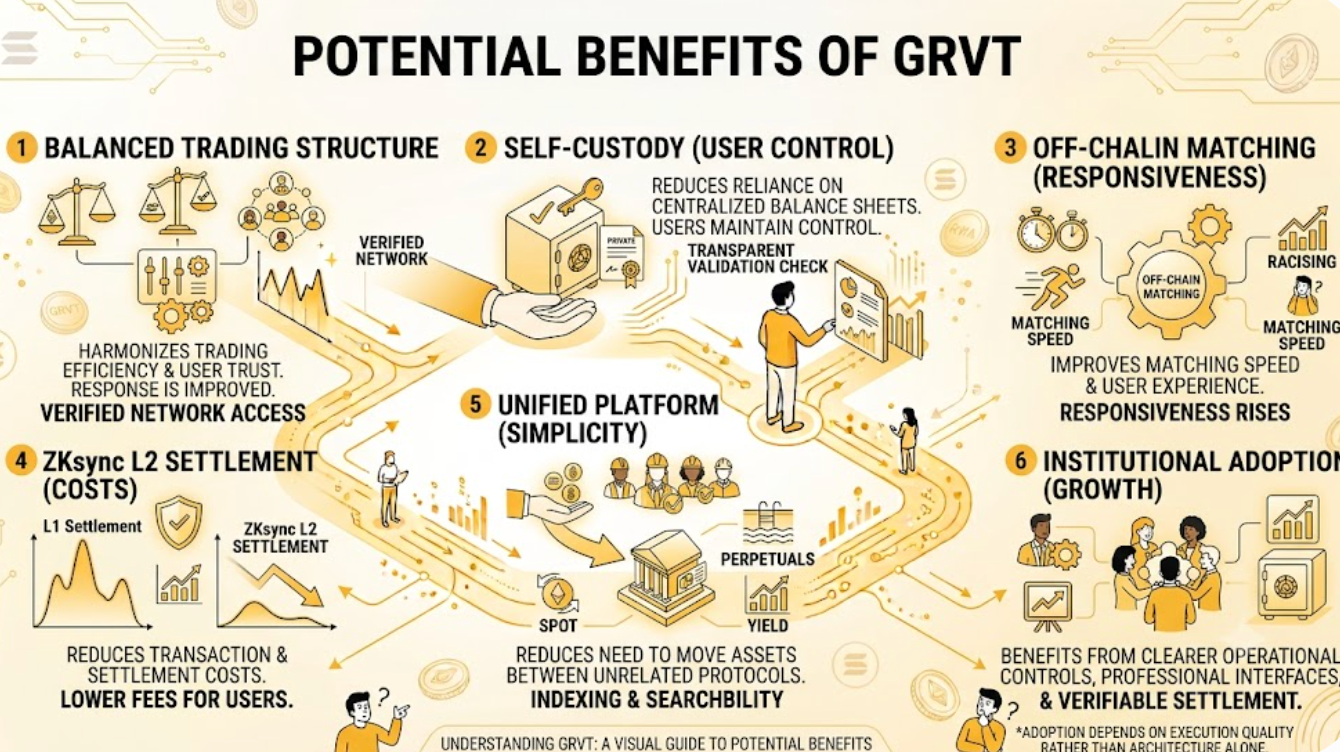
Institutional adoption could also benefit from clearer operational controls, professional interfaces, and verifiable settlement. Still, adoption depends on execution quality rather than architecture alone.
Conclusion: Is GRVT Worth Watching?
GRVT reflects an important trend in crypto infrastructure: combining decentralized ownership with centralized performance. Its ZKsync-based settlement and hybrid execution model could make self-custodial trading more practical for sophisticated users.
Whether GRVT achieves broad adoption will depend on sustained liquidity, security, regulatory execution, product reliability, and transparent communication. It is worth monitoring as a technology and trading platform, but users should evaluate it on verified performance rather than relying only on the hybrid-exchange narrative.
Frequently Asked Questions
What is GRVT crypto?
GRVT is a hybrid crypto exchange built on ZKsync. It combines off-chain order matching with on-chain settlement and offers products such as spot trading, perpetual futures, and yield strategies.
Is GRVT a decentralized exchange?
GRVT is better described as a hybrid exchange. Matching occurs off-chain for speed, while settlement takes place on-chain through ZKsync.
What blockchain does GRVT use?
GRVT uses ZKsync, an Ethereum Layer 2 network based on zero-knowledge rollup technology.
Does GRVT support perpetual futures?
Yes. Perpetual futures are a central GRVT product, allowing leveraged long and short exposure without a fixed expiration date.
Is GRVT safe?
Self-custody and zero-knowledge settlement can reduce some risks, but GRVT still involves smart contract, liquidity, leverage, infrastructure, and user-security risks. No crypto platform is completely risk-free.


