

Is Tapbit safe? Tapbit has several meaningful user-protection measures, including proof of reserves, a stated 50 million USDT insurance fund, two-factor authentication and published withdrawal procedures. Those controls support a positive safety assessment, but no centralized crypto exchange is risk-free. A balanced answer depends on three questions: what regulatory status Tapbit actually holds, whether customer assets are transparently backed, and how withdrawals work when an account or blockchain network is under review.
Tapbit presents itself as a global crypto exchange with spot and derivatives services. Users evaluating the platform should distinguish verifiable operational controls from broad claims such as “regulated” or “fully protected.” If you decide the platform fits your jurisdiction and risk tolerance, you can create a Tapbit account and enable all security settings before depositing funds.
Is Tapbit Regulated?
Tapbit states that its operating entity is registered as a Money Services Business with the U.S. Financial Crimes Enforcement Network, or FinCEN. MSB registration brings Bank Secrecy Act obligations related to anti-money-laundering controls and reporting. Tapbit has also published identification numbers associated with the National Futures Association and Canadian MSB registration.
These labels need careful interpretation. FinCEN explains that MSB registration is not a government endorsement, certification of legitimacy or safety-and-soundness review. It also does not provide federal deposit insurance. Similarly, the NFA warns that an entity can have an NFA ID without being an approved NFA member. Users should search the current FinCEN, NFA BASIC and Canadian FINTRAC records and confirm that the legal name, number, address and status match Tapbit's disclosures.
Regulatory access also varies by location. Tapbit's Terms of Use list restricted territories and allow identity checks or account limitations where required by law. A service being accessible online does not automatically mean every product is authorized in every country.
How Tapbit Protects User Assets
Tapbit's strongest transparency measure is its public proof of reserves page. The exchange states that it maintains at least a 1:1 reserve for user funds and uses Hacken to verify on-chain custodian assets. Proof of reserves can show that identified wallets hold enough assets at a point in time, but users should also consider liabilities, report dates, asset coverage and whether audit updates remain current.
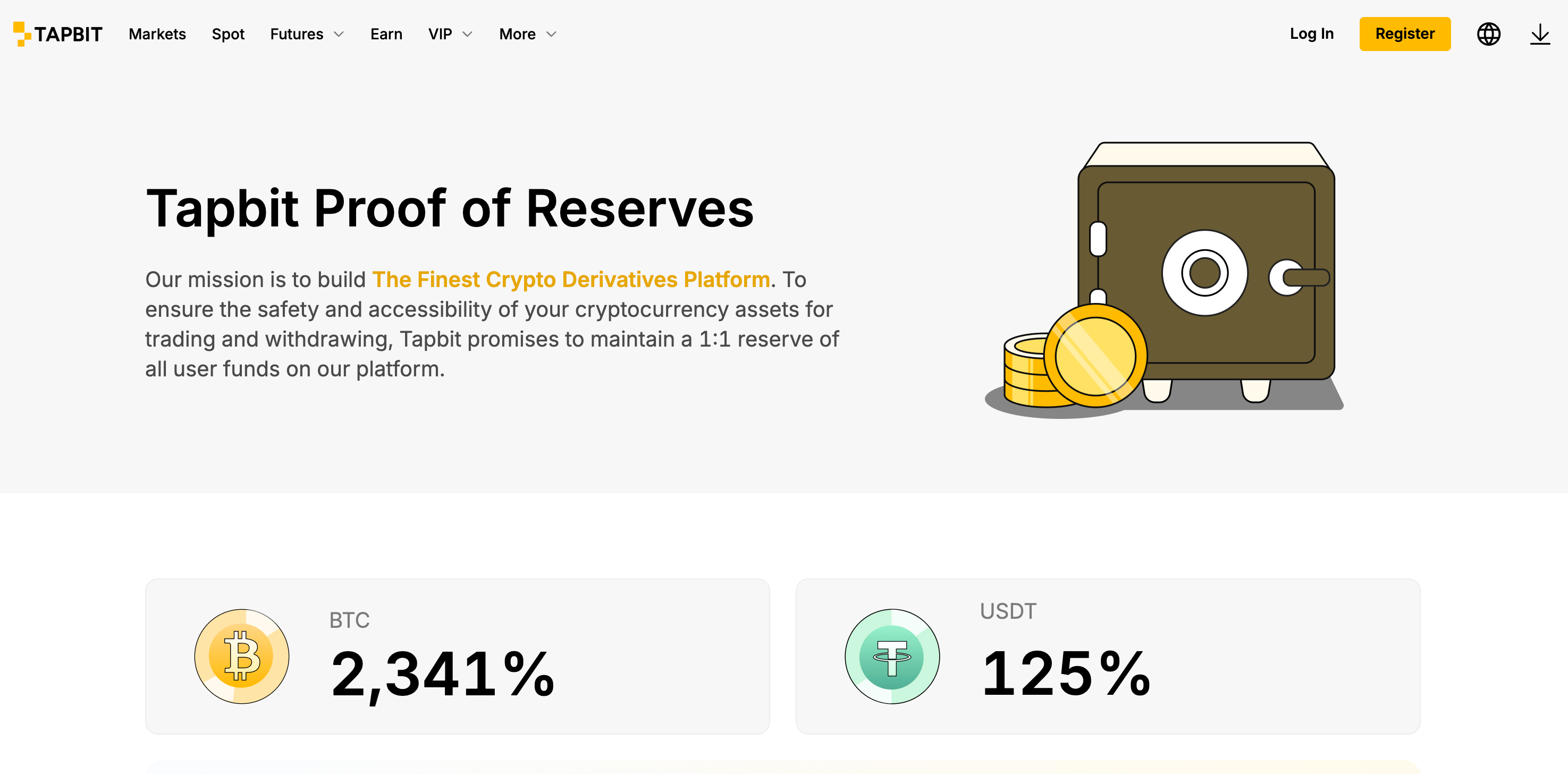
The exchange also advertises a 50 million USDT insurance fund. This should be understood as a platform protection mechanism, not government-backed deposit insurance. The practical value depends on the fund's rules, eligible events, claim process and available balance when an incident occurs.
At the account level, Tapbit supports several controls:
- Google Authenticator or SMS-based two-factor authentication
- Email verification for security alerts and withdrawals
- A separate PIN code
- Device and login-history review
- Cross-device withdrawal verification
These tools are most effective when users choose a unique password, secure their email account, store authenticator recovery details offline and reject requests for passwords or one-time codes. Tapbit has warned about phishing sites that imitate its interface, so users should type the official domain directly instead of following social-media links.
Are Tapbit Withdrawals Reliable?
Tapbit publishes a withdrawal process that separates exchange processing from blockchain confirmation and crediting by the receiving platform. Its FAQ says a transaction ID is normally generated after the platform processes a withdrawal; the remaining time depends on network confirmations and the destination service. If an account record still shows “processing” after six hours, the FAQ advises contacting support.
Published limits distinguish between verified and unverified accounts. Tapbit's withdrawal FAQ currently cites a 24-hour limit of 10 BTC without identity verification and 60 BTC after verification, with higher limits subject to support review. These figures can change, so the withdrawal screen and current account tier should be treated as the final authority.
Withdrawal fees and minimum amounts vary by coin and network. Deposits are generally listed as free, while withdrawal charges reflect network conditions and can be updated. Before confirming a transfer, users should verify the asset, network, destination address, memo or tag, minimum amount and fee shown on the final order page.
Why Can a Tapbit Withdrawal Be Delayed?
A delayed withdrawal does not by itself prove an exchange is insolvent. Common causes include blockchain congestion, wallet maintenance, incomplete identity verification, a new-device security hold, compliance screening or an incorrect destination network. Tapbit's Terms also allow restrictions when an account is suspended, a court order applies, assets are suspected to be fraudulent, or required verification is incomplete.
Users should preserve the withdrawal ID, transaction hash, screenshots and destination address when asking for help. Check the blockchain explorer first: if no transaction hash exists, the transfer may still be inside Tapbit's processing system; if the blockchain confirms it, the receiving platform may need to credit the deposit. Tapbit lists support through its official support center and support email.
How to Use Tapbit More Safely
Exchange safety is partly institutional and partly behavioral. Start with a small deposit and test withdrawal before moving a larger balance. Enable authenticator-based 2FA, email verification and withdrawal protections. Bookmark the official domain, review active devices regularly and never share a verification code with anyone claiming to be support.
Keep only actively traded funds on any centralized exchange. Long-term holdings may be better suited to a wallet whose private keys you control, provided you can manage backups securely. Also review proof-of-reserves updates, terms, fees and regulatory records periodically rather than relying on a one-time review.
Tapbit Safety FAQ
Is Tapbit a regulated exchange?
Tapbit states that it holds MSB-related registrations and publishes identifying numbers. These registrations impose compliance obligations, but they are not the same as bank regulation, government endorsement or deposit insurance. Verify current status in official registries.
Does Tapbit have proof of reserves?
Yes. Tapbit publishes a proof-of-reserves page and states that Hacken independently verifies identified on-chain assets. Users should check the latest report date, scope and liability coverage.
Can I withdraw from Tapbit without KYC?
Tapbit's published FAQ lists a limited withdrawal allowance for accounts without completed identity verification. Requirements may vary by jurisdiction, risk review and account status, so check the live withdrawal page.
How long do Tapbit withdrawals take?
Processing time varies by security checks and network conditions. Tapbit advises contacting support if a withdrawal remains in “processing” for more than six hours.
Is the Tapbit insurance fund the same as deposit insurance?
No. Tapbit's stated 50 million USDT insurance fund is an exchange-managed protection mechanism. It is not government-backed bank deposit insurance, and coverage depends on platform terms.
Conclusion
So, is Tapbit safe? The exchange provides useful safeguards: published proof of reserves, a stated insurance fund, layered account security and documented withdrawal support. Its regulatory registrations add compliance context, but they should be described precisely and independently verified. Users can improve their protection by testing withdrawals, enabling every security control, checking official registries and keeping long-term assets under an appropriate custody plan.


