




If you are trading this Tuesday morning using a 1990s macroeconomic textbook, you are probably getting your account chopped to pieces.
The legacy rulebook is simple: when geopolitical conflict escalates, you sell equities, buy crude oil, and blindly long gold as the ultimate safe haven.
But if you look at the raw tape across global markets right now, that script is completely broken. Over the last 24 hours, the situation in the Middle East has severely deteriorated. With reports indicating that Saudi Arabia and the UAE are opening their airbases to U.S. forces, we are no longer looking at a contained, localized operation. We are looking at a massive, regional coalition war. The Strait of Hormuz is functionally bottlenecked, and Brent crude just violently spiked 4% to test the $104 mark.
European shares are sliding. S&P 500 futures are bleeding. By every historical metric, gold should be printing all-time highs.
Instead, gold is suffering its longest daily losing streak on record, completely collapsing under institutional sell pressure. Meanwhile, Bitcoin—the asset legacy finance dismisses as purely speculative—has shrugged off a weekend slide, bounced 3.1%, and is stubbornly defending the $70,352 level, dragging ETH and SOL up with it.
Why is the 5,000-year-old safe haven in freefall while the volatile digital asset holds the line? Here is the unfiltered breakdown of the market mechanics from the Tapbit derivatives desk.
The Gold Crash is a Margin Call ATM
To understand Bitcoin’s relative strength today, you have to understand exactly why gold is dying.
A safe-haven asset crashing during an active war doesn’t mean investors suddenly hate gold. Markets don’t trade on pure sentiment; they trade on liquidity. Right now, massive multi-strategy hedge funds are watching their equity portfolios and European stock positions go deep underwater.
When prime brokers issue margin calls to cover those bleeding equity positions, funds are forced to raise U.S. Dollars instantly. When you get a margin call, you don’t sell your highly illiquid, losing positions. You sell your most liquid assets to raise cash. Because gold is deeply integrated into the traditional prime brokerage collateral system, it has become Wall Street’s ATM. This unprecedented dump isn’t a fundamental shift in gold’s value; it is a forced, mechanical liquidity flush to prevent total portfolio liquidations.
Why is Bitcoin Defending $70,000?
While gold gets liquidated for USD cash, Bitcoin is acting like an absolute fortress. This divergence is the most disorienting signal in global finance today.
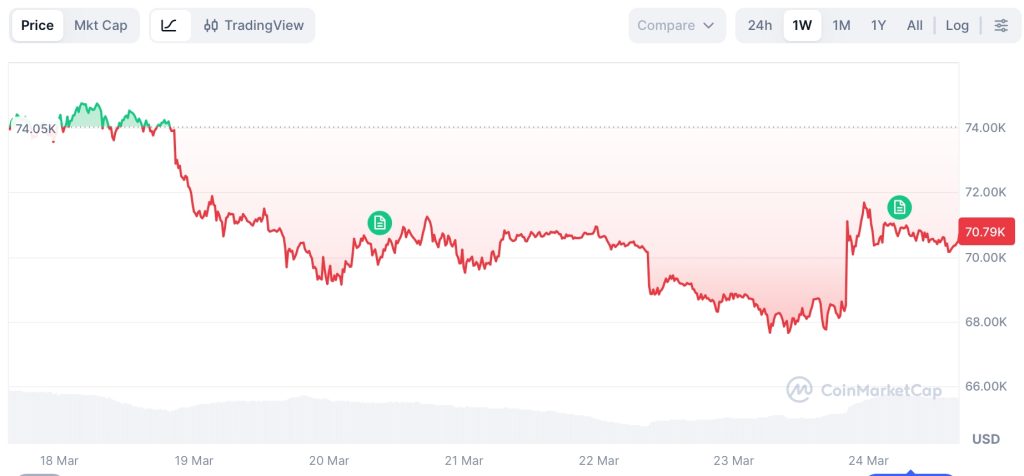
There are two ways we are reading this action on the desk:
1. The Collateral Isolation: Bitcoin and crypto assets are largely siloed from the traditional Wall Street prime brokerage networks. When a macro fund gets a margin call on their S&P 500 longs, their prime broker automatically liquidates their gold or treasuries. They don’t typically have automated cross-margin access to spot Bitcoin to liquidate it. Crypto is surviving simply because it isn’t part of the traditional collateral wrecking ball.
2. The True Digital Gold Test: We might actually be witnessing the real-time activation of the “digital gold” thesis. With the U.S. Dollar strengthening and physical gold proving vulnerable to Wall Street liquidity crunches, capital might be actively rotating into Bitcoin as a non-sovereign, unseizable asset that operates completely outside the legacy banking system.
The Desk Execution Plan
Do not let the green numbers on your crypto terminal make you arrogant. The macro environment is incredibly hostile.
If Brent crude stays above $104, the Federal Reserve’s inflation fight gets infinitely harder. Sticky inflation means interest rates stay higher for longer, which eventually suffocates risk assets.
Furthermore, the five-day window Trump gave Iran expires this Saturday. A regional coalition fighting a direct war puts oil infrastructure on both sides of the Gulf at severe risk.
Here is the playbook for the rest of the week: Crypto is the only market on earth that stays open 24/7. When the traditional equity and commodity markets close on Friday afternoon, they are locked until Monday. That means anykinetic military escalation that happens over the weekend will be priced entirely into Bitcoin’s order book.
Expect violent, erratic liquidity wicks this weekend as the market attempts to price in a war with limited liquidity. Log in to your Tapbit account right now and audit your open positions. If you are trading perpetual futures, tighten your leverage and ensure your hard stop-losses are firmly placed below structural support.
If you want to trade this extreme volatility with institutional-grade matching engines that don’t freeze when the market nukes, register your free Tapbit account here and get your limit orders set up before the weekend chaos begins.
Frequently Asked Questions (FAQ)
If war causes inflation, shouldn’t both Gold and Bitcoin be pumping?
In a vacuum, yes. But markets are currently dealing with an acute liquidity crisis, not just an inflation trade. Institutions are hoarding U.S. Dollars to cover losses elsewhere. When the Dollar Index (DXY) spikes, assets priced in dollars (like gold) get mechanically crushed. Bitcoin is currently outperforming because it has massive native retail and ETF support that isn’t caught up in those specific Wall Street margin calls.
Is this the start of a massive Bitcoin bull run decoupling from traditional finance?
It is too early to call a permanent decoupling. While Bitcoin is showing incredible relative strength at $70,000, it is still operating within a known trading range. For a true decoupling to be confirmed, we need to see BTC break local highs while traditional equities continue to print lower lows. Until then, treat this as range-bound resilience, not a confirmed moonshot.