

Oil’s straight-up panic move finally hit some resistance on Monday.
After surging as high as $119.50 a barrel earlier in the session, Brent crude pulled back as reports emerged that G7 finance ministers would discuss a possible coordinated release of emergency oil reserves. Reuters reported that the talks would involve the International Energy Agency, with at least three G7 countries, including the United States, supporting the idea.
That headline changed the tone fast. For most of the move higher, crude had been trading almost entirely on supply fear. The war involving Iran had already disrupted production and shipping across the Middle East, with Reuters reporting that around 20% of global crude and natural-gas supply had been affected by the conflict. That was enough to send oil more than 25% higher and to push prices to their highest levels since 2022.
What Shifted the Market
The core story did not suddenly disappear. The market is still dealing with a real supply shock, and traders are still pricing in the risk that disruption around the Strait of Hormuz could drag on. But once the market saw that governments might step in with a reserve release, oil stopped behaving like a one-way panic trade.
That is also the same pivot highlighted by CoinDesk. In its March 9 report, the publication noted that crude futures on Hyperliquid dropped from around $114 to $102 after the Financial Times reported the G7 discussion. In other words, traders were no longer just pricing war risk. They were also pricing the chance of coordinated intervention.
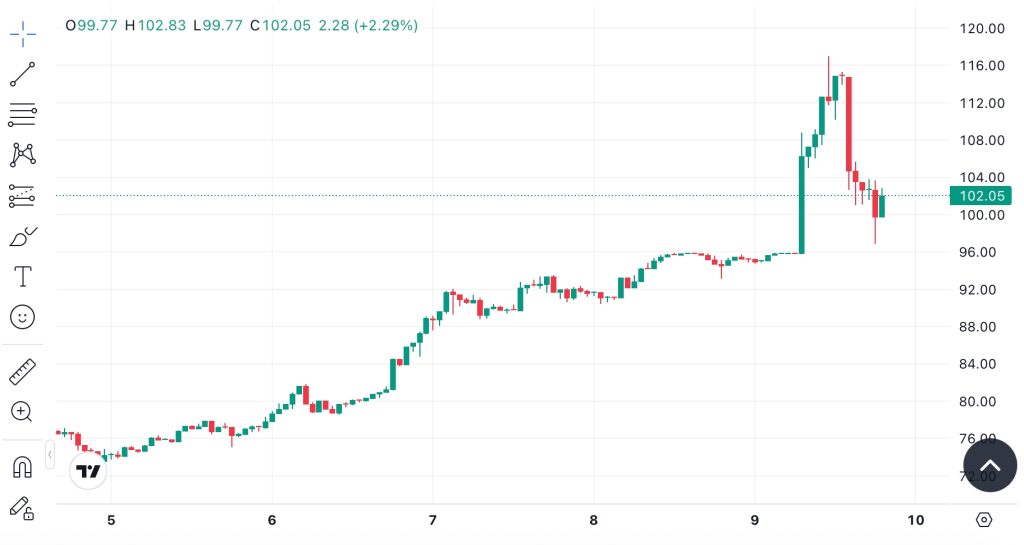
The reversal was visible across broader energy markets too. AP reported that Brent briefly hit $119.50 before sliding back toward $105, while West Texas Intermediate swung from nearly $119.48 to around $102 intraday. That kind of move does not mean the market suddenly thinks the supply problem is solved. It means traders have started asking how much of the spike was pure fear premium and how much can be capped, at least temporarily, by emergency stockpiles.
X Turned Just as Quickly
The reaction on X was almost immediate.
At first, a lot of macro and breaking-news accounts were posting the oil surge as a full-scale energy panic. But once the reserve-release headline started circulating, the conversation changed. Posts surfaced quickly from fast-news accounts flagging that the G7 was preparing to discuss a joint emergency release, including mentions on First Squawk and LiveSquawk, both of which pushed the Financial Times angle into traders’ feeds almost immediately.
That shift mattered because it gave the market a second narrative to trade. Before that, the move was basically “Middle East risk premium goes vertical.” After the headline, it became “how much of that premium survives if governments start leaning against it?”
You could see that change in tone in market-focused X chatter as well. Instead of just talking about oil breaking $115 or $120, more posts started focusing on how quickly crude gave back roughly $15 a barrel once reserve-release talk hit the tape. In a market moving this fast, the speed of the reversal became part of the story.
Why the Pullback Does Not End the Story
None of this means the energy shock is over.
If the conflict keeps widening or if shipping disruptions continue, traders may decide that even a coordinated release is only a short-term patch. Reuters has already reported that governments across Asia are scrambling to limit the fallout, while South Korea is preparing fuel-price caps for the first time in nearly three decades. That tells you policymakers are already treating the spike as something more serious than a temporary headline scare.
At the same time, if the G7 discussions produce a credible plan with IEA backing, the market could keep trimming some of the most aggressive war premium. That would not send oil back to pre-crisis levels overnight, but it could stop the market from pricing the move as a completely unchecked squeeze. Reuters’ reporting suggests that is exactly what officials are trying to prevent.
Why Crypto Traders Are Watching Too
This is not just an oil-market story. It is also a macro story for risk assets.
CoinDesk noted that bitcoin recovered above $67,300 after crude came off its highs, clawing back part of the earlier weakness that followed the oil shock. That does not mean crypto suddenly trades tick-for-tick with crude, but it does show that traders are still treating energy spikes as part of the broader inflation and risk backdrop. Higher oil feeds into rate expectations, growth fears, and the overall mood across markets, and crypto is not isolated from that. :
Bottom Line
The center of this story has not changed: oil surged because the supply shock was real, and it pulled back because the market finally saw a possible policy response.
That is why the G7 discussions matter. They do not erase the war premium, but they do give traders a reason to stop pricing oil like there is no ceiling at all. For now, the market is caught between two live questions: whether the conflict keeps pushing supply risk higher, and whether emergency reserves can keep the first major commodity shock of this war from turning into something even bigger. :contentReference[oaicite:8]{index=8}
For traders tracking macro volatility, commodities, and the knock-on effects across digital assets, broader market moves are worth following on Tapbit. Existing users can access the market through the Tapbit login page, while new users can get started via Tapbit registration.