I really don't want to praise Zuck, but Muse is indeed a smart move
 Tapbit Wire
Authors: DaiDai, Frank, MSX 麦通
In Silicon Valley, whenever Zuckerberg gets ready to preach earnestly about the next generation of technology, Wall Street's first reaction is usually to flip open Meta's capital expenditure table.
From the metaverse to AI, the script has barely changed.
Especially heading into 2026, Meta is on one hand continuing to buy GPUs at scale, build data centers, and poach model and Agent talent, while on the other hand pushing its full-year capex guidance to $130 billion–$145 billion. Once the money is being burned at this scale, the secondary market naturally starts to wonder: how exactly is all this money going to be earned back?
The old standard answer was easy enough — feed the models into the recommendation algorithms, make ads more precisely targeted, and let the massive money-printing machine that is Facebook and Instagram keep getting more efficient.
The problem is, this logic has a ceiling too.
For a giant with annual revenue in the hundreds of billions of dollars, if hundreds of billions in AI investment ends up only making feed ads a bit more accurate and click-through rates a bit higher, then why should the market give you any new valuation imagination?
That's why Muse is a little interesting.
For the first time, it connects Meta's increasingly massive AI investment of the past few years to a product that sits outside advertising, yet is close enough to real consumption and transactions. From model capability, to Agent product, to transactions and commercialization, at least logically, a complete path has begun to emerge.
This is also why I really don't want to praise Zuck, but I have to say it: the move that is Muse was played with extreme shrewdness.
I. Meta's AI is not just a cost center
First, let's look at the recent market action.
From late August to September 21, Meta's stock climbed from over $570 all the way to $741.25, a cumulative gain of nearly 30%, with September 21 alone up 11.34%.
Of course, attributing all of that 30% to Muse would be inaccurate. Meta's rally had already started before Muse's launch; the earlier leg was more about repairing the market's pessimistic expectations around capex, cost growth, and margins.
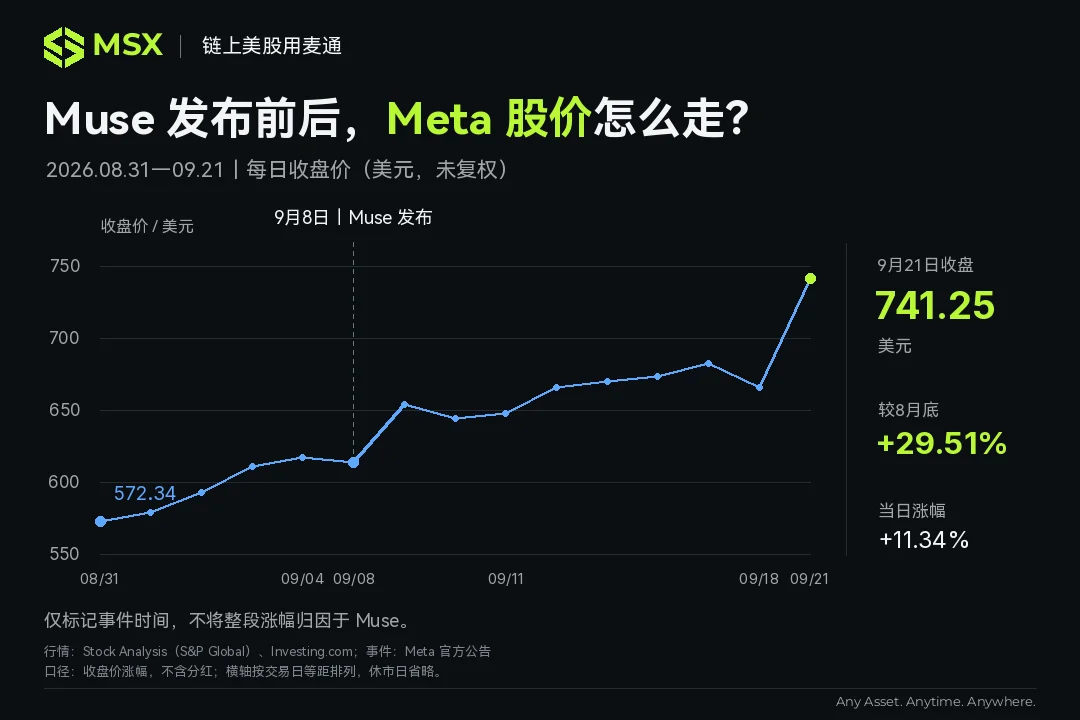
But after Muse went live on September 8, the discussion around Meta AI did start to gain an extra layer: is it possible that this money could actually grow a second growth curve?
That's where the difference lies.
Muse was never built according to the chatbot logic at all. It is a very pure personal AI Agent — once you grant it authorization, it can jump into web pages on its own, call APIs, fill out forms, compare prices across platforms, and even keep running errands for you in the background after you lock your phone. Only when it reaches the point of actually paying or sending a critical email does it pull you back in for confirmation.
In other words, AI in the past was more like answering "what should I do?" What Muse wants to do is take one more step forward — "fine, I'll go do it."
This change may look like merely moving from Chatbot to Agent, but the commercial significance is completely different. After all, once AI can take over actions, it naturally cuts into the entry points closest to money: search, shopping, booking, and payment.
And it is precisely here that Meta truly deserves to be revalued.
It doesn't necessarily need to make Muse the No. 1 model on every benchmark in the world. For the vast majority of ordinary users, they don't care whether a model scores two points higher or three points lower; they only care whether, after handing something over to it, it can actually get it done.
This echoes the judgment we made about Google a couple of days ago: when the capability gap between underlying models begins to narrow, the companies that truly own the entry points, product ecosystems, and distribution capabilities are the ones more likely to reap the dividends in the second half of AI (further reading: "Gemini 4.0 is so strong it's 'flooding the feed' — is Google's AI counterattack here?").

From this angle, Muse is not Meta re-entering the exam of "whose large model is the strongest." It simply switched exam rooms: when the underlying model capability is basically sufficient, I'll be the first to quietly slip an Agent into the daily lives of my billions-strong user pool.
And in this exam room, the hand Meta is holding starts to look very different.
II. Intent and interception: why is Amazon on guard while Shopify embraces it?
To do this, Meta holds a trump card that others can only envy — native distribution.
AI startups worry every day about customer acquisition costs, while Meta sits on Facebook, Instagram, WhatsApp, Messenger, plus the smart glasses it's still pushing forward. Billions of people are already immersed in its products.
But if it were just "lots of people," that still wouldn't explain Muse's value.
What's truly interesting is that it has the chance to push what Meta originally controlled from "Attention" further down to "Intent."
For example, in the past, when we watched a video about a soy milk maker on Instagram and lingered a few extra seconds, the algorithm might judge that you've recently become interested in small kitchen appliances, and then push you a few more related ads — and Meta earned the exposure fee.
But if you actually wanted to buy one, you'd most likely close Instagram, open Amazon/Temu, search, compare prices, read reviews, and place the order.
That is to say, Meta holds "what you might like," but the actual consumption decision and transaction still happen on someone else's turf.
Muse, however, could completely restructure this path — we just directly tell Muse: "Find a soy milk maker under $100, easy to clean, suitable for a couple." The subsequent filtering, comparison, confirmation, and payment all run through the Agent's channel.
Attention and purchase intent may look like they're only one step apart, but in the business world, that one step is worth a lot of money.

Once you understand this, you can understand why the major players' attitudes toward Muse are polar opposites.
Amazon is on high alert, quickly restricting Muse from placing orders on behalf of customers, trotting out reasons that amount to authorization compliance and privacy security. Shopify, on the other hand, is giving it the green light, eager to embed Shop Pay directly into Muse's transaction flow.
It's purely a matter of whose interests are at stake:
Amazon is itself a closed hub of search and transactions. Its most valuable asset isn't cloud services, but the moment a consumer decides to buy something — that moment must involve opening Amazon. If everyone in the future buys things with a single sentence to an external Agent, Amazon will be forced into becoming a pure backend shelf, and the on-site search bidding and advertising system it painstakingly built will have its ladder pulled out from under it;
Shopify, by contrast, has always been a water seller. Whether an order comes from Instagram, is searched up on Google, or drops out of an Agent like Muse, as long as it ultimately settles through its payment system and flows through its merchant channel, it can steadily take its cut;
This is the most realistic power restructuring of the Agent era: whoever is closest to the user's final decision holds the "Strait of Hormuz" of the e-commerce landscape.
Of course, we shouldn't be blindly optimistic here either. There are plenty of people scrolling IG, but those willing to entrust their email passwords, calendar permissions, and credit card numbers/CVV security codes to an AI are still a minority at this stage.
After all, if GPT or Gemini answers wrong once, you just chalk it up to AI having another glitch. But if an Agent buys the wrong quantity when placing an order for you, books the wrong hotel, or sends an email that shouldn't have been sent, the user's trust in it could vanish in a single incident.
So if Meta wants to eat the fattest cut of "intent," it first has to solve a very plain problem: do people dare to actually hand things over to it?
III. Subscriptions are just small money; the real business is in transactions
Talking to the end, we still have to do the math: how does Muse help Zuck recoup his investment?
The easiest thing to understand right now is the subscription fee. Muse offers a free version, as well as paid tiers of $20 and $100 per month. Suppose it really reaches 10 million users paying $20 a month long-term, that's $2.4 billion in annual revenue.
For the vast majority of software companies, that would already be a very big business, but for Meta it doesn't even come close to quenching the thirst.
Keep in mind that Meta's Q2 revenue this year alone hit $60.8 billion, with advertising alone accounting for $59.3 billion. Relying on selling memberships alone simply cannot fill that enormous hardware black hole.

So in the view of the MSX Research Institute, subscriptions are not the most important part of Muse to watch. What truly has imagination is the transaction commission — that's the main course.
If an Agent becomes the digital butler of hundreds of millions of people, the gross merchandise volume (GMV) it leverages would theoretically far exceed its own membership fees. At that point, the space for commercialization opens up completely: commissions on transaction matching, referral fees for merchants who want to rank at the top of recommendations, revenue sharing on payment channels...
In the past, merchants advertising on Meta were paying for an exposure probability of "you might buy." But a future Agent holds in its hands the certainty of an order where "the user is already ready to pay." Would merchants be willing to pay a commission to close the deal? Would payment companies be willing to share revenue for Agent Checkout? Would merchants be willing to buy some kind of commercial service to become a priority option?
These are the places more worth imagining.
However, this also plants a landmine for Meta.
The reason people use your Agent is that they believe it stands on their side, a "silly girl assistant" that helps maximize their interests. But if one day Muse frantically recommends a certain hotel, and people discover it's not because that hotel is suitable but because it gives Meta the highest kickback, then the trust foundation of this product collapses on the spot.
So for Meta, the deeper its commercialization goes into the transaction end, the more it has to handle a contradiction: how to make money from user intent without making users feel their intent has been sold.
This is also why Meta must repeatedly emphasize that Muse's private conversations and secure sandbox (Secure VM) will not be directly connected to the advertising system — it must independently establish a new fee-and-credit system outside of advertising.
The reason this matters so much ultimately comes back to Meta's increasingly outrageous AI bill. Revenue grew 28%, but total costs and expenses surged 55%, and operating margin was hammered directly from 43% down to 31%. Quarterly operating cash flow was $31.8 billion, while capex plus lease principal ate up over $31 billion, squeezing free cash flow into an extremely narrow range of $784 million.
Although there are one-time charges mixed in, one fact is already very clear: Meta is reinvesting cash back into AI infrastructure at an unprecedented speed.
If all these GPUs burned through end up only adding a few more clicks to feed ads, then at best it's patching up the existing business, and it can't support the next round of valuation restructuring.
But if Muse really tears open a transaction entry point led by Agents, then the story Meta tells in the eyes of the capital market could use AI to build a new entry point, completely transforming from "an advertising middleman frantically buying shovels" into "the dispatch console of the next-generation internet life."
These are two entirely different valuation models.
In closing
I have to admit that for Meta, Muse has begun to connect the increasingly frightening AI bills of the past few years to a sufficiently concrete commercial path.
What Meta owned in the past was the world's largest attention machine; what Muse wants to do is keep moving down the line of attention — from knowing what you like, to understanding what you truly want, to getting things done for you.
If this chain really works end to end, what Meta gets may not just be a ChatGPT competitor, but a new layer of internet entry point.
Of course, the stock has already risen to over $700, and the market has given it plenty of applause in advance.
Wins and losses on the model leaderboards may soon pass, but how this bill gets recouped is what META is truly worth trading on in the next phase.