A Conversation with Robinhood SVP Johann Kerbrat: Not Competing on Public Chains, Building the Next Generation of Finance from DeFi to AI Agents
 Tapbit Wire
Interview: Tong, Tapbit news
No one expected that Robinhood Chain, with its traditional finance DNA, could become a dark horse in the L2 space in such a short time, even steamrolling a host of competitors. However, as market enthusiasm has cooled recently, this emerging public chain has begun to face a liquidity test—especially with the Meme coin sector visibly cooling down—raising questions about whether the on-chain ecosystem can sustain its growth.
At the same time, at the recent HOOD Summit 2026, Robinhood unveiled a slew of new products spanning AI, perpetual contracts, and weekend trading, further signaling its intent to expand the boundaries of its crypto business.
During TOKEN2049 Singapore, Tapbit news interviewed Johann Kerbrat, Robinhood's Senior Vice President and General Manager of Crypto, covering Robinhood Chain's strategic positioning and market competition, international expansion, and the convergence of AI and the crypto industry.
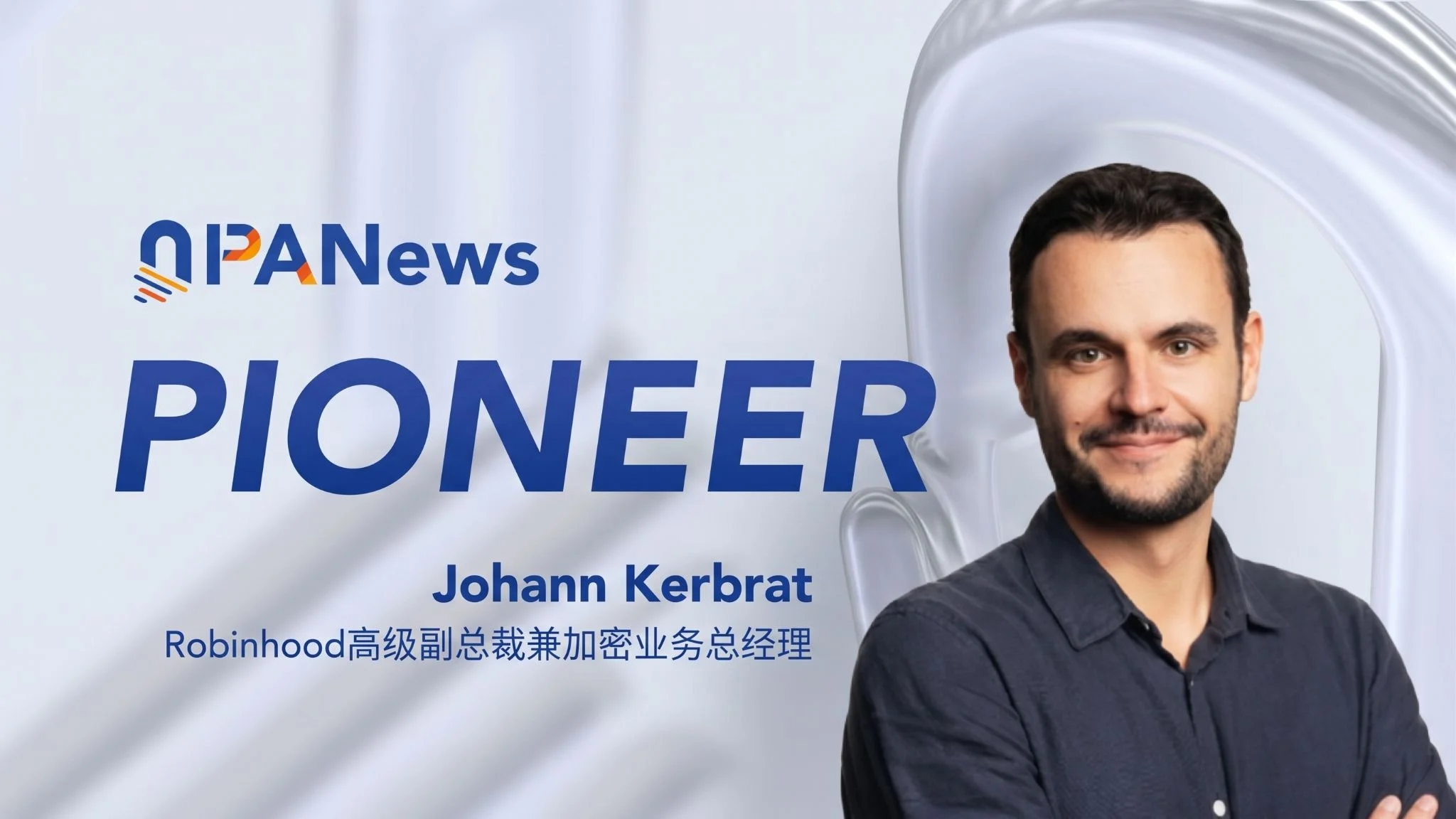
In his view, Robinhood Chain is not just an independent blockchain, but an important piece of infrastructure for Robinhood's future financial services, allowing users to enjoy the benefits of DeFi even through centralized applications. Rather than competing for market share among public chains, Robinhood hopes to use blockchain to lower the cost of financial services, drive asset tokenization, and attract more traditional finance users into the crypto world. And as AI Agents gradually gain capabilities such as trade execution, wallet operations, and portfolio management, blockchain is also poised to become an important underlying infrastructure for automated financial activity.
The following is the interview:
Bringing Crypto into Everyday Life, Expanding Globally Through Blockchain
Tapbit news: Johann, thank you so much for joining us today. It's a pleasure to have you. Today we'll focus on Robinhood Crypto, Robinhood Chain, and your vision for the global financial market. Let's start with the first question.
Johann Kerbrat: Glad to be here.
Tapbit news: Before joining Robinhood, you had already spent many years in the crypto industry and even worked as a Bitcoin miner. What initially drew you into this space? Which early experiences still influence the way you build products today?
Johann Kerbrat: For me personally, the idea of decentralization is very appealing. I believe that people's financial activities, and the way they buy and transfer assets, should not be controlled by any single entity. That's what attracts me most about crypto technology.
But I also noticed that, for a long time, crypto products were mainly built by technical people for technical people, which left many users excluded—they needed a lower barrier to entry.
When I joined Robinhood, I was very excited about making crypto technology more accessible and letting people actually use it in their daily lives.
Tapbit news: You currently oversee both Robinhood's crypto business and its international business. How do these two parts work together in day-to-day operations? Are there differences in their priorities?
Johann Kerbrat: I think leveraging blockchain technology is an important way for us to expand internationally. For example, tokenized stocks are a great entry point that can help us expand our market and reach more users. Robinhood has already launched stock tokens in more than 120 countries and regions, and users can access these assets through Robinhood Wallet as well as other wallets connected to Robinhood Chain. I think this is one of the major advances we've made in international expansion.
Our user base is inherently global, so we don't focus only on the U.S. market. Since then, we've expanded our business to more regions, including launching crypto and brokerage services in the UK, running crypto operations in the EU, and planning to further expand into markets like Singapore in the future. This requires a lot of work, but we're excited to keep expanding the reach of our products.
Bringing DeFi to Mainstream Users, Robinhood Chain to Become New Financial Infrastructure
Tapbit news: Robinhood Chain now seems to have become the core of Robinhood's crypto business. What is your strategic positioning for this chain? Is it just one product within a broader crypto and international business strategy, or is it the center of the entire strategy?
Johann Kerbrat: I think Robinhood Chain means much more than that. It will become the underlying infrastructure for many new financial services, allowing us to bring the benefits of DeFi to customers who use financial services through centralized applications.
A great example is the Robinhood Earn product, which can offer users roughly 7% yield on their cash. Specifically, we convert users' cash into stablecoins, create smart wallets, and then deposit the funds into a lending protocol on the platform.
We think it's very important to bring these two worlds together. Because blockchain can bring a lot of innovation and enable 24/7 instant settlement. By adopting a more modern, blockchain-based technical architecture, we can also significantly reduce costs for our customers.
In the future, you'll see more and more services like this appear on the Robinhood platform. As long as blockchain can create value for customers, we'll consider integrating it.
Tapbit news: Since Robinhood Chain launched, it has gained increasing popularity and attracted considerable attention in the Chinese community. Are there any community data points or user behaviors that surprised you?
Johann Kerbrat: What makes us happy is that the community is actively building various applications on this chain. Our goal isn't just to launch our own products, but to build an ecosystem where developers can freely build and develop new applications.
We've also turned stock tokens into a foundational component, allowing developers to build composable innovations on top of it and create new types of applications that even we hadn't thought of before.
That's one of the most interesting parts of the whole process. Every morning, I check my X (Twitter) account to see what new projects have been deployed on the chain. We see community members from different regions actively participating, and we've met many people who proactively talk to me about Robinhood Chain. Seeing this momentum, we're very excited.
Expanding Crypto Users Is the Top Priority, Not Pursuing Independence for Now
Tapbit news: However, on-chain activity seems to have cooled recently, especially Meme coin-related activity. What measures will you take in the future to attract developers and users to keep building on this chain?
Johann Kerbrat: I think we're still at a very early stage. In a few days, the chain will have been live for 100 days (note: it had already passed 100 days at the time of publication), so the journey has only just begun.
Right now, we haven't completed all the planned integrations. For example, we plan to further connect with Robinhood's main app, which has about 27.9 million funded accounts. In addition, there are many products under development on Robinhood Wallet, which is the primary wallet for Robinhood Chain. At the same time, we're also in talks with various service providers.
So we think we're still at a very early stage, and there's a lot more to do in the future. We won't worry too much about day-to-day trading volume fluctuations; instead, we're more focused on the next five to ten years: how Robinhood Chain gradually becomes the underlying infrastructure for many of our financial systems.
Tapbit news: I'm curious—which blockchains do you view as competitors to Robinhood Chain? For example, Solana, BNB Chain, Base, or do you hope to develop it into a relatively independent ecosystem?
Johann Kerbrat: Frankly, we haven't paid much attention to competing for market share among different blockchains.
I think the number of people who actually use blockchain technology is still a very small fraction of the global population. So we're more focused on how to bring more users into the blockchain world and get them using tokenized assets, rather than fighting for market share from other blockchains like Base.
In the long run, we believe users will increasingly use blockchains, because different blockchains may specialize in specific areas of financial services. What the industry needs to do is ensure that users can easily switch between different blockchains. That's why Robinhood Wallet doesn't only support Robinhood Chain—it also supports many of the other blockchains you just mentioned.
Overall, we want more users to be able to use our services.
Tapbit news: Robinhood Chain is currently deployed within the Arbitrum ecosystem. In the future, will you consider making it more independent?
Johann Kerbrat: I think we always have the option to become more independent, but it mainly depends on how we allocate resources.
Right now, we're more interested in introducing new foundational components to the blockchain, such as the stock tokens mentioned earlier, and using them to drive industry innovation.
On the blockchain technology side, we're also quite satisfied with the current performance. One of our goals is to achieve very low latency, such as sub-microsecond block times. These performance metrics are very important for building a truly effective financial system.
But we don't think we need to invest resources right now to build decentralization and security mechanisms from scratch, because we can benefit from Ethereum Layer 1 and the tech stack built on the Arbitrum Stack. I think this is a great approach: we can focus on what we do best—building new financial systems—while leveraging the advantages of existing blockchain architecture.
Blockchain itself is permissionless. If we want to become more independent in the future, we certainly can. But for now, our product roadmap is already full, and there are many new products that need our attention.
Bringing New Users to Blockchain, Robinhood Accelerates Multi-Front Crypto Expansion
Tapbit news: How much of the crypto activity on Robinhood Chain comes from Robinhood's existing traditional finance users, and how much from native crypto users?
Johann Kerbrat: This question is hard to answer precisely, because we don't specifically track the source of these on-chain activities, nor do we determine whether each activity is associated with a particular customer.
That said, I expect that we still see quite a few crypto-native users participating in trading, such as some Meme coins launched on the trading platform. As for the Earn product, it's open to all customers on our platform.
So we do see quite a few new users starting to engage with blockchain, some of whom may be touching blockchain technology for the first time. I think that's one of the most exciting things right now.
Tapbit news: In other words, you're bringing quite a few new users to blockchain. Looking ahead to the next quarter and the coming year, what will be the next major growth focus for Robinhood Crypto? U.S. perpetual contracts, tokenized assets, Robinhood Chain, or international expansion?
Johann Kerbrat: I think all of these will be our focus. We just launched our U.S. perpetual contracts product last week, and we're gradually opening it up to more customers—we're very excited about it. The product uses the crypto exchange Bitstamp (owned by Robinhood) on the backend. We believe that consolidating global liquidity is crucial to building a great perpetual contracts product.
As for tokenized assets, as I mentioned earlier, we're just getting started. We've already launched tokens for 190 U.S. stocks and ETFs, but in the future we hope to expand the range of assets to more types. This includes not only U.S. assets, but also assets from other exchanges around the world, as well as assets like private equity.
On international expansion, we're also actively pushing forward. Recently, we just launched crypto asset trading services in Canada.
We believe there are many more products and services that can be brought to the platform over time.
The Convergence of AI Agents and Crypto, More Opportunities Ahead for Automated Finance
Tapbit news: At the end of September, at the HOOD Summit, Robinhood announced the launch of several new products, including AI Agents. How do you think AI will shape the future of the crypto industry?
Johann Kerbrat: I think there are many intersections between AI and crypto technology. Creating wallets through software, transferring assets, and buying and selling various assets—these operations are all very well suited to automation, and AI Agents are very good at executing such tasks.
We're making sure that the various Agent systems we launch are compatible with different types of trading, including stocks, options, and crypto assets. We're also providing a variety of skills and tool support for the blockchain, so that AI Agents can easily interact with it.
I think there's still a lot of room to explore in this direction. As the world increasingly moves toward a digital financial system that operates around the clock, having AI Agents continuously monitor portfolios and investment positions on behalf of users will become increasingly important.
Looking Forward to Hearing from the Chinese Community, Welcoming Community Participation
Tapbit news: For the Chinese community, if they want to get involved with Robinhood Chain, what would you like to say to them, or what advice do you have?
Johann Kerbrat: We very much hope to hear from the Chinese community.
We're building more tools and have been talking with customers to understand which features work well, where there are still shortcomings, and what users want to see on this chain.
So please actively give us feedback and clearly tell us what's missing, what's worth building, and where we should focus next. We hope this chain becomes easier and easier to use, and that it can better serve different communities.
Tapbit news: There are also many developers in China. I'm not sure whether you've already established connections with the Chinese developer community?
Johann Kerbrat: There are certainly already some developers involved, although I haven't specifically confirmed the details. But we do want this chain to be open to all developers and communities, so that anyone can build applications on it.