A Conversation with Justin Sun: In the Golden Age of AI, How Should Ordinary People Place Their Bets?
 Tapbit Wire
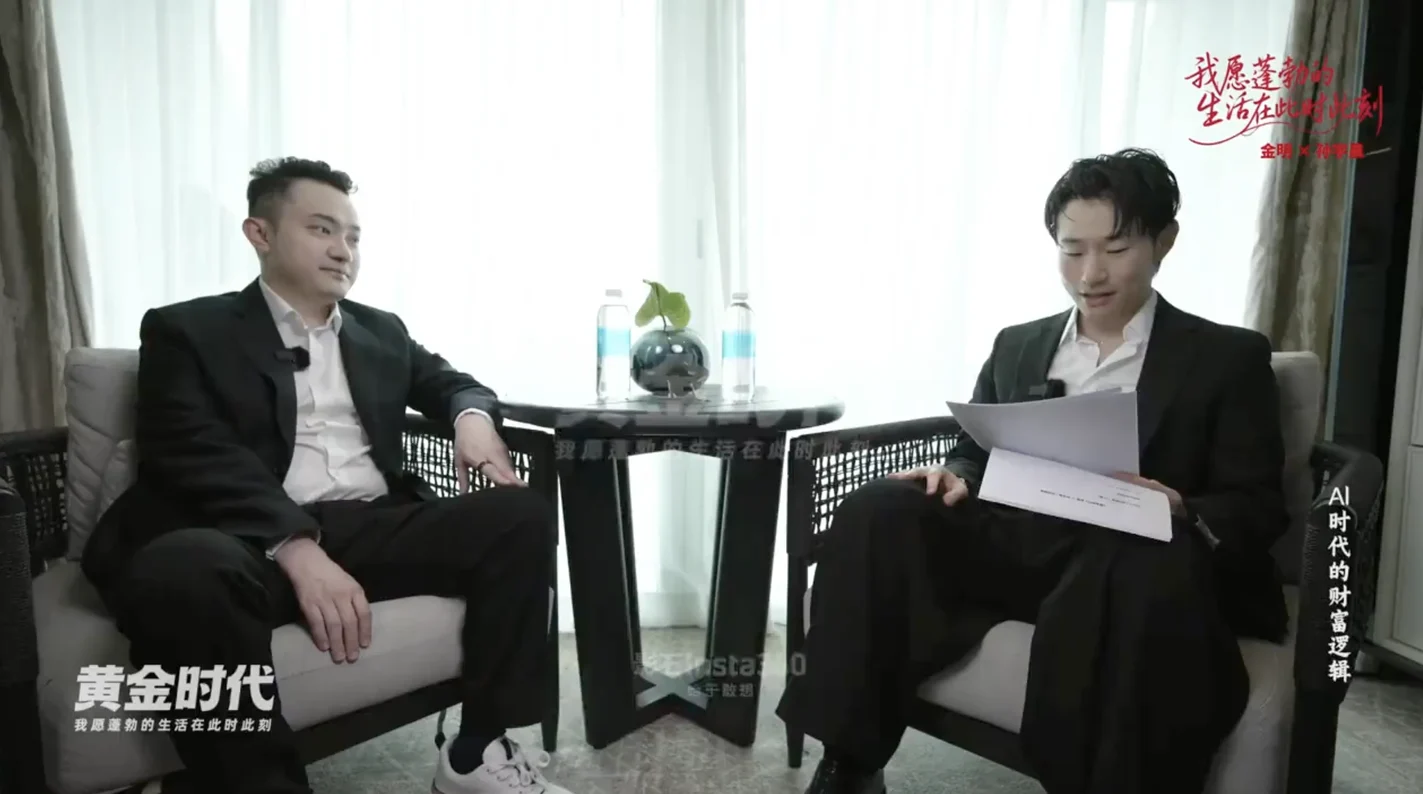
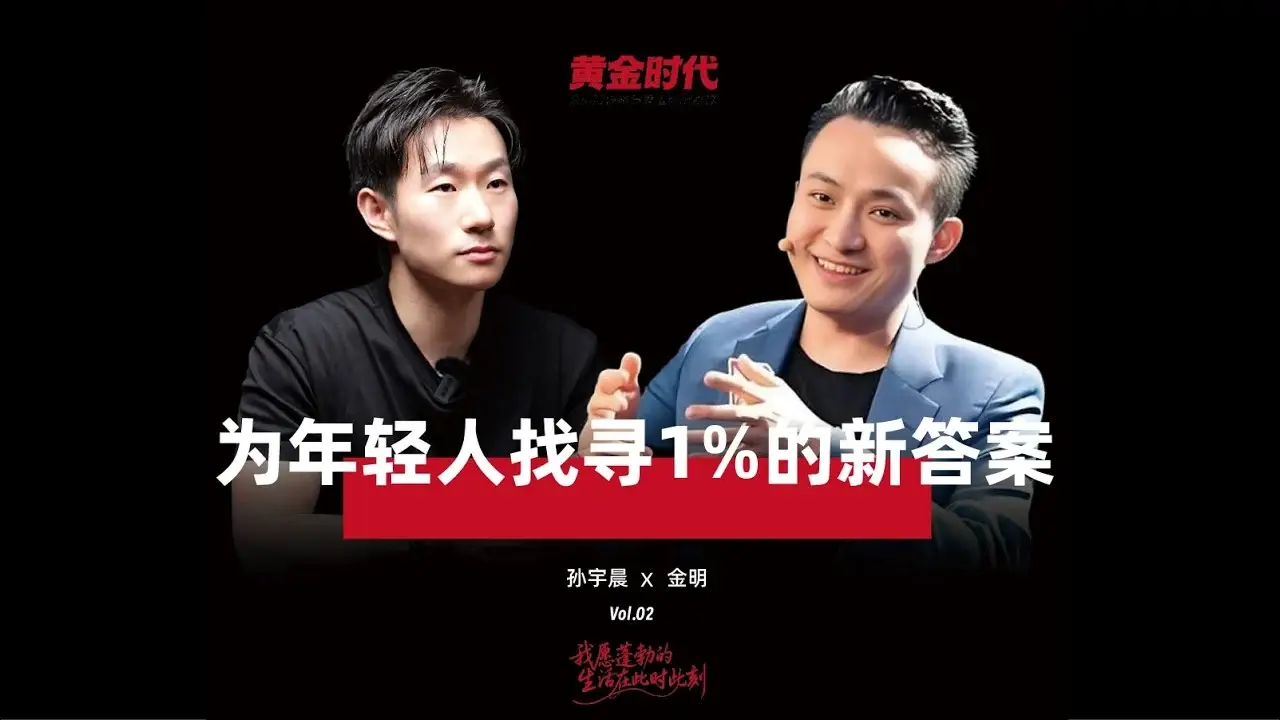
Guest: Justin Sun (Founder of TRON, Global Advisor of HTX)
Host: William Joy / Guest Host
This article is compiled from a conversation between Jin Ming and Justin Sun on the program The Golden Age, and is republished with authorization. The original program was supported by Insta360 as brand sponsor. For the full conversation and program introduction, please refer to the original program link. (Related reading: A Conversation between Shao Allen and Justin Sun: How Can Young People Seize the Opportunities of the AI Era?)
Introduction
Justin Sun's first offline, no-holds-barred conversation in nearly three years, lasting 3.5 hours. It has been exactly two years since their last long conversation in Singapore.
· One is the world's richest post-90s entrepreneur, who appeared on the cover of Forbes with a net worth of $8.5 billion — founder of Tron and "Sunology," the man who paid $4.56 million for a Buffett lunch, $100 million to buy Trump, and $6 million to buy a banana 🍌 — perhaps the most money-savvy and also the most "criticized" Chinese entrepreneur of this era.
· The other is Jin Ming, the only active national-team world champion athlete among Chinese entrepreneur-investors — China's No. 1 breath-holder at 9 minutes 08 seconds, holder of 59 national records, twice breaker of the world record in freediving, who by age 27 had completed 1 billion yuan in financing including from Alibaba, and who is the longest-holding Chinese IPO shareholder of Tesla with a return of 5900%.
· One was born in 1990, the other in 1993. The two are also classmates at Hupan University. Justin Sun is three cohorts ahead of Jin Ming, yet is the only controversial entrepreneur in all of Hupan to use "MY apprentice."
· This time, after Jin Ming participated in Coinbase's global trading competition in Singapore and won third place globally and first place in Asia, he and Justin Sun conducted a 3.5-hour closed-door recording — the latter's first in-person one-on-one recording in nearly three years.
· By the end of the conversation, the most striking thing was not how Justin Sun makes money, but his extreme inner fear:
▪️ The physical body is the ultimate trump card: he can fend off hackers, but what he fears most is "the assets are there, but the body is ruined."
▪️ The cold-blooded exit algorithm: big money never falls in love with its chips.
▪️ A direct response to the JT controversy: for the first time since it happened, he reviews his PR calculations and real response on camera.
· Two people who push limits to the extreme in their respective fields spar behind closed doors. The Golden Age, Season 2 — no chicken soup for the young people of this era, just a clear look at real, living people.
· The original intention of The Golden Age is to use society's most extreme cognition to give today's confused young people some inspiration. About the future, we do not presuppose a stance; we only light a spark of inspiration. ·
The main text is as follows:
The Latest Judgment on BTC: AI Algorithm Evolution and the Quantum-Resistant (QD) Crisis
Host: The last time we met, you mentioned that because of miner selling pressure, BTC was not as heavily weighted in your personal participation as DeFi and Ethereum. Two years have passed — has your view on BTC changed? Are you more bullish on BTC now?
Justin Sun: If you ask me personally, my current thinking is somewhat more bearish. The reason is very simple: the issue of AI algorithms and QD (quantum computing). I think it is very hard for BTC to come out of this unscathed. And I believe the vast majority of people in the industry underestimate the impact this will have on BTC.
Because BTC is now a fairly mature ETF product. You see many people at BlackRock and elsewhere who hold large amounts of BTC while completely not understanding BTC — they actually don't understand what QD means, so the market currently does not have reasonable pricing. Including these past few days, people have been discussing the progress OpenAI has made in mathematics. It may not even require waiting for QD — through classical decryption computing and AI algorithms, it is possible to crack unprotected early wallets or private keys within 1 to 1.5 years.
Right now, a large number of exchange hot wallets still lack basic quantum-resistant protection, which is indeed quite dangerous.
The Massive Selling Pressure of 2 Million BTC and Global Cryptographic Security
Host: To deal with this crisis, how do you view the market's and community's preventive mechanisms?
Justin Sun: BTC can only help people who are "willing to help themselves." For example, BTC could introduce a quantum-resistant address type, and people could transfer their funds over. But addresses like Satoshi Nakamoto's (about 1 million BTC) or the large number of historically lost-private-key addresses (such as someone's lost 5,000 BTC) — no one has the private key to actively move them.
Once QD or AI decryption arrives, these dormant assets will be breached, and in the worst case, the market could see massive selling pressure of more than 2 million BTC. Given BTC's extremely high degree of decentralization, it is extremely difficult for the community and miners to reach consensus to freeze, confiscate, or restrict circulation through a hard fork.
Host: Is this only a cryptocurrency problem, or a systemic problem?
Justin Sun: This is by no means only a problem for the crypto space — it is a challenge facing the entire internet and financial system. The SSL certificates people rely on today to access Google, and the mathematical foundations of all equity-type assets at China Merchants Bank, Bank of America, the New York Stock Exchange, and so on, are all built on asymmetric encryption (such as elliptic curve algorithms). This is somewhat like the Y2K millennium bug crisis we experienced as children — a systemic cryptographic challenge.
Justin Sun's Real Positions and Response Strategy: "Bunker Mode" and a Major 80–90% ETH Reallocation
Host: Facing this potential crisis, what is your action plan? Will you still hold a BTC position?
Justin Sun:
BTC position: not a single share reduced. We have not reduced our BTC position, because BTC is positioned as a core holding in our allocation, somewhat like Nvidia in the AI field. Unless we completely lose faith in the entire industry, we will not reduce a single share of the core holding.
Activating "Bunker Mode": Our first step was isolation — transferring all involved BTC to new cold wallet addresses that have never signed anything and never transferred funds out. Although this sacrifices interaction and trading liquidity, it ensures security at the algorithmic level. Because BTC lacks high-yield DeFi, isolating it into cold wallets causes little loss in yield.
Subsequent BTC operations: whether to sell will "await the development of the tech community," with the attitude shifting from complete non-attention to close attention.
ETH position: a major reduction of 80–90%. ETH is an interest-bearing and DeFi mining asset. When ETH rebounded to around $3,600–4,000 in the last round, we judged that it had formed a fragile "double top" structure relying on favorable factors such as the ETF — a spent force — so we cleared 80–90% of our ETH position, and have remained in a flat position since, rotating into US stocks.
TRON and HTX project side: TRON and HTX are already running quantum-resistant algorithms on the testnet, and are expected to officially deploy on the mainnet about one year before the crisis erupts. If an extreme crisis occurs, they will back up data in advance and carry out a "consensus pause," then recover under a security plan.
The RMB, US Treasury Credit, and the Logic of AI Hegemony
Host: Do you think the RMB will strengthen or weaken in the future? Is the US Treasury credit crisis underestimated or over-worried?
Justin Sun:
RMB: I think it will strengthen in the future.
US Treasury credit: The market is over-worried about a US Treasury credit crisis. For an asset of the size of US Treasuries, it can essentially be renewed indefinitely — new debt can always be issued to repay old debt. The core reason new debt can be issued to repay old debt is that the United States maintains technological and military hegemony globally.
Humanity's future is heading toward AI, and the key to AI lies in chips, process technology, and the technology supply chain. Just as Sun Wukong cannot escape the palm of the Buddha, as long as the United States continues to maintain ultimate control over the AI supply chain, US Treasuries will not lack buyers.
Views on US Stocks and the AI Crowding: Slightly Bearish on the Nasdaq, Bullish on AI Health Management Applications
Host: What do you mainly allocate in US stocks? What do you think of the current crowding into AI assets?
Justin Sun:
Heavily holds US tech stocks such as Nvidia, but is "slightly bearish" on the Nasdaq and crowded AI assets in the short-to-medium term. The risk-free yield on US Treasuries is relatively high, and funds are overly crowded into general-purpose large models and hardware, lacking a sense of security.
He is uniformly bearish on "old-climb" type assets and actively embraces "new-climb" type assets. The upper limit of humanity's largest single enterprise probably will not exceed half of US Treasuries, and after the surge in hardware stocks like Nvidia, upside is limited. Sectors such as storage and optical modules are currently overvalued.
He predicts that AI investment will diverge, and is genuinely bullish on application-side uses that bring AI into real life. For example, AI health management: from devices like the Oura Ring for data buy-points and collection, to data mining, and then AI providing first-hand health decisions supplemented by expert second opinions — this will reshape the medical and insurance industries.
"Sunology," Game Theory, and the Establishment of the "Sun Prize" in the AI Era (Poker Strategy)
Host: You recently established the "Sun Prize," but only put up a very tiny fraction of your wealth. Why not put up most of your estate like Nobel did back then?
Justin Sun:
It's a bit like playing Texas Hold'em — first look at the cards, first look at the cards. Humanity is entering a new industrial revolution, and AI is advancing at the speed of light (even capable of producing 50 Nobel Prize-level achievements in a single day), so there is no fixed template for how to set up a prize. We start by investing a small portion to test the waters, combine it with LEAN formal verification to achieve machine-automated problem-solving and prize-awarding, and then dynamically iterate based on technological evolution.
Sunology draws on the ideas of Ayn Rand's The Fountainhead and Wang Xiaobo's The Golden Age. It is a "zero-cost installation system" written for the most ordinary young people in China, helping everyone bootstrap and achieve going from 0 to 1. In essence, it is a game theory that combines the evolution of the era's environment and seeks to maximize personal interests.
What is most lacking right now is understanding and application of AI (as well as love); the ultimate ideal is to perfectly combine AI with current business; using AI to monitor bodily data and "maximize the value of life with dignity." The recommended reading list is The Fountainhead, The Golden Age, and his own Sunology.
TRON's On-Chain Ecosystem and the RWA (US Stocks/S&P500 On-Chain) Plan
Host: What is the current logic of TRON's deposited funds and service fees? What are the future plans in the RWA sector?
Justin Sun:
TRON has become the core transfer infrastructure for global USD stablecoins, providing non-USD countries with a channel to access USD asset allocation. The plan is to bring high-quality US stock assets such as QQQ and the S&P500 onto the TRON chain in November of that year, allowing users in developing countries to easily allocate high-quality USD equity assets.
Although TRON's transaction fees had risen previously, users can transfer for free through TRX staking, and fees were cut by 60% last year. Users are willing to stay on TRON because they trust the network's security and brand premium. In the future, TRON will continue to give back to users by providing value-added services such as US stock RWA.