

XRP exchange-traded funds recorded net inflows of roughly $110 million for the week ending August 28, with positive flows every session — including about $26.2 million on Friday.
XRP itself moved in the opposite direction. From $1.52 on August 23, it slipped to around $1.35 by the end of the month — a clear divergence between ETF buying and spot-market pricing.
That doesn't invalidate the ETF narrative. It simply underscores that ETFs are one participant, not the entire market.
A Strong Week for XRP ETFs
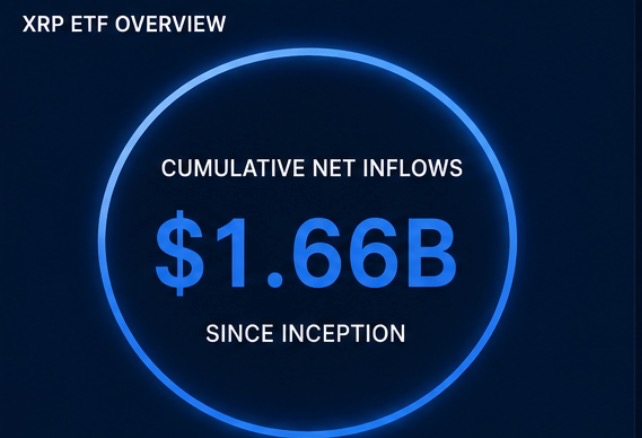
The latest available data show cumulative net inflows into the main US spot XRP products reaching approximately $1.66 billion by August 28. Their combined net assets stood near $1.44 billion, with an estimated 1.03 billion XRP held in custody.
Bitwise led the August 28 session with about $15.4 million of new capital. Canary Capital added approximately $5.1 million, while Franklin Templeton and 21Shares also recorded inflows.
Those are meaningful figures for an altcoin ETF market. They show that investors are using regulated funds to obtain XRP exposure without opening a crypto wallet or trading directly on an exchange.
They do not show that Wall Street now controls the XRP market. ETF shares can be purchased by institutions, financial advisers and retail brokerage clients. “ETF inflow” describes the investment vehicle, not the identity or time horizon of every buyer.
The Funds Own Only a Small Part of XRP
XRP had a market capitalization of roughly $85 billion at the end of August, with about 62.7 billion tokens in circulation. At that scale, $1.44 billion of ETF assets represents around 1.7% of the token’s market value.
The estimated 1.03 billion XRP held by the funds accounts for approximately 1.6% of circulating supply.
That position is large enough to affect marginal demand. It is not large enough to neutralize every other holder deciding to sell.
XRP trades continuously across global spot and derivatives markets. ETF creations take place during US market hours, while exchanges, large holders and leveraged traders respond to price changes around the clock. A positive ETF session can therefore coincide with stronger selling elsewhere.
The August Rally Created Its Own Sellers
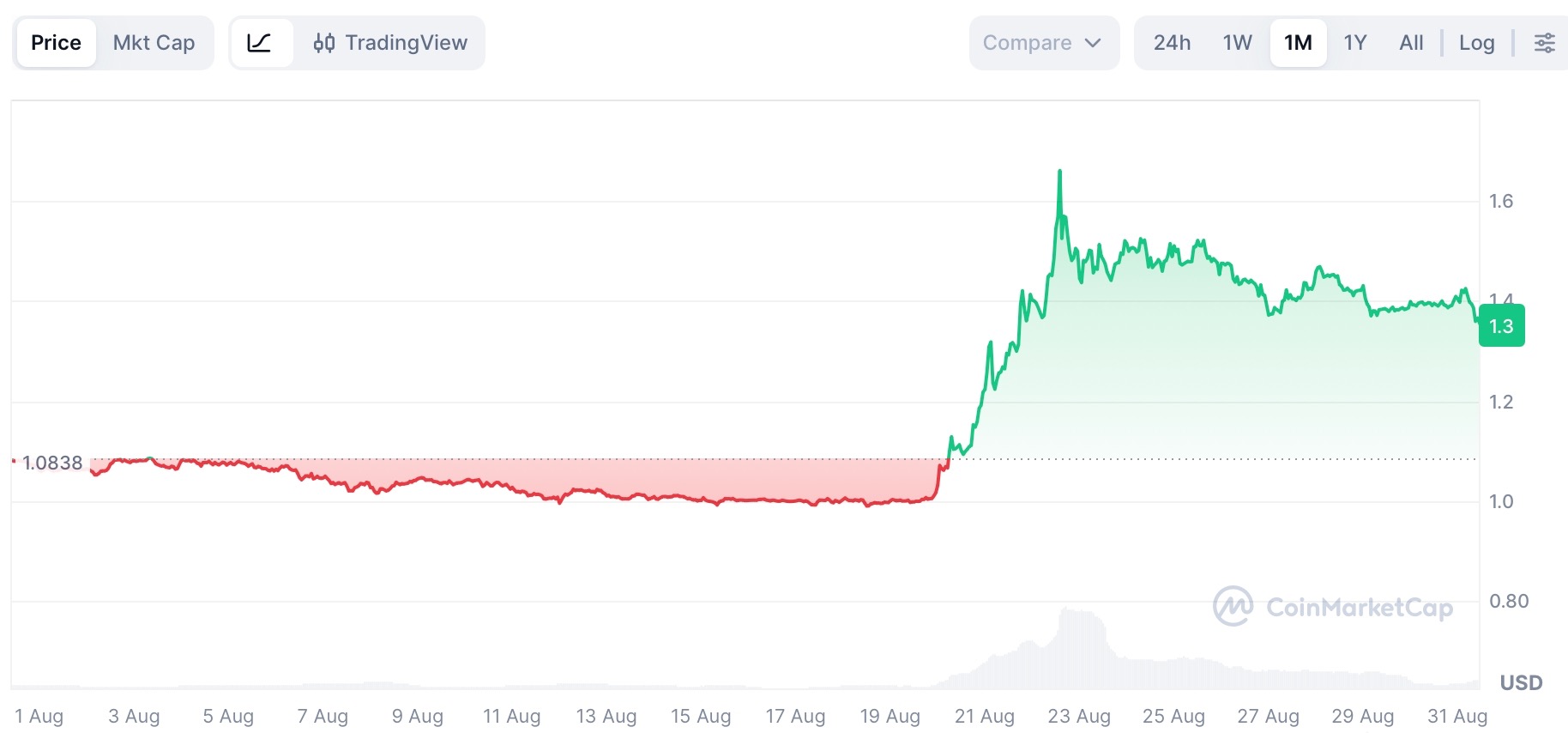
XRP traded close to $1 in the middle of August before accelerating toward $1.52. That was a gain of roughly 50% in a short period.
A move of that size naturally creates profit-taking. Traders who bought near the lows may lock in gains, while investors who entered at higher prices can use the rebound to reduce losses.
This is one reason ETF inflows did not translate into a straight move higher. The funds were absorbing supply, but the rally was also bringing more supply into the market.
The price history makes the imbalance visible. XRP closed near $1.52 on August 23, fell to about $1.38 by August 28 and traded near $1.35 at the end of the month, even as ETF flows remained positive.
Cumulative Inflows Are Not Fresh Money Arriving Today
The headline figure of $1.66 billion is the sum of net inflows since the products began trading. It should not be read as if that amount entered the XRP market at the current price.
Some ETF capital arrived when XRP was trading above its August lows. Those investors may still be near breakeven or underwater. As the token recovers, ETF shareholders can sell their fund shares just as direct XRP holders can sell tokens.
Fund flows create a new source of demand, but they do not permanently remove every dollar that has entered. Future outflows and redemptions can reverse part of that effect.
The more useful measure is therefore not cumulative inflows alone. Traders should watch whether positive flows continue through periods of weak prices and whether total XRP held by the funds keeps increasing.
Regulatory Clarity Opened the Door
The expansion of US XRP funds followed an important change in the regulatory environment.
In March 2026, the Securities and Exchange Commission issued an interpretation establishing a broader crypto-asset taxonomy. The Commodity Futures Trading Commission joined the framework and stated that it would administer commodity law consistently with the interpretation. XRP was included among the examples of digital commodities.
That clarification removed a major barrier to regulated XRP products. SEC filings now document operational funds from managers including Bitwise and 21Shares. Bitwise’s fund directly holds XRP, while 21Shares recently updated the benchmark used to calculate its product’s value.
Regulatory clarity makes XRP easier to package and distribute. It does not set the market price or remove volatility.
XRP Ledger Adoption Is a Separate Question
Ripple’s institutional relationships and growth on the XRP Ledger are often presented as part of the same bullish argument. The connection to XRP demand is more complicated.
XRPL supports payments, stablecoins, decentralized trading and tokenized assets. Most transactions require XRP for fees, but the standard cost is only 10 drops, or 0.00001 XRP under normal network conditions. The fee is destroyed rather than paid to a validator.
As a result, more ledger activity does not necessarily require users to accumulate large XRP positions. A company can issue or transfer another asset on XRPL while holding only enough XRP to maintain an account and pay small transaction costs.
ETF demand is different. A spot fund must obtain XRP to support new shares, creating a more direct relationship between investor demand and token purchases.
For XRP to build a stronger long-term valuation case, the market will need evidence that growth across payments, liquidity and tokenization creates demand beyond minimum transaction requirements.
The Supply Side Has Not Disappeared
XRP has a maximum supply of 100 billion tokens, with approximately 62.7 billion currently circulating. Ripple-related escrow arrangements add another layer to the supply discussion.
Escrow releases do not mean one billion XRP is automatically sold into the market every month. Ripple has historically returned substantial portions to escrow. Still, the structure contributes to the perception of future supply and affects how traders value scarcity.
ETF accumulation helps absorb available tokens, but the funds are working against a much larger supply base than Bitcoin ETFs faced during their early expansion. Bitcoin also has a fixed issuance schedule and no company-linked escrow system with the same market significance.
The comparison between XRP and Bitcoin ETFs therefore has limits.
ETF Success and Price Success Are Different
XRP’s ETF market has made real progress. Investors now have multiple regulated US products, cumulative flows have exceeded $1.6 billion, and more than one billion XRP is estimated to sit in fund custody.
However, the price has still fallen more than 60% from its $3.65 high.
Both facts can be true. ETFs have improved access and created a structural buyer. They have not removed existing holders, profit-taking, global derivatives activity or XRP’s large supply.
For traders, the useful question is no longer whether XRP ETFs matter. They do. The question is how large and persistent their demand must become before it outweighs the rest of the market.
Follow XRP, ETF and digital asset market coverage through Tapbit. Existing users can access their account through the Tapbit login page, while new users can register here.
Frequently Asked Questions
How much money has entered XRP ETFs?
The main US spot XRP products had accumulated approximately $1.66 billion in net inflows by August 28, 2026. Their combined net assets were about $1.44 billion.
How much entered XRP ETFs during the week ending August 28?
The funds recorded approximately $110 million in weekly net inflows. The final session contributed about $26.2 million.
Why did XRP fall while ETF inflows were positive?
ETF purchases were offset by selling in global spot and derivatives markets. Profit-taking after XRP’s sharp August rebound, exits by underwater holders and broader crypto weakness also pressured the price.


