
Dogecoin now has US-listed exchange-traded products, a Nasdaq-listed company focused on its ecosystem and a growing payments network. So far, none of these developments has been enough to produce a lasting price recovery.
As of August 3, 2026, DOGE was trading near $0.070, up slightly over 24 hours but down approximately 3.51% over the previous seven days. Its market capitalization stood near $10.9 billion, while daily trading volume was about $422 million.
Those figures leave DOGE more than 90% below its May 2021 all-time high of $0.7316. The gap between improving market access and weak price performance raises an important question: why is Dogecoin still struggling despite several positive developments?
Dogecoin Is Under Pressure, but It Is Not Crashing Today
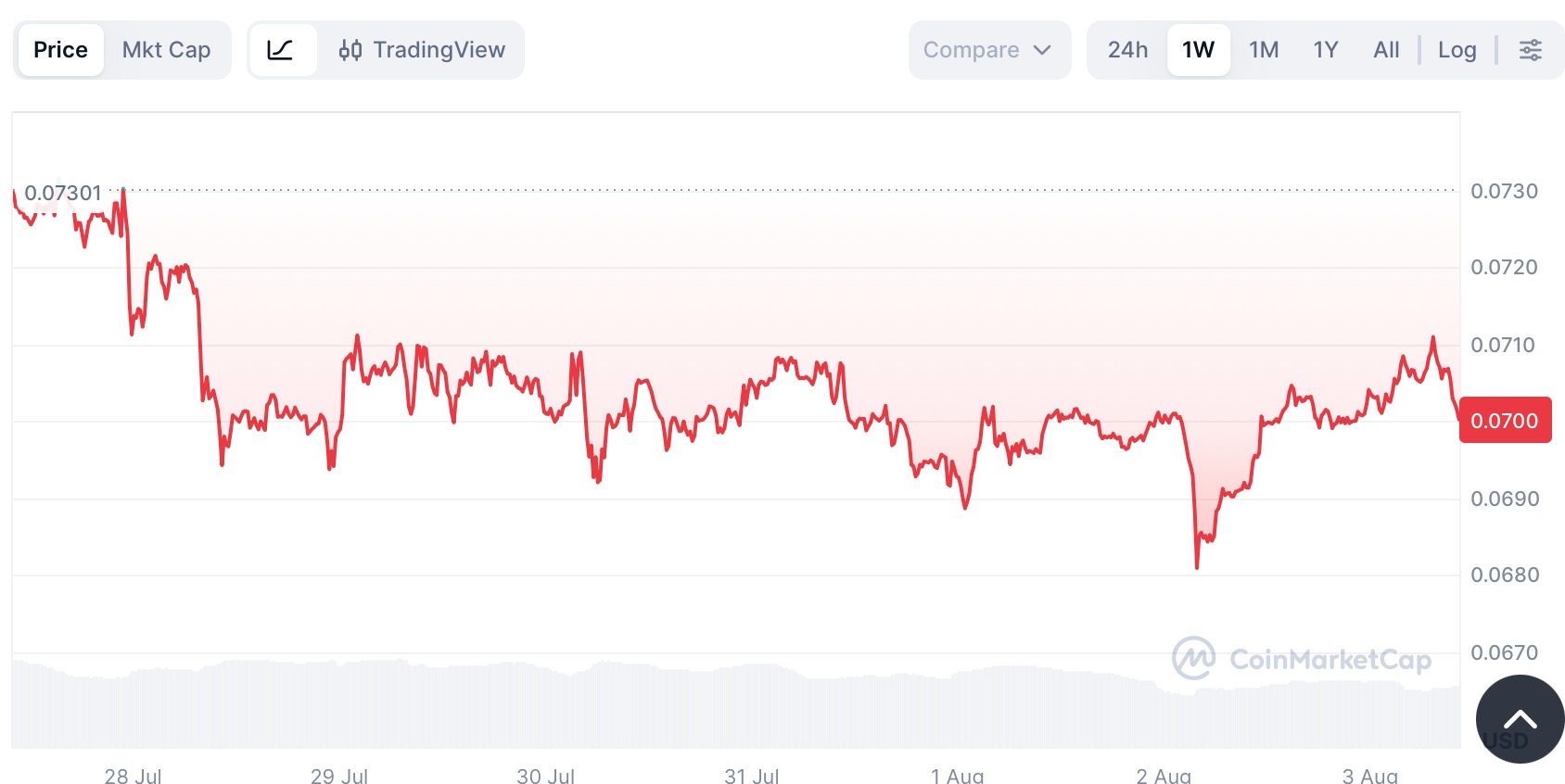
DOGE traded near $0.072 in early July and remained close to $0.070 at the beginning of August. That represents continued pressure and limited buying momentum, rather than a new one-day collapse.
The broader market environment is part of the explanation. Memecoins usually depend heavily on risk appetite, social activity and short-term capital flows. When traders become more defensive, money often concentrates in Bitcoin, stablecoins or larger assets with clearer sources of demand. Tokens driven primarily by community attention can then struggle to attract fresh capital.
Dogecoin also faces a high comparison point. Its 2021 rally was supported by exceptional retail participation, frequent social media attention and repeated comments from Elon Musk. Recreating that combination is difficult, even when the ecosystem produces legitimate new developments.
DOGE ETFs Have Expanded Market Access
One of the biggest changes since 2025 is the arrival of U.S.-listed products offering exposure to Dogecoin.
The REX-Osprey DOGE ETF, trading under the ticker DOJE, began operating in September 2025. The fund reported approximately $12.3 million in assets as of July 30, 2026.
Bitwise launched the BWOW Dogecoin ETF in November 2025, while the 21Shares Dogecoin ETF, or TDOG, launched on Nasdaq in January 2026.
These products allow eligible investors to gain DOGE exposure through traditional brokerage accounts without directly managing crypto wallets or private keys. Their existence also gives Dogecoin a level of financial-market access that few memecoins have achieved.
However, access and demand are not the same thing. An ETF creates another route for investors to obtain exposure, but it cannot guarantee that significant capital will enter. The reported asset levels remain small compared with major Bitcoin and Ether funds.
For DOGE, future ETF flows may be more important than the number of available products. Consistent inflows would suggest growing demand from brokerage-based investors. Weak inflows or persistent redemptions would show that regulatory access alone is not enough to revive the market.
HODO Brings the Dogecoin Ecosystem to Nasdaq
Another notable development is the public listing of House of Doge. House of Doge completed its merger with Brag House Holdings in June 2026. The combined company began trading on Nasdaq under the ticker HODO on July 1.
The company describes itself as the corporate arm and innovation partner of the Dogecoin Foundation. Its plans cover payments, treasury services, tokenization and commercial partnerships connected with the Dogecoin ecosystem.
House of Doge also states that its partnership with MoonPay has made DOGE payments available across more than 6,000 merchants, supported by real-time merchant settlement. This represents a more practical adoption story than social media speculation alone.
Still, HODO and DOGE are different assets. Buying shares in House of Doge is not the same as purchasing Dogecoin, and commercial growth at the company does not automatically create equivalent demand for DOGE. Traders should evaluate whether its products generate measurable payment activity rather than relying only on partnership announcements.
The X Money Catalyst Is Still Missing

For years, some Dogecoin traders have expected Elon Musk to integrate DOGE into X’s payment system. That expectation remains one of the most powerful narratives surrounding the token, but it has not been confirmed.
When Musk outlined X Money’s features in March 2026, the service was described as offering bank deposits, peer-to-peer payments, a debit card and cashback rewards. The announcement contained no confirmed Dogecoin or cryptocurrency functionalit.
DOGE briefly reacted to the announcement because traders speculated that crypto support could be added later. That reaction followed a familiar pattern: news involving Musk or X generates expectations about Dogecoin, even when the underlying announcement does not mention it.
A future DOGE integration could create a meaningful catalyst, particularly if it involved payments or tipping inside X. Until X provides a direct announcement, however, this remains speculation rather than established adoption.
Network Activity Is Improving, but the Evidence Is Mixed
Glassnode data cited by an on-chain analyst indicated that daily active addresses rose from approximately 36,000 in late June to nearly 48,000 at the beginning of July. Activity later eased but reportedly remained around 44,000, according to Bloomingbit.
Rising active addresses can indicate that more wallets are sending or receiving DOGE. It may reflect payments, transfers between exchanges or renewed speculative activity. It does not reveal the purpose of every transaction, and it does not guarantee that users are accumulating DOGE.
Development activity also requires careful interpretation. The latest formal release shown in the official Dogecoin Core repository remains version 1.14.9, released in December 2024.
At the same time, DogeOS is developing an application layer with testnet tools, smart contract deployment and software development kits. Its developer documentation shows an effort to support applications around Dogecoin, but DogeOS should not be confused with a completed upgrade to the Dogecoin Core protocol.
How Dogecoin’s Supply Model Affects the Market
Dogecoin has no fixed maximum supply. Miners currently receive 10,000 newly issued DOGE per block, according to Dogecoin’s official educational materials.
With blocks produced roughly once per minute, the network adds approximately 5.26 billion DOGE each year. The number of new coins is relatively predictable, while the percentage inflation rate gradually declines as the total supply becomes larger.
This does not mean that Dogecoin must fall because of inflation. It does mean that the market must continuously absorb newly mined coins. If demand from payments, investors and traders fails to keep pace, the additional supply can contribute to selling pressure.
ETF inflows, merchant usage and ecosystem applications therefore matter because they could provide new sources of demand. Announcements alone are less important than evidence that these channels are attracting users and capital.
What Could Change the DOGE Narrative?
A confirmed integration with X Money would immediately attract attention, but it is not the only development worth monitoring.
Sustained ETF inflows would suggest that traditional investors are building DOGE exposure. Growing payment volume through MoonPay and House of Doge would provide evidence of practical adoption. A new Dogecoin Core release or meaningful developer growth around DogeOS could strengthen the technology narrative.
DOGE would also benefit from a broader recovery in crypto risk appetite. Historically, memecoins have performed best when market liquidity is expanding and traders are willing to move beyond Bitcoin and other large-cap assets.
Without these conditions, DOGE may continue trading as a sentiment-driven asset whose rallies depend on short-lived attention.
Conclusion
Dogecoin is no longer supported only by memes. It now has U.S.-listed investment products, a Nasdaq-listed ecosystem company, expanding merchant payment infrastructure and new application-layer development.
Yet the market is still waiting for those developments to produce stronger, measurable demand.
The most discussed catalyst, DOGE integration with X Money, remains unconfirmed. ETF assets are still modest, ecosystem initiatives need time to demonstrate adoption and the wider crypto market remains cautious.
Dogecoin’s next major move may therefore depend less on another viral headline and more on whether its growing infrastructure produces sustained usage, capital inflows and demand
Traders can visit Tapbit to review available cryptocurrency markets and monitor current prices. Existing users can access their accounts through the Tapbit login page, while new users can register here.
Frequently Asked Questions
Why is Dogecoin still under pressure in 2026?
DOGE continues to face limited buying momentum, cautious market sentiment and competition for capital from larger crypto assets. New ETFs and payment initiatives have improved access and utility, but they have not yet generated enough sustained demand to produce a lasting price recovery.
Is Dogecoin crashing right now?
Not necessarily. As of August 2, 2026, DOGE was trading near $0.070, with a modest daily gain and a decline of approximately 4.2% over seven days. “Under pressure” is more accurate than describing the current movement as a sudden crash.
Are Dogecoin ETFs available in the United States?
Yes. U.S.-listed products offering DOGE exposure include REX-Osprey’s DOJE, Bitwise’s BWOW and 21Shares’ TDOG. These products allow eligible investors to gain exposure through brokerage accounts, although investing in an ETF is not the same as owning DOGE directly.


