
Proof-of-stake (PoS) blockchains rely on participants locking up their cryptocurrency to help validate transactions and secure the network. In return, these participants earn rewards from the protocol. But running a full validator node often requires technical expertise, capital, and a reliable internet connection. This is where staking pools come in.
So what is the purpose of a staking pool in a proof-of-stake system, how do these pools work, and why have they become such an important part of today’s staking ecosystem?
What Is a Staking Pool in Proof-of-Stake?
A staking pool is a coordinated group of token holders who combine their stake to participate in a PoS blockchain’s validation process. Instead of every individual setting up and maintaining their own validator node, they delegate their coins to a shared pool that is operated by one or more validators.
In most PoS designs, validators need to lock a minimum amount of the network’s native cryptocurrency and keep specialized software running around the clock. Staking pools lower this barrier by allowing many smaller holders to contribute any supported amount of tokens to a single validator or group of validators. The pool then participates in block validation, and any rewards earned are distributed among the contributors according to their share of the total stake.
Because PoS systems do not rely on centralized intermediaries, pools are typically managed either through on-chain logic or transparent off-chain agreements. The core idea remains the same: a staking pool turns many small stakes into one large, protocol-recognized stake.
Start Staking
Earn passive rewards
How Staking Pools Work in Practice
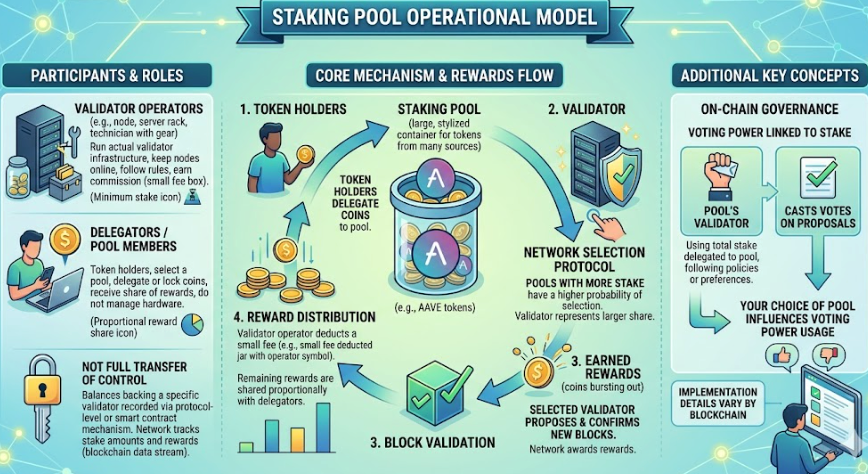
Although implementation details vary from one blockchain to another, most staking pools follow a similar operational model. Token holders choose a pool, delegate or lock their coins, and then receive a share of rewards while the pool’s validator handles the technical workload.
When you join a staking pool, you do not usually transfer full control of your funds to another person in the same way you would send coins in a regular transaction. Instead, you use the network’s staking or delegation mechanism, which records that your balance is backing a specific validator or pool. On many PoS chains, this delegation is managed with smart contracts or protocol-level instructions that automatically track stake amounts and reward distribution.
The protocol periodically selects validators to propose and confirm new blocks. Pools with more stake delegated to them often have a higher probability of being chosen, because their total stake represents a larger share of the network. When a pool’s validator is selected and successfully validates a block, it earns rewards from the network. These rewards are then shared with all participants in the pool, usually after deducting a small fee for the operator.
At a high level, most PoS ecosystems distinguish between two types of participants linked to pools:
-
Validator operators: These participants run the actual validator infrastructure. They maintain nodes, keep them online, and comply with the network’s rules. Validator operators often set up one or more pools and may require a minimum stake to join. In exchange for their work, they keep a predefined commission from the rewards generated by the pool.
-
Delegators or pool members: These are token holders who do not run validator hardware themselves. Instead, they delegate or stake their assets to a chosen pool. They receive a portion of the rewards proportional to the amount they contribute, without needing to manage the technical aspects of validation.
Some PoS protocols also link staking pools to on-chain governance. In those cases, the validator may cast votes on protocol proposals using the total stake delegated to the pool, often following its own policies or community preferences. This means your choice of pool can influence how your voting power is used in governance, even if you do not vote directly.
The Core Purposes of a Staking Pool
Staking pools address several structural challenges in PoS networks. Their main purposes relate to accessibility, network security, and economic efficiency.
|
What it does |
Why it matters (plain English) |
|
Lowers the barrier Why Staking Pools Matter in Proof-of-Stake Networksto entry |
Running a validator on your own can be expensive and technical. A staking pool lets people with small amounts of crypto join in without buying extra hardware or worrying about uptime. |
|
Pools tokens together to get more rewards |
In many PoS networks, the more you stake, the more often you get picked to validate blocks. By combining funds, the pool gets chosen more regularly, which means steadier rewards for everyone—even those with tiny stakes. |
|
Helps keep the network secure |
The more coins that are actively staked, the harder it is for someone to attack the chain. Pools make it easy for passive holders to pitch in, boosting total staked value and keeping the network healthy. |
|
Gives token holders flexibility |
Depending on the blockchain, pools may offer things like flexible lock‑up periods, automatic reinvesting of rewards, or switching which validator you support. That way people can stake in a way that fits their own risk and time preferences. |
How Staking Pools Shape the PoS Market
As PoS networks have grown, staking pools have become one of the primary ways everyday users participate in consensus. Major PoS chains often support thousands of validators and many additional pools or delegation options on top of them. Independent data providers track how much value is staked on different networks and how it is distributed among validators and pools, allowing users to monitor decentralization and participation trends across the ecosystem.
In parallel, centralized trading platforms and wallets have introduced staking-related features that mirror or integrate with on-chain pools. Some services aggregate user balances and delegate them to external validators, while others provide interfaces that help users choose specific validators directly. When comparing options, traders often pay attention to details such as trading fees, staking commissions, and the overall transparency of each service’s operations.
High liquidity PoS assets are also widely traded in spot and derivatives markets. Active traders may hold a portion of their portfolio on-chain for staking while keeping another portion on an exchange to take advantage of short-term market movements. On platforms that emphasize transparency, features such as independently verifiable proof of reserves can help users evaluate how client assets are managed alongside staking and trading services.
Staking Pools vs Solo Validation
Most PoS systems try to keep things balanced—for example, by capping how much stake a single validator or pool can control, tweaking reward curves, or encouraging people to spin up new validators. That way pools can still help with accessibility and aggregation without killing decentralization.
|
Aspect |
Solo Validation |
Staking Pools |
|
What’s the basic idea? |
You lock your own funds, run your own hardware, and handle everything yourself. |
You hand over most of the technical work to a pool operator. |
|
Who gets the rewards? |
You keep 100% of what your validator earns. |
You get rewards minus the pool’s fees. |
|
Who takes the risks? |
You bear all risks: slashing, downtime, hardware failures, etc. |
You still take some risk (e.g., if the operator messes up or the smart contract has bugs), but it’s shared. |
|
Who is this for? |
People with a lot of capital, technical know‑how, and a tolerance for managing infrastructure. |
Everyday holders who want to stake without running nodes or buying extra hardware. |
|
How does it affect network security? |
You’re directly securing the chain, but only if you stay online and honest. |
You help boost total staked value, but you’re relying on the operator’s reliability. |
|
Any downsides? |
High barrier to entry, full responsibility, and no one to lean on if something breaks. |
You give up some control; rewards are smaller after fees; trust in the operator matters. |
FAQ
What is a staking pool in Proof-of-Stake?
A staking pool is a group of participants who combine their funds to stake on a Proof-of-Stake network. Instead of running individual validator nodes, users delegate their tokens to a shared pool and earn proportional rewards.
How do staking pools generate rewards?
Pools earn rewards when their validator is selected to validate blocks. These rewards are:
-
Distributed proportionally to participants
-
Reduced by a small operator fee (commission)
The more stake a pool has, the higher its chances of earning rewards.
What are the risks of joining a staking pool?
Key risks include:
-
Validator performance risk (downtime reduces rewards)
-
Slashing risk (penalties for misbehavior on some chains)
-
Smart contract risk (if applicable)
-
Centralization risk (large pools dominating the network)
Choosing a reliable pool is critical.
What is the difference between a validator and a delegator?
-
Validator: Runs the node, validates transactions, earns rewards, takes commission
-
Delegator: Provides stake to the validator, earns a share of rewards without technical work
How do staking pools impact network security?
Staking pools generally increase total staked value, which:
-
Makes attacks more expensive
-
Improves network stability
However, overly large pools can reduce decentralization if too much stake is concentrated.
What should I look for when choosing a staking pool?
Important factors include:
-
Validator uptime and performance
-
Commission fees
-
Pool size (avoid overly dominant pools)
-
Transparency and reputation
Balancing these helps optimize both rewards and risk.


