
What Is Sky AI Coin (SKYAI)?
SKYAI is a blockchain-native AI infrastructure protocol designed to connect large language models and AI agents with structured, real-time on-chain data through an extended implementation of the Model Context Protocol (MCP).
Most AI projects in crypto are one of two things: a chatbot wrapper with a governance token, or a meme coin riding the AI narrative. SKYAI positions itself as neither.
Built on BNB Smart Chain, SkyAI's core thesis is that the next generation of autonomous AI agents — systems that execute real tasks rather than just generate text — will need a reliable, queryable, multi-chain data layer to function at scale. Without it, every agent has to build its own indexer, maintain its own data pipeline, and manage its own blockchain context. That is an enormous duplication of effort, and it creates fragmentation that slows the entire AI-on-chain ecosystem down.
SKYAI is building the shared data infrastructure layer that solves this problem. It currently aggregates full-node datasets from BNB Chain and Solana that exceed 10 billion rows, and it serves this data to AI agents through an extended version of the Model Context Protocol — the emerging standard for how LLMs interact with external tools and information sources.
The result is an AI middleware layer for Web3: a protocol that sits between the AI model and the blockchain, translating on-chain complexity into clean, structured context that agents can act on. If you want to follow how the market is reacting to this thesis in real time, you can check crypto prices for SKYAI and related AI tokens on Tapbit.
How Does SkyAI Work? Understanding MCP and AI Data Infrastructure
To understand why SKYAI matters, you first need to understand what MCP actually is — and why it is becoming one of the most important infrastructure standards in AI.
What Is MCP (Model Context Protocol)?
The Model Context Protocol is an open standard that defines how large language models communicate with external data sources and tools. Think of it as a universal plug adapter for AI: instead of every application building a custom integration for every LLM, MCP creates a shared language that any compliant AI agent can use to access any compliant data source.
Originally developed to standardize LLM tool access, MCP has become the de facto protocol for building AI agents that interact with the real world — reading files, querying APIs, executing code, and now, with SKYAI, accessing blockchain data.
SkyAI's Extended MCP: What Makes It Different
SKYAI takes the standard MCP specification and extends it with multi-chain blockchain support, specifically optimized for LLM use cases. The extended protocol is backward-compatible with existing MCP clients — any agent already using standard MCP can connect to SKYAI's data layer immediately and start accessing blockchain context without rebuilding its integration.
But SKYAI also releases a dedicated MCP client that unlocks the full capability set of the extended protocol, including cross-chain queries, structured on-chain data access, and the coordination features that make the MCP Hub work.
The MCP Hub: AI Agent Coordination at Scale
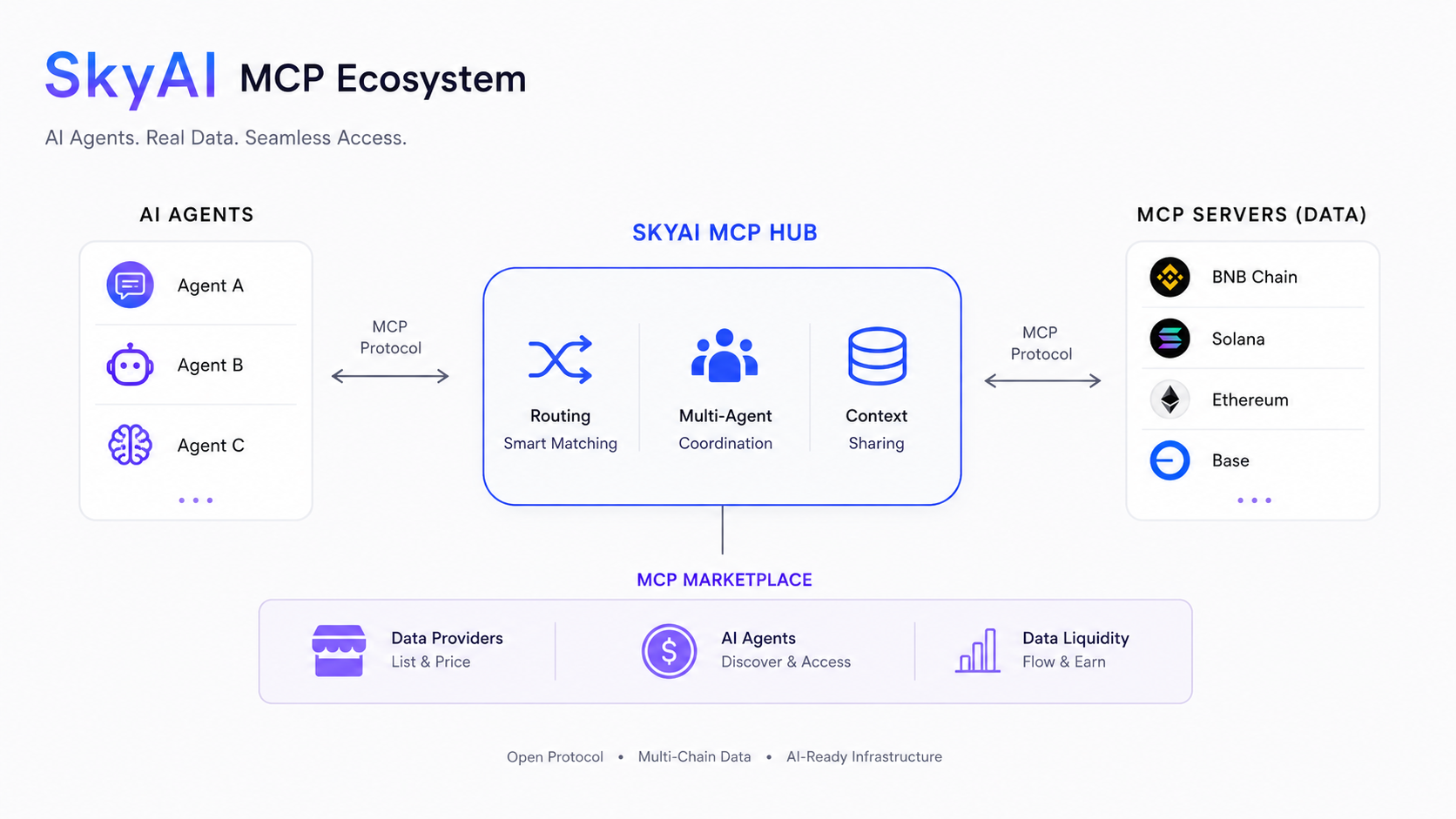
The headline product entering final testing in May 2026 is the SKYAI MCP Hub — a routing layer that lets multiple AI agents coordinate across multiple MCP servers simultaneously.
Here is the practical difference this makes. A standard MCP setup lets one agent access one data source. The MCP Hub enables:
-
Dynamic tool routing: requests are matched to the optimal MCP server rather than hardcoded to a single endpoint
-
Multi-agent cooperation: different agents can hand off tasks, share context, and avoid duplicating work
-
Cross-agent context sharing: an agent mid-task can pass its state to a specialist agent and pick up where it left off
This moves SKYAI from a data provider to an orchestration layer — closer to what middleware does in enterprise software than what a typical blockchain data oracle does.
Multi-Chain Data Infrastructure
SKYAI currently serves aggregated, queryable data from:
-
BNB Smart Chain (primary, full-node coverage)
-
Solana (active coverage)
-
Ethereum and Base (roadmap expansion in 2026)
Total aggregated data: over 10 billion rows. This gives AI agents working through SKYAI's MCP access to a data foundation that would take months and significant engineering resources to build independently.
The MCP Marketplace and Data Liquidity
Beyond its own data layer, SKYAI has introduced the concept of data liquidity — the idea that on-chain data is a monetizable asset that should flow freely between producers and consumers through a decentralized market.
The MCP Marketplace, planned for 2026, allows third-party data providers to list their own extended MCP servers, set pricing in SKYAI tokens, and earn revenue when agents access their data. This creates a decentralized on-chain data economy where the protocol functions as the coordination and settlement layer rather than the only data source.
Why SKYAI Is Different From Most AI Coins
The AI token category in 2026 is crowded, and most projects in it share a common weakness: the token exists before the infrastructure does. The AI narrative drives speculation, but there is no underlying product that creates real demand for the token.
SKYAI's differentiation case rests on three structural claims that separate it from the narrative-only crowd.
It Is Infrastructure, Not an Application
Most AI crypto projects are applications — a chatbot, a trading agent, a content tool — that happen to have a token. SKYAI is building the layer those applications run on top of. The distinction matters because infrastructure captures value from every application built on it, rather than competing in a winner-take-all product market.
Think of the difference between a social media app and the cloud provider it runs on. The app might fail; the infrastructure gets paid either way.
It Is Middleware, Not a Data Oracle
Traditional blockchain data oracles (Chainlink, API3, Pyth) are designed to bring external real-world data onto the chain — price feeds, weather, sports scores. SKYAI does the opposite: it brings blockchain data to AI systems in a format those systems can actually use.
This is a fundamentally different product for a fundamentally different customer. SKYAI's customers are not smart contracts that need a price feed. They are AI agents that need to understand what is happening across thousands of contracts, wallets, and protocols in order to make decisions and take actions.
It Has Real Product Milestones Attached to Its Price Catalysts
The 263% weekly surge and 106% single-session move in early May 2026 were not purely narrative-driven. Three catalysts stacked on top of each other in roughly a week:
-
Bitget listing on April 30 opened a fresh liquidity wave and dramatically broadened accessibility
-
MCP Hub final testing announcement on May 3 gave the rally a concrete product milestone to price
-
Broader AI agent narrative rotation alongside Virtuals Protocol provided sector tailwind
The Phemex analysis noted that the data layer plus orchestration layer pitch is "one of the more credible product stories in the AI agent category." That framing separates SKYAI from projects where the product narrative is entirely circular.
The Honest Risk Picture
None of this means SKYAI is without risk. Analysts have flagged two significant concerns that investors should weigh:
Whale concentration: On-chain data shows 73 wallet clusters holding 296 million tokens, indicating potential market maker control. Coordinated selling from this group could precipitate sharp corrections toward the $0.16–$0.07 support range.
Execution risk: The MCP Marketplace and multi-chain expansion are roadmap items. Delays or low adoption on launch could disappoint a market that has already priced significant execution optimism into the current valuation.
Informed positioning in SKYAI means tracking MCP Hub launch metrics and real on-chain query volume — not just price action.
What Is SKYAI Token Used For?
The SKYAI token is not a governance token that only votes on obscure protocol parameters. It is designed as the core economic unit across multiple functions within the SkyAI ecosystem.
Payments for Data Access
When AI agents query the SkyAI data layer — whether directly through the protocol's own MCP servers or through third-party providers listed on the MCP Marketplace — they pay for that access in SKYAI tokens. This creates organic, utility-driven demand that scales with actual usage of the protocol.
As the MCP Marketplace launches and more data providers join, the volume of payment transactions through SKYAI is designed to grow proportionally with the broader AI agent ecosystem it serves.
Staking and Network Security
SKYAI holders can stake tokens to participate in the protocol's economic security model. Stakers contribute to network validation, earn a share of fees generated by data access transactions, and align their economic incentives with the health of the ecosystem.
This staking model also creates a supply sink — tokens locked in staking contracts reduce circulating supply, which can support price stability during periods of growth.
Governance
As the protocol advances toward its planned transition to DAO governance in 2026, SKYAI token holders will vote on key protocol decisions including:
-
Fee structures for MCP data access
-
MCP Marketplace listing standards
-
Multi-chain expansion priorities
-
Treasury allocation for ecosystem grants
This gives active participants a direct role in shaping how the protocol evolves, and creates long-term alignment between token holders and the project's direction.
Ecosystem Access
Beyond payments and governance, SKYAI tokens function as access keys across the broader ecosystem. Developers building on top of the protocol may require token holdings to access premium data tiers, early product features, and developer tooling as the ecosystem matures.
Can SKYAI Reach $1? Market Cap and Price Reality
This is one of the most searched questions about SKYAI right now — and the math is more accessible than most people expect.
Current Numbers
-
Current price: approximately $0.45–$0.48 (as of mid-May 2026)
-
All-time high: $0.8543
-
Circulating supply: 1,000,000,000 SKYAI (fully circulating — no future unlock cliff)
-
Current market cap: approximately $450–$480 million
-
CoinMarketCap ranking: approximately #95–#118
What $1 Requires
At $1 per token with 1 billion circulating supply, SKYAI's market cap would be exactly $1 billion. That is roughly a 2× increase from current levels.
For context, a $1 billion market cap would place SKYAI roughly in the same valuation range as established mid-cap DeFi protocols and infrastructure tokens. It is not an outlandish target for a project with a credible product narrative in a category — AI infrastructure for blockchain — that the market has been actively re-rating higher throughout 2025 and 2026. For a deeper look at where SKYAI's valuation could go, see Tapbit's SKYAI price forecast and long-term price outlook.
What Makes $1 Realistic
-
Fully circulating supply removes the dilution risk that typically kills mid-cap tokens when vesting cliffs hit
-
The MCP Marketplace, if it launches successfully in 2026, would generate real fee revenue and create ongoing token demand
-
Ethereum and Base chain integration would dramatically expand the addressable data market SKYAI can serve
-
Sustained institutional rotation into AI agent infrastructure tokens has been a visible trend throughout 2026
What Makes $1 Difficult
-
The 73-wallet cluster concentration creates asymmetric downside risk if coordinated selling emerges
-
The RSI reached 81.25 at the peak of the May surge — a technically overbought reading that historically precedes consolidation
-
Product delivery risk: if the MCP Hub launch underperforms expectations or the Marketplace faces adoption challenges, the valuation premium collapses
-
The broader AI token category is subject to rapid narrative rotation — what the market prices aggressively one month can reprice sharply the next
The most honest framing: $1 is achievable in a favorable macro and narrative environment with successful product execution. It is not guaranteed by tokenomics or current momentum alone.
How to Buy SKYAI and Trade AI Tokens on Tapbit
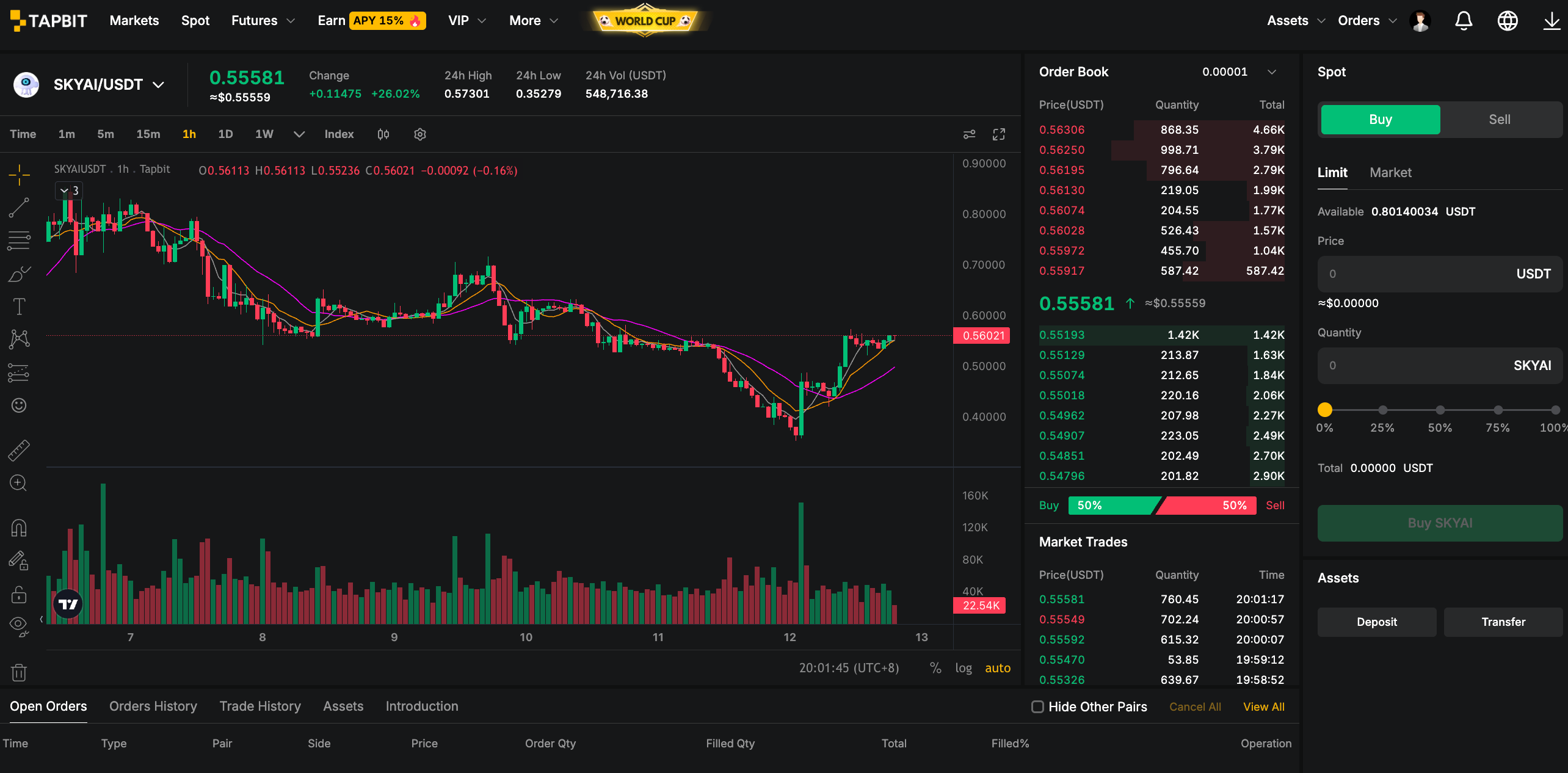
SKYAI is an active market for traders who want exposure to the AI infrastructure narrative in crypto. It currently trades on major centralized exchanges with significant daily volume ($76–$179 million at peak), making it a liquid market by mid-cap standards.
Spot trading is well-suited for investors who want direct token exposure and are comfortable holding through the volatility that comes with a token that has run 4,100% from its lows. You can buy SKYAI directly through spot trading on Tapbit with straightforward order execution and transparent pricing. Position sizing matters significantly at current valuations.
Futures trading gives more experienced traders the ability to express both long and short views — useful in a market where whale concentration creates asymmetric risk and technical overbought conditions can produce sharp retracements alongside genuine breakouts. Tapbit's SKYAI futures trading market offers the flexibility to go long or short depending on how you read the MCP Hub launch and broader AI narrative momentum.
If you are new to crypto trading, starting with spot markets and smaller position sizes before moving to leveraged futures is strongly recommended — particularly for tokens in early-stage infrastructure categories where conviction requires understanding the underlying product. Create a Tapbit account to get started, and review the trading fee structure before your first trade.
Final Thoughts
The most important thing to understand about SKYAI is what it is actually trying to build.
It is not an "AI coin" in the way most of the market uses that phrase — a token attached to a chatbot feature or an AI-generated image service. It is an attempt to build the data infrastructure layer that autonomous AI agents on-chain will need to function at scale.
The real value proposition is this: AI + blockchain data infrastructure.
MCP is becoming the standard protocol for how AI agents interact with external tools and data. SKYAI is extending that standard specifically for multi-chain blockchain data and building the orchestration layer — the MCP Hub — that lets multiple agents coordinate across it.
Whether SKYAI succeeds depends on whether the MCP Hub drives real on-chain query volume when it fully launches, whether the MCP Marketplace achieves genuine data provider adoption, and whether the broader AI agent ecosystem develops at the pace the market is currently pricing.
Those are execution questions, not narrative questions. And execution questions only get answered by watching the actual product metrics — not the price chart.
For now, SKYAI sits at an interesting intersection: credible technical design, real product milestones, an identified niche that the market has underserved, and the volatility and concentration risks that come with any mid-cap infrastructure play in an early-stage category.
Understanding that full picture — the infrastructure thesis and its risks — is more valuable than any price target.
FAQ
What is Sky AI coin used for?
The SKYAI token is used for paying for data access on the SkyAI protocol, staking to participate in network security and earn fee rewards, governance voting as the protocol transitions to DAO control in 2026, and gaining access to ecosystem features including premium data tiers and developer tooling on the MCP Marketplace.
How does SKYAI work?
SKYAI works by aggregating over 10 billion rows of full-node blockchain data from BNB Chain and Solana, then serving that data to AI agents through an extended implementation of the Model Context Protocol (MCP). The MCP Hub — currently in final testing — acts as a routing layer that lets multiple AI agents coordinate across multiple data sources, share context, and hand off tasks without each agent maintaining its own data pipeline.
Can SKYAI reach $1?
At $1 per token, SKYAI's market cap would be $1 billion — approximately 2× its current valuation of around $450–$480 million. This is achievable in a sustained AI narrative environment with successful product execution, particularly the MCP Marketplace launch and Ethereum chain integration. However, whale concentration among 73 wallet clusters holding 296 million tokens creates asymmetric downside risk that investors should factor into any price target analysis.
Is SKYAI an AI agent coin?
SKYAI is more accurately described as an AI agent infrastructure coin than a pure AI agent coin. The distinction is important: AI agent coins are typically associated with specific autonomous agents or agent platforms. SKYAI is building the underlying data layer and coordination protocol that AI agents across many platforms can use — functioning more like middleware or infrastructure than a specific agent product.


