
Introduction: Saga Modular Blockchain Overview
Saga is a modular blockchain platform designed to simplify Web3 development. Unlike traditional platforms where all DApps share the same chain, Saga allows each application to run on its own dedicated Chainlet, improving performance, lowering costs, and making scaling easier.
Think of Saga as the "AWS of blockchain"—developers can deploy an exclusive chain for their project with a single click.
Chainlet Model: The Modular New Paradigm of Web3
The Chainlet is the core innovation of Saga. Each Chainlet operates as an independent blockchain with dedicated resources and validators.
| Feature | Description |
|---|---|
| Performance | Exclusive resources, no competition for block space |
| Customization | Supports EVM, CosmWasm, SolanaVM, and more |
| Scaling | Deploy multiple Chainlets as traffic increases |
| Developer-Friendly | One-click deployment, similar to smart contracts |
The Chainlet model allows developers to focus on product innovation rather than infrastructure management.
Pegasus Upgrade: More Secure, More Decentralized
In 2024, Saga launched the Pegasus Upgrade, bringing three key improvements:
- $SAGA Staking Mechanism – Users stake tokens to secure the network and earn rewards.
- Shared Security (CCV) – Chainlets inherit security from the main Saga chain without recruiting separate validators.
- Validator Network Decentralization – External validators can join Chainlets or the main chain to enhance stability.
These features give Saga shared security similar to Cosmos Hub, while maintaining modular flexibility.
Saga Token Economy and Market Performance
The $SAGA token underpins the ecosystem and serves multiple purposes:
| Usage | Description |
|---|---|
| Security Guarantee | Staking maintains network security; violators are penalized |
| Pay Chain Fee | “Musical Chairs” mechanism sets transaction fees per Chainlet |
| Flexible Payment | Developers can pay in stablecoins; converted to $SAGA automatically |
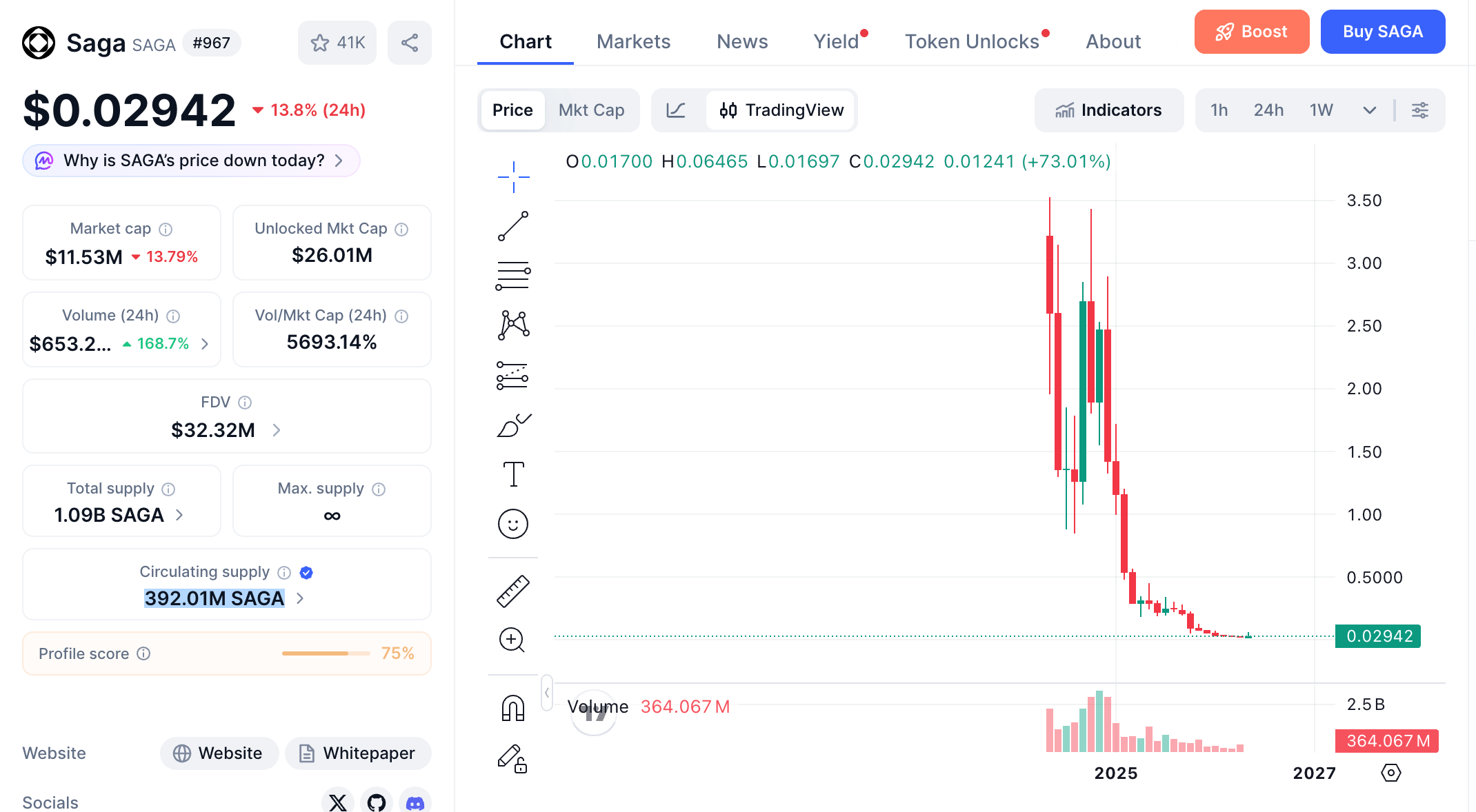
Market Performance (May 2026):
| Metric | Value |
|---|---|
| Current Price | $0.029 USD |
| Circulating Supply | 392.01M $SAGA |
| Market Cap | $11.48M USD |
| Price Trend | Early adoption stage with high volatility |
Investors should monitor price fluctuations and manage risk carefully due to the speculative nature of modular blockchain projects.
Saga Ecosystem Potential and Future Prospects
Saga integrates modular blockchain technology with multi-chain interoperability, offering:
- Advanced Tech: Cosmos-SDK base, supporting IBC protocol
- Low Development Threshold: Fast onboarding for developers
- High Scalability: Supports multiple virtual machines and on-chain logic
- Ecosystem Partnerships: Connected with Ethereum, Celestia, Polygon, and others
With emerging trends in AI, DePIN, and autonomous agent networks, Saga’s automated Chainlet deployment may become a preferred choice for high-performance DApps.
Summary: Why Saga Matters
Saga’s Chainlet model is reshaping Web3 infrastructure by:
- Lowering development barriers
- Enabling large-scale application chains
- Offering shared security and multi-chain support
For developers and investors tracking Web3 infrastructure trends, Saga represents a strategically important project.
FAQ: Saga Blockchain
What is Saga?
Saga is a modular blockchain that enables developers to launch independent chains (Chainlets) quickly and efficiently.
What is a Chainlet in Saga?
A Chainlet is an independent blockchain with dedicated resources, customizable virtual machines, and shared security from the main Saga chain.
What is the Pegasus Upgrade?
A 2024 update introducing staking, shared security, and validator decentralization to enhance Saga’s scalability and security.
How does $SAGA token work?
$SAGA is used for staking, paying transaction fees on Chainlets, and participating in governance, with flexible payment options including stablecoins.
What is the current price of $SAGA?
As of May 2026, $SAGA trades at $0.029 USD, with a circulating supply of 392.01M tokens and a market cap of $11.48M.
Is Saga a good investment?
Saga is promising for developers and investors focused on modular blockchain infrastructure, but price volatility and ecosystem adoption should be carefully considered.


