If you’re exploring Web3 gaming or play-to-earn (P2E) projects, you might be wondering: what exactly is MONI, and why does it matter? In simple terms, MONI is the primary governance and value-capture token of Monsta Infinite—a GameFi ecosystem built on the BNB Smart Chain. The game blends turn-based card battles with match-3 puzzle mechanics, creating a hybrid gameplay experience. Within this ecosystem, MONI works alongside the in-game utility token STT (Stamen Tellus Token), forming a dual-token economy designed for long-term sustainability.
Understanding how MONI functions within Monsta Infinite’s gameplay, tokenomics, and governance can help you better evaluate its potential as both a gaming asset and an investment.
What Is Monsta Infinite and How Does MONI Work?
Monsta Infinite is a decentralized play-to-earn gaming ecosystem built on BNB Smart Chain. It was created to address common issues in early GameFi projects, such as unsustainable token economies and “pay-to-win” dynamics, by introducing more strategic gameplay and a more balanced economic model.
The game is set on a fictional planet called Shani, home to creatures known as Monstas. When a destructive force called JILAKA threatens their world, ancient “Origin Monstas” awaken and connect with humans through blockchain technology. As a player, you respond to this call by assembling a team of Monsta NFTs and leading them into battle.
In return for your performance and victories, you earn STT—the in-game utility token. MONI, on the other hand, operates at a higher level. It functions more like an ecosystem “governance share,” giving holders voting rights, staking rewards, and access to core features like cloning.
How to Play Monsta Infinite and Use MONI
Getting Started
To fully participate in the play-to-earn system, you typically need three Monsta NFTs, which act as your core battle units. Once your team is ready, you can enter different game modes and start earning STT.
For beginners, the game also offers lower-barrier options like soulbound Monstas, allowing players to explore gameplay before investing in NFTs.
Gameplay Mechanics
Monsta Infinite is not a passive auto-battler—it emphasizes active decision-making. The core gameplay combines turn-based card strategy with match-3 puzzle mechanics.
You use cards to attack, defend, or trigger abilities, while also managing a puzzle board. Matching tiles can deal extra damage, heal your team, or provide strategic advantages, making each turn impactful.
Game Modes
- PVE (Player vs Environment): Battle AI enemies, progress through stages, and earn consistent rewards.
- PVP (Player vs Player): Compete against other players for higher rewards, rankings, and seasonal incentives.
Fair Matchmaking with ELO
To avoid “pay-to-win” issues, Monsta Infinite uses an ELO-based matchmaking system, pairing players with opponents of similar skill and team strength. This ensures that outcomes depend more on strategy than spending.
Token Utility: Cloning and Modification
Two key systems drive long-term progression:
- Cloning: Create new Monsta NFTs by spending both MONI and STT. Offspring inherit traits, enabling strategic team building.
- Modification: Transfer traits or body parts from one Monsta to another, improving your team while consuming tokens.
These systems create continuous demand for both MONI and STT, tying token usage directly to gameplay.
Dual-Token Economy: MONI vs STT
Monsta Infinite’s economic design uses a dual-token model to prevent the hyperinflation that plagued many early P2E projects. MONI and STT have clearly separated roles.
|
Token |
Role |
Key Functions |
|
MONI |
Governance & value-capture |
Voting on proposals, staking for rewards, cloning, ecosystem-level mechanics. |
|
STT |
In-game utility & reward |
Earned through PvE/PvP, spent on cloning, augmentation, upgrades, and other in-game actions. |
How MONI and STT Interact
While they have distinct functions, many important actions—such as cloning—require both MONI and STT. This ensures that long-term players engage with the entire token stack. Players often swap between the two tokens via liquidity pools or external markets. As more MONI is staked or used within the ecosystem, its circulating supply decreases, while the constant demand for STT helps keep the in-game economy active.
Tokenomics: Supply and Distribution
The total supply is hard-capped at 270,000,000 tokens. No additional MONI can be minted, making scarcity a core part of its tokenomics.
Allocation and Distribution
While exact figures may vary over time due to vesting, the broad distribution structure is as follows:
|
Category |
Purpose |
|
Play-to-Earn & Staking Rewards |
Incentives for active players and MONI stakers. |
|
Team & Advisors |
Compensation for core development and strategic guidance. |
|
Pre-Sale & Public Sale |
Early funding rounds for development and marketing. |
|
Marketing, Ecosystem & Liquidity |
Partnerships, user acquisition, and liquidity provision on exchanges. |
Vesting Schedules
To reduce the risk of sudden sell-offs, allocations for the team, advisors, and private investors are unlocked gradually through vesting schedules. This spreads token distribution over months or years, aligning long-term incentives and allowing for more organic price discovery.
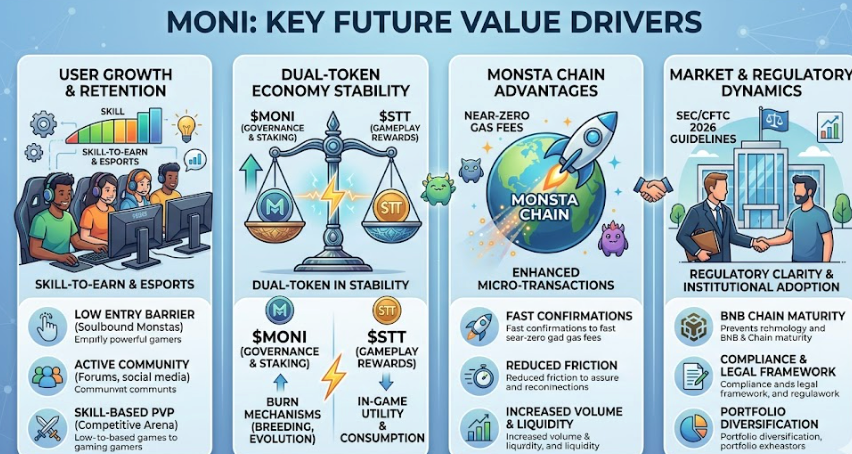
What Could Influence MONI’s Future Value?
Several factors may shape MONI’s long-term performance:
- User Growth & Retention: Sustained demand depends on an active player base.
- Economic Stability: Effective balance between token issuance and consumption.
- GameFi Market Trends: Broader adoption of blockchain gaming and BSC ecosystem growth.
- Ecosystem Expansion: New features, DeFi integrations, and governance participation.
As with all crypto assets, volatility remains high, and long-term success depends on execution and adoption.
How to Buy MONI
- Choose an Exchange: Select a platform that supports MONI trading.
- Register & Verify: Complete account setup and KYC if required.
- Deposit Funds: Add fiat or crypto (e.g., USDT or BNB).
- Buy MONI: Trade via a MONI trading pair (e.g., MONI/USDT).
- Store Securely: Transfer to a non-custodial wallet for long-term storage.
Summary
MONI is more than just a token—it represents governance, value capture, and participation within the Monsta Infinite ecosystem. Together with STT, it forms a dual-token model designed to address inflation and sustainability challenges seen in early GameFi projects.
By combining strategic gameplay, a capped governance token, and a utility-driven reward system, Monsta Infinite aims to strike a balance between player engagement and economic stability.
FAQ
What is MONI used for?
MONI serves as the core governance token of the ecosystem. It allows holders to vote on proposals, earn staking rewards, and participate in key features such as cloning Monsta NFTs.
Is Monsta Infinite free to play?
While you can explore some basic features for free, full participation in the play-to-earn system typically requires owning three Monsta NFTs.
Which blockchain is MONI on?
MONI is a BEP-20 token built on the BNB Smart Chain.
What’s the difference between MONI and STT?
MONI is a fixed-supply governance and value token, whereas STT is an in-game utility token earned through gameplay and used for actions like upgrades and cloning.
Where can I buy MONI?
MONI can be purchased on selected centralized and decentralized exchanges that support tokens on the BNB Smart Chain ecosystem.


