
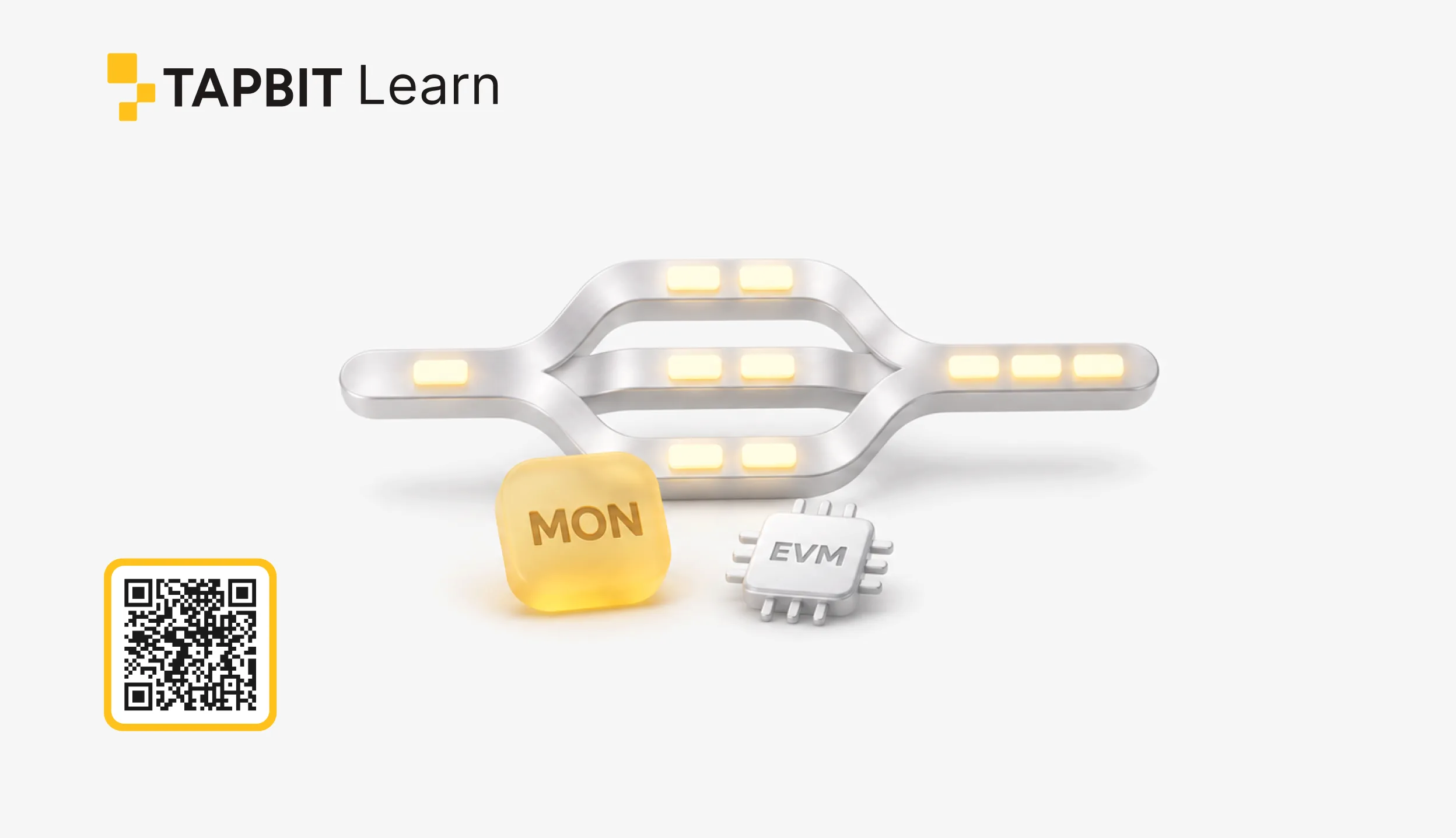
Monad is an Ethereum-compatible Layer 1 blockchain built to process many transactions without forcing developers to abandon Ethereum tools. MON is its native token. The token pays network fees, supports validator staking and links demand for the network to its security system.
The main idea is simple: Monad keeps the Ethereum Virtual Machine, or EVM, but rebuilds the software around it for faster execution. Monad's published specifications describe 300-millisecond blocks, 600-millisecond finality and capacity above 10,000 transactions per second.
What Is the Monad Coin?
MON is the native asset of the Monad network. A user pays MON when sending a transaction or using a smart contract. Validators stake MON to help order transactions, produce blocks and secure the chain. Block rewards compensate validators and their delegators for that work.
MON is not equity in Monad and does not give holders a claim on company revenue. Its value comes from market supply and demand, the need for gas, staking activity and expectations for applications on the chain. That distinction matters when a new token is promoted as part of a fast-growing technology network.
How Does Monad Process Transactions Faster?
Monad separates the job of agreeing on transaction order from the job of executing every transaction. Validators can reach consensus on a block while execution continues in a coordinated pipeline. The network also runs independent transactions in parallel when they do not need the same state.
 Independent transactions can run in parallel before the results settle into one ordered state.
This design does not mean every transaction always runs at the advertised maximum speed. Real performance depends on contract complexity, network load and validator conditions. The useful point is that the architecture removes some work from the single-file line that limits traditional EVM execution.
How Is Monad Different From Ethereum?
Ethereum and Monad use the same EVM programming model, but they are separate Layer 1 networks with separate validators, assets and security. Ethereum has the larger economic base and application ecosystem. Monad competes on speed, cost and compatibility.
 The same EVM tools can connect to two separate Layer 1 networks.
A developer can move Solidity contracts and familiar wallet connections to Monad without rewriting the entire application. Users still need MON for fees and must bridge or obtain assets supported on Monad. This is similar to how another high-performance Layer 1 can support familiar applications while maintaining its own network.
What Is the MON Token Used For?
MON has two direct uses: gas and staking. Gas pays for computation and discourages spam. Staking puts capital behind validators, which can lose rewards or face penalties if they fail to follow network rules. Validator-led governance can also coordinate protocol changes.
 MON connects transaction demand with validator security.
Token supply matters as well. Rewards add tokens to circulation, while base-fee burning can remove part of network fees. Investors should compare issuance, unlocks and staking participation instead of treating usage as the only price driver. A new Layer 1 token supply can change quickly as scheduled allocations unlock.
Why Is Monad Crypto Trending?
Monad attracts attention because it combines a live EVM network, fast published performance and a native token that trades across several markets. Developers can test high-frequency DeFi, games and payment applications without moving to a different virtual machine.
Price attention can rise faster than network use. At 10:46 a.m. China Standard Time on November 5, CoinGecko showed MON near $0.01822, up about 4.3% over 24 hours, with roughly $24.6 million in daily volume. A fast move can also trigger a liquidation cascade in leveraged markets.
What Would Drive MON's Future Price?
MON demand can grow when more users pay gas, more tokens are staked and more applications hold liquidity on Monad. The strongest evidence would be sustained active addresses, transaction fees, stablecoin liquidity and developer activity rather than a short burst of volume.
Supply can work in the opposite direction. New rewards and scheduled unlocks increase tradable supply, while staking and fee burning reduce liquid supply. MON reaches $1 only if market demand supports a much larger network value; the percentage move alone does not make that outcome likely.
FAQ
Is Monad crypto a good investment?
Monad has a working high-speed EVM network, but MON remains a volatile token. A decision should weigh network use, token issuance, unlocks, liquidity and valuation together.
Will Monad reach $1?
No one can confirm that target. At about $0.01822, reaching $1 would require the price to rise roughly 55 times and enough demand to support the resulting market value.
Is Monad a Layer 1 or Layer 2?
Monad is a Layer 1. It has its own validators, consensus system and native token.
Can Ethereum apps run on Monad?
Yes. Monad is EVM-compatible, so many Solidity contracts and Ethereum development tools can be reused.


