Global Digital Nuclear Reserve, commonly known as GDNR, has started attracting attention because it combines several powerful themes: nuclear energy, strategic reserves, sovereign infrastructure, and blockchain technology. The name sounds serious and institutional, which can make GDNR stand out in a crypto market filled with meme coins and short-term speculative tokens.
However, investors should approach Global Digital Nuclear Reserve with caution. A token using nuclear reserve language does not automatically represent ownership of real energy infrastructure, uranium reserves, nuclear power capacity, or government-backed assets. Before evaluating GDNR, beginners need to separate the project narrative from verifiable evidence.
What Is Global Digital Nuclear Reserve (GDNR)?
Global Digital Nuclear Reserve (GDNR) is commonly described as a Solana-based token built around a nuclear energy reserve narrative.
The project branding suggests themes such as digital reserves, nuclear energy capacity, sovereign-grade infrastructure, and tokenized strategic assets. These ideas may sound advanced, but investors should focus on what can be verified on-chain and through official documentation.
| Project Element | Description |
|---|---|
| Token Name | Global Digital Nuclear Reserve |
| Symbol | GDNR |
| Blockchain | Solana |
| Market Category | Reserve-themed speculative token |
| Core Narrative | Nuclear energy, sovereign reserve, digital infrastructure |
| Verified Asset Backing | Not clearly proven through public documentation |
| Risk Profile | High-risk micro-cap crypto asset |
For beginners, the key point is simple: GDNR may use nuclear energy language, but that does not automatically make it a regulated energy-backed product.
Is GDNR Backed by Real Nuclear Assets?
Investors should not assume GDNR is backed by real nuclear assets.
A genuine real-world asset token normally requires legal structures, asset custody arrangements, independent audits, ownership disclosures, redemption rights, and clear investor protections. This is especially important for nuclear energy, which is one of the most regulated sectors in the world.
Before treating GDNR as a nuclear-backed asset, investors should look for legal registration documents, a named operating company or issuer, independent reserve audits, energy contract disclosures, nuclear asset custody or ownership records, regulatory approvals, redemption or revenue-sharing terms, and clear investor rights documentation.
Without these materials, GDNR should be viewed as a speculative crypto token rather than a verified nuclear reserve product.
Why GDNR Is Getting Attention
GDNR is gaining attention because the nuclear narrative is powerful.
Nuclear energy has become part of broader discussions around clean energy, data center demand, AI infrastructure, energy independence, and national security. A token that uses nuclear reserve language can quickly attract traders searching for assets connected to future infrastructure themes.
| Narrative Driver | Why Traders Notice It |
|---|---|
| Nuclear Energy Theme | Connects with clean energy and power demand |
| AI Infrastructure Demand | Data centers increase electricity discussions |
| Sovereign Reserve Branding | Sounds official and strategic |
| Solana Token Activity | Supports fast-moving speculative trading |
| Micro-Cap Volatility | Appeals to high-risk traders |
| RWA Narrative | Suggests a link to real-world assets |
This attention can create short-term demand, but attention is not the same as verified value. GDNR still needs transparency, liquidity, and credible documentation to support long-term confidence.
GDNR and the Reserve Token Trend
Global Digital Nuclear Reserve appears to be part of a broader wave of reserve-themed crypto tokens.
Recent markets have seen tokens using names connected to oil reserves, water reserves, energy reserves, strategic assets, and sovereign-sounding financial language. These projects often use real-world resource themes to attract attention, even when legal asset backing is unclear.
| Reserve-Themed Token Feature | Investor Concern |
|---|---|
| Official-Sounding Name | May create false confidence |
| Commodity Narrative | May imply asset backing without proof |
| Micro-Cap Trading | Can move sharply on low volume |
| Limited Documentation | Makes claims difficult to verify |
| Similar Naming Patterns | Raises copycat and confusion risk |
For GDNR, the word reserve should be treated as branding unless documents prove otherwise.
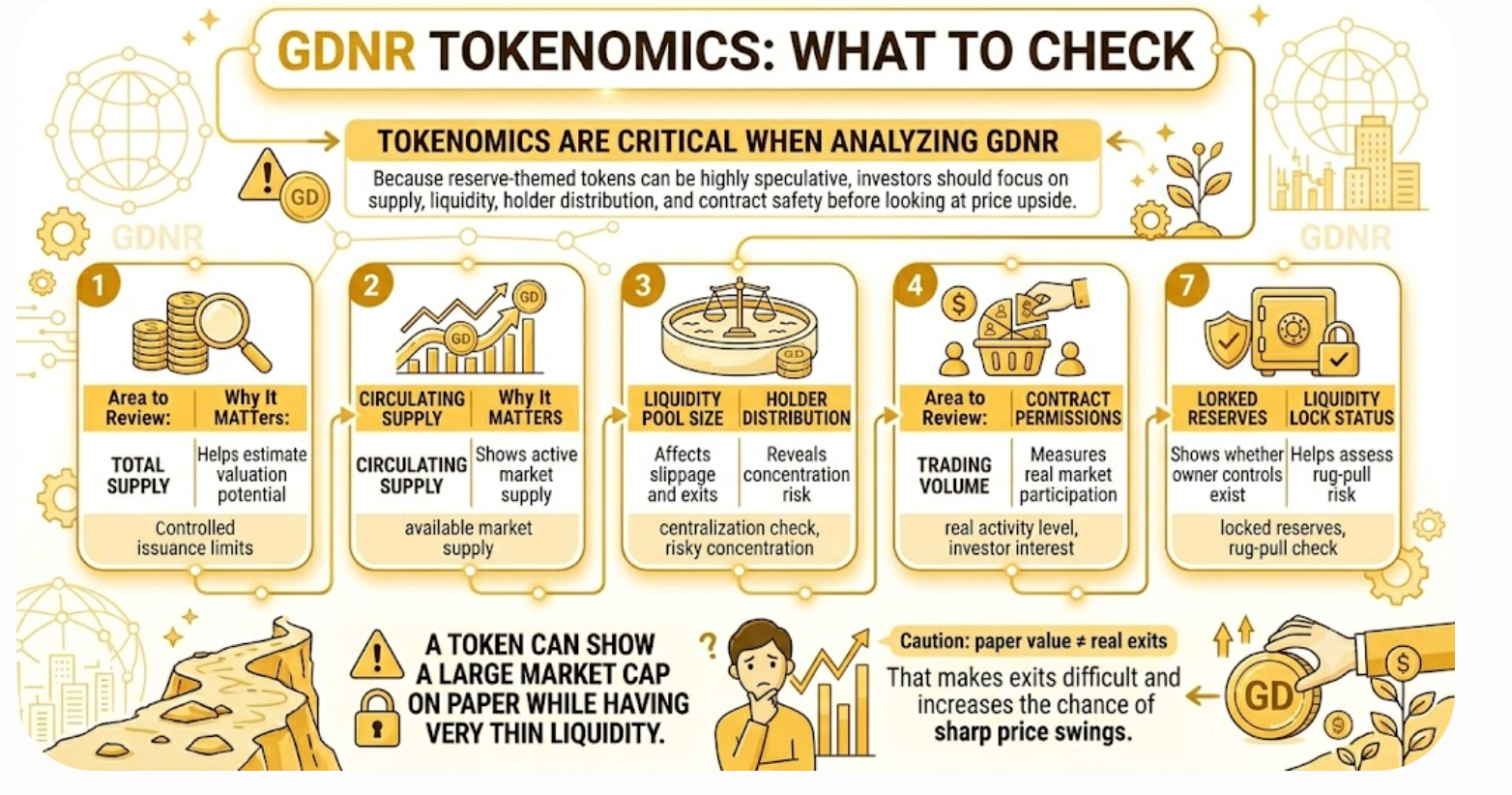
GDNR Tokenomics: What to Check
Tokenomics are critical when analyzing GDNR.
Because reserve-themed tokens can be highly speculative, investors should focus on supply, liquidity, holder distribution, and contract safety before looking at price upside.
| Tokenomics Area | Why It Matters |
|---|---|
| Total Supply | Helps estimate valuation potential |
| Circulating Supply | Shows active market supply |
| Liquidity Pool Size | Affects slippage and exits |
| Holder Distribution | Reveals concentration risk |
| Contract Permissions | Shows whether owner controls exist |
| Trading Volume | Measures real market participation |
| Liquidity Lock Status | Helps assess rug-pull risk |
A token can show a large market cap on paper while having very thin liquidity. That makes exits difficult and increases the chance of sharp price swings.
Is GDNR Legit or a Scam Risk?
It is not always possible to label a token definitively as legitimate or a scam from public information alone.
However, GDNR has several characteristics that investors should treat as high-risk signals. These include ambitious asset-backed language, limited public documentation, uncertain backing, and speculative micro-cap trading conditions.
| Risk Signal | Why It Matters |
|---|---|
| No Verified Nuclear Backing | The core narrative may be only marketing |
| Limited Team Transparency | Hard to assess accountability |
| Thin Liquidity | Increases slippage and exit risk |
| Multiple Similar Contracts | Raises copycat-token risk |
| No Independent Audit | Security and asset claims remain uncertain |
| Official-Sounding Branding | May mislead beginners |
| High Volatility | Price can collapse quickly |
For beginners, the safest view is that GDNR is unproven unless strong evidence says otherwise.
How Beginners Should Research GDNR
Before considering GDNR, investors should verify the token carefully.
Start with the contract address. Do not rely only on the ticker or project name, because copycat contracts can appear quickly around trending assets. Then review liquidity, holder distribution, trading volume, and project documentation.
A practical checklist includes verifying the official GDNR contract address, confirming the blockchain network, checking liquidity depth, reviewing holder concentration, inspecting contract permissions, looking for independent audits, searching for legal documentation, confirming whether nuclear asset claims are proven, avoiding unknown wallet-connection links, and limiting exposure to speculative assets.
Users who want to explore broader crypto markets can create an account to access market tools and monitor supported digital assets.
Price and Market Outlook for GDNR
GDNR price performance may depend heavily on narrative demand.
If traders continue searching for energy-themed crypto assets, GDNR may benefit from short-term attention. Nuclear energy is a strong theme because it connects to AI infrastructure, electricity demand, and national energy security. However, long-term demand would require more than branding.
| Market Factor | Bullish Interpretation | Risk Reality |
|---|---|---|
| Nuclear Energy Narrative | Strong future infrastructure theme | May not connect to real assets |
| Solana Trading Activity | Can increase speculative volume | Volatility can be extreme |
| Micro-Cap Status | Possible sharp upside | Severe downside risk |
| RWA Branding | May attract attention | Backing may be unverified |
| Community Growth | Can support momentum | Can fade quickly |
For most beginners, GDNR should be treated as a high-risk watchlist asset rather than a confirmed investment opportunity.
Trading Considerations for GDNR
Trading GDNR requires strict risk management.
Small-cap tokens can move quickly, but liquidity may disappear when traders try to exit. Market orders may suffer high slippage, and copycat contracts can mislead users into buying the wrong asset.
A disciplined approach may include avoiding oversized positions, checking slippage before trading, monitoring liquidity changes, watching large wallet activity, verifying contract details before every trade, avoiding hype-driven entries, and setting clear exit rules.
Existing users can access their trading dashboard to review market activity and manage risk exposure.
Where GDNR Fits in the Crypto Market
GDNR fits into the high-risk energy narrative token category.
It is not the same as buying shares in an energy company, owning uranium exposure, investing in nuclear infrastructure, or holding a regulated commodity-backed product. Instead, GDNR should be understood as a crypto token whose value may depend on market psychology, liquidity, and whether traders continue believing in the narrative.
Users exploring emerging crypto trends can also explore platform rewards while learning how different market narratives develop.
Conclusion
Global Digital Nuclear Reserve (GDNR) is a Solana-based token using nuclear energy and sovereign reserve branding to attract attention. Its narrative may appeal to traders interested in energy, AI infrastructure, and real-world asset themes.
However, public information does not clearly prove that GDNR is backed by real nuclear assets, power plants, energy contracts, or government programs. That makes the token highly speculative.
For beginners, GDNR should be approached with caution. Before considering exposure, investors should verify the contract address, check liquidity, review holder distribution, inspect project documentation, and avoid assuming that reserve-style branding means real asset backing.
Cryptocurrency trading involves significant risk and may result in total loss. This article is for informational purposes only and does not constitute financial advice.
FAQ
What is Global Digital Nuclear Reserve (GDNR)?
Global Digital Nuclear Reserve (GDNR) is a Solana-based crypto token using nuclear energy, sovereign reserve, and digital infrastructure narratives.
Is GDNR backed by real nuclear assets?
There is no clearly verified public evidence proving that GDNR is backed by physical nuclear assets, power plants, energy contracts, or government reserves.
Is GDNR a real-world asset token?
GDNR uses real-world asset-style language, but investors should not treat it as a verified RWA token unless legal documentation and audits prove asset backing.
Is GDNR legit?
GDNR cannot be confirmed as legitimate based only on branding. Investors should verify contract data, liquidity, team transparency, audits, and legal disclosures before considering exposure.
Why is GDNR getting attention?
GDNR is getting attention because nuclear energy, AI infrastructure, energy security, and reserve-themed crypto narratives are attracting speculative interest.
What are the main risks of GDNR?
Main risks include unverified backing, thin liquidity, copycat contracts, anonymous teams, contract risk, holder concentration, and sharp volatility.
Is GDNR suitable for beginners?
GDNR is generally not suitable for beginners unless they understand speculative token risk, contract verification, liquidity analysis, and high-volatility trading.


