
BERA crypto coin has become one of the more closely watched Layer 1 tokens because it is connected to Berachain, a blockchain designed specifically around DeFi liquidity. Unlike many new networks that rely only on conventional staking narratives, Berachain introduces a Proof of Liquidity model that attempts to connect network security, validator rewards, and decentralized finance activity.
For beginners, BERA crypto coin can be understood as the core utility token of Berachain. It is used for transaction fees, staking, validator participation, and network security. However, BERA crypto coin is only one part of Berachain's broader token system, which also includes BGT and HONEY.
What Is BERA Crypto Coin?
BERA crypto coin is the native gas and staking token of Berachain.
Berachain is an EVM-identical Layer 1 blockchain, meaning it is designed to be highly compatible with Ethereum tools, applications, and smart contracts. Developers familiar with Ethereum can more easily deploy or adapt applications on Berachain, while users can interact with DeFi protocols in a familiar environment.
| Project Element | Description |
|---|---|
| Token Name | BERA |
| Network | Berachain |
| Blockchain Type | EVM-identical Layer 1 |
| Consensus Model | Proof of Liquidity |
| Token Role | Gas, staking, validator security |
| Related Tokens | BGT and HONEY |
| Market Category | DeFi-focused Layer 1 token |
The most important point is that BERA crypto coin is not just a meme-style asset. It has a defined network role as the token used to pay transaction fees and support staking within Berachain.
How Berachain Works
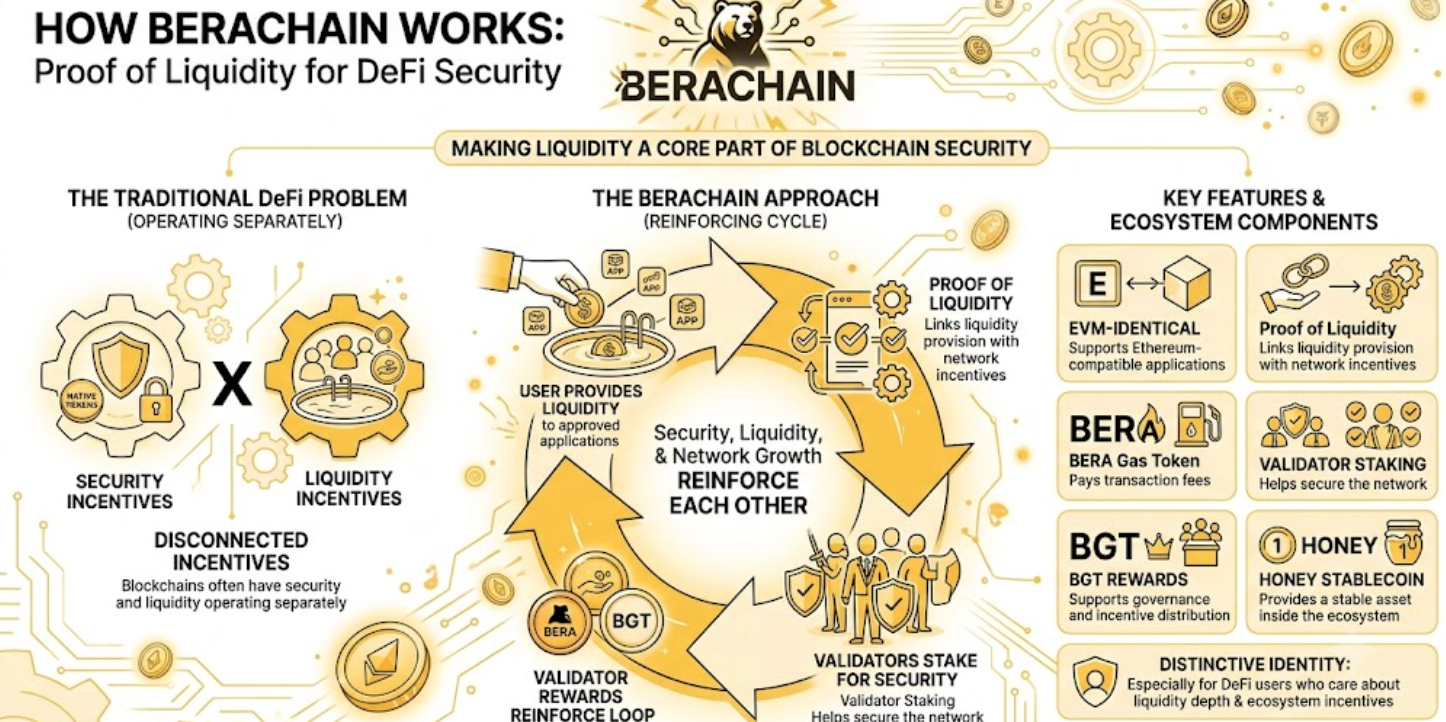
Berachain is designed to make liquidity a core part of blockchain security.
Most proof-of-stake networks rely on users locking a native token to secure the chain. Berachain takes a different approach by using Proof of Liquidity, which aims to reward users who provide liquidity to approved ecosystem applications.
This design attempts to solve a common DeFi problem: blockchains often have security incentives and liquidity incentives operating separately. Berachain tries to connect them so that network growth, application liquidity, and validator rewards reinforce each other.
| Feature | Why It Matters |
|---|---|
| EVM-Identical Design | Supports Ethereum-compatible applications |
| Proof of Liquidity | Links liquidity provision with network incentives |
| BERA Gas Token | Pays transaction fees |
| Validator Staking | Helps secure the network |
| BGT Rewards | Supports governance and incentive distribution |
| HONEY Stablecoin | Provides a stable asset inside the ecosystem |
This structure gives Berachain a distinctive identity, especially for DeFi users who care about liquidity depth and ecosystem incentives.
BERA, BGT, and HONEY Explained
Berachain uses a multi-token model.
BERA is the gas and staking token. Users need BERA to pay transaction fees, and validators use BERA as part of network security.
BGT, or Berachain Governance Token, is connected to governance and rewards. It is commonly described as non-transferable, meaning users earn it through participation rather than simply buying it like a normal token.
HONEY is Berachain's native stablecoin, designed to support trading, liquidity, and DeFi activity within the ecosystem.
| Token | Main Function |
|---|---|
| BERA | Gas fees, staking, validator security |
| BGT | Governance and ecosystem rewards |
| HONEY | Stablecoin for DeFi activity |
| sWBERA | Staked BERA representation in certain staking contexts |
This multi-token system is important because BERA crypto coin does not operate alone. Its demand may be influenced by how users interact with BGT rewards, HONEY liquidity, and Berachain DeFi applications.
What Is Proof of Liquidity?
Proof of Liquidity is Berachain's core innovation.
In simple terms, Proof of Liquidity is designed to reward users who bring liquidity into the Berachain ecosystem. Instead of treating liquidity providers as separate from validators and governance participants, Berachain tries to connect those roles through incentives.
The goal is to create a stronger relationship between network security and real economic activity.
| Proof of Liquidity Element | Description |
|---|---|
| Liquidity Providers | Supply assets to approved ecosystem pools |
| Validators | Secure the network and participate in block production |
| BGT Emissions | Help direct incentives across the ecosystem |
| Governance | Influences where rewards and incentives flow |
| BERA Staking | Supports validator security and network participation |
If successful, Proof of Liquidity could make Berachain more attractive to DeFi applications. However, the model is still complex, and investors should understand that incentive systems can change over time.
BERA Tokenomics: What Investors Should Know
BERA tokenomics are important because supply structure affects long-term valuation.
Berachain documentation lists a genesis supply of 500 million BERA. BERA is used for transaction fees, staking, and validator security. Fee usage can create token demand, while vesting schedules, incentives, and emissions can influence supply pressure.
| Tokenomics Area | Why It Matters |
|---|---|
| Genesis Supply | Helps investors understand initial issuance |
| Circulating Supply | Shows available market supply |
| Vesting Schedule | Can create future sell pressure |
| Community Allocation | Supports ecosystem growth |
| Investor Allocation | May affect unlock risk |
| Staking Demand | Can reduce liquid supply |
| Fee Burning | May offset some supply pressure |
Investors should pay close attention to unlock dates, staking participation, validator incentives, and how much BERA is actively circulating.
Why BERA Crypto Coin Is Getting Attention
BERA crypto coin is getting attention because Berachain combines several strong crypto narratives.
It is a Layer 1 blockchain, it is compatible with Ethereum, it focuses on DeFi, and it uses a unique Proof of Liquidity model. These themes can attract developers, liquidity providers, validators, and speculative investors.
| Narrative Driver | Why Investors Notice It |
|---|---|
| New Layer 1 Network | Attracts ecosystem speculation |
| DeFi Liquidity Focus | Appeals to active on-chain users |
| Ethereum Compatibility | Reduces developer friction |
| Multi-Token Economy | Creates a distinctive incentive model |
| Staking and Governance | Encourages ecosystem participation |
| Community Momentum | Supports early adoption narratives |
This attention may support demand for BERA, but investors should separate ecosystem excitement from measurable adoption.
Is BERA Crypto Coin a Good Investment?
BERA crypto coin may appeal to investors who believe Berachain can become a major DeFi-focused Layer 1 network.
The bullish case depends on network adoption. If Berachain attracts strong DeFi applications, deep liquidity, active validators, real transaction demand, and sustainable BGT incentives, BERA could benefit from increased usage.
The bearish case is that new Layer 1 networks face intense competition. If liquidity incentives fade, applications fail to retain users, or token unlocks create sell pressure, BERA may struggle.
| Investment Factor | Bullish View | Risk View |
|---|---|---|
| Layer 1 Utility | BERA has real gas and staking use | Many Layer 1 tokens compete for users |
| Proof of Liquidity | Innovative DeFi incentive model | Complex and still relatively new |
| EVM Compatibility | Easier developer adoption | Compatibility alone does not guarantee usage |
| Staking Demand | May support long-term holding | Unlocks and emissions may pressure price |
| Ecosystem Growth | Could drive transaction demand | Incentive-driven activity may be temporary |
For most beginners, BERA should be treated as a high-risk Layer 1 and DeFi asset rather than a guaranteed growth token.
Key Risks of BERA Crypto Coin
BERA crypto coin carries several risks.
The first major risk is execution. Berachain's model depends on liquidity providers, validators, governance, and applications working together effectively. If incentives are poorly balanced, users may leave when rewards decline.
The second risk is token supply. Unlocks, investor allocations, and ecosystem incentives may create future selling pressure.
| Risk Factor | Potential Impact |
|---|---|
| Token Unlocks | New supply may pressure price |
| DeFi Liquidity Volatility | Liquidity can move quickly between chains |
| Smart Contract Risk | Bugs or exploits may damage trust |
| Validator Concentration | May affect network decentralization |
| Incentive Dependence | Activity may fall if rewards decline |
| Governance Complexity | Reward allocation may become contentious |
| Layer 1 Competition | Users may choose other ecosystems |
Because Berachain is deeply connected to DeFi activity, BERA investors should monitor both token price and ecosystem health.
How Beginners Should Research BERA
Before buying or trading BERA, beginners should review both the token and the network.
A good research process should include checking official documentation, tokenomics, ecosystem applications, staking data, liquidity metrics, and network activity. Investors should also compare Berachain with other Layer 1 and DeFi-focused ecosystems.
A practical checklist includes verifying the official BERA token contract and network, reviewing total supply and circulating supply, checking token unlock schedules, monitoring staking and validator participation, reviewing Berachain ecosystem dApps, tracking transaction activity and fees, understanding BGT and HONEY mechanics, reviewing smart contract and bridge risks, and avoiding overexposure to new Layer 1 tokens.
Users who want to explore broader crypto markets can create an account to access market tools and monitor supported digital assets.
Trading Considerations for BERA
BERA may experience strong volatility because it combines Layer 1 speculation, DeFi incentives, staking demand, and ecosystem growth expectations.
Short-term price movement may react to exchange listings, ecosystem launches, staking updates, BGT incentive changes, and broader market sentiment. Long-term performance depends more on whether Berachain can attract real users and durable liquidity.
Beginners should avoid judging BERA only by social media hype. Instead, they should compare price action with actual network metrics.
Existing users can access their trading dashboard to review market activity and manage risk exposure.
Where BERA Fits in the Crypto Market
BERA crypto coin fits into the Layer 1 and DeFi infrastructure category.
It is different from simple meme coins because it has direct network utility. It is also different from ordinary staking tokens because Berachain's Proof of Liquidity model connects network incentives with DeFi liquidity.
That makes BERA a more complex asset. Its value may depend on several factors at once: gas demand, staking demand, validator economics, BGT emissions, HONEY usage, application growth, and market sentiment.
Users exploring emerging crypto narratives can also explore platform rewards while learning how different blockchain ecosystems develop.
Conclusion
BERA crypto coin is the native gas and staking token of Berachain, an EVM-identical Layer 1 blockchain built around Proof of Liquidity. Its role includes transaction fees, staking, validator security, and broader ecosystem participation.
The strongest part of the BERA investment case is Berachain's differentiated DeFi design. If Proof of Liquidity attracts durable liquidity, real users, and strong applications, BERA may remain an important asset within the ecosystem.
The main risks are token unlocks, incentive-driven activity, smart contract exposure, validator concentration, and competition from other Layer 1 networks. Investors should evaluate BERA through data, not just ecosystem hype.
Cryptocurrency trading involves significant risk and may result in total loss. This article is for informational purposes only and does not constitute financial advice.
FAQ
What is BERA crypto coin?
BERA crypto coin is the native gas and staking token of Berachain, an EVM-identical Layer 1 blockchain focused on Proof of Liquidity.
What is Berachain?
Berachain is an Ethereum-compatible Layer 1 blockchain designed to align network security with DeFi liquidity through Proof of Liquidity.
What is BERA used for?
BERA is used for transaction fees, staking, validator participation, and network security within the Berachain ecosystem.
What is Proof of Liquidity?
Proof of Liquidity is Berachain's incentive model that connects liquidity provision, validator rewards, governance, and network security.
What are BGT and HONEY?
BGT is Berachain's governance and rewards token, while HONEY is the ecosystem stablecoin used in DeFi applications.
Is BERA crypto coin risky?
Yes. BERA carries risks including token unlocks, DeFi liquidity volatility, smart contract exposure, incentive dependence, and Layer 1 competition.
Is BERA suitable for beginners?
BERA may be difficult for beginners because it requires understanding Layer 1 networks, DeFi liquidity, staking, governance, and tokenomics.


