SpaceX token price has become a popular search term as traders look for crypto-native exposure to one of the most discussed private-market companies in 2026. The key point is that SpaceX token price does not automatically refer to an official SpaceX cryptocurrency. In practice, the phrase may point to tokenized stock products, synthetic exposure, pre-IPO themed markets, or unofficial community tokens that use the SpaceX name.
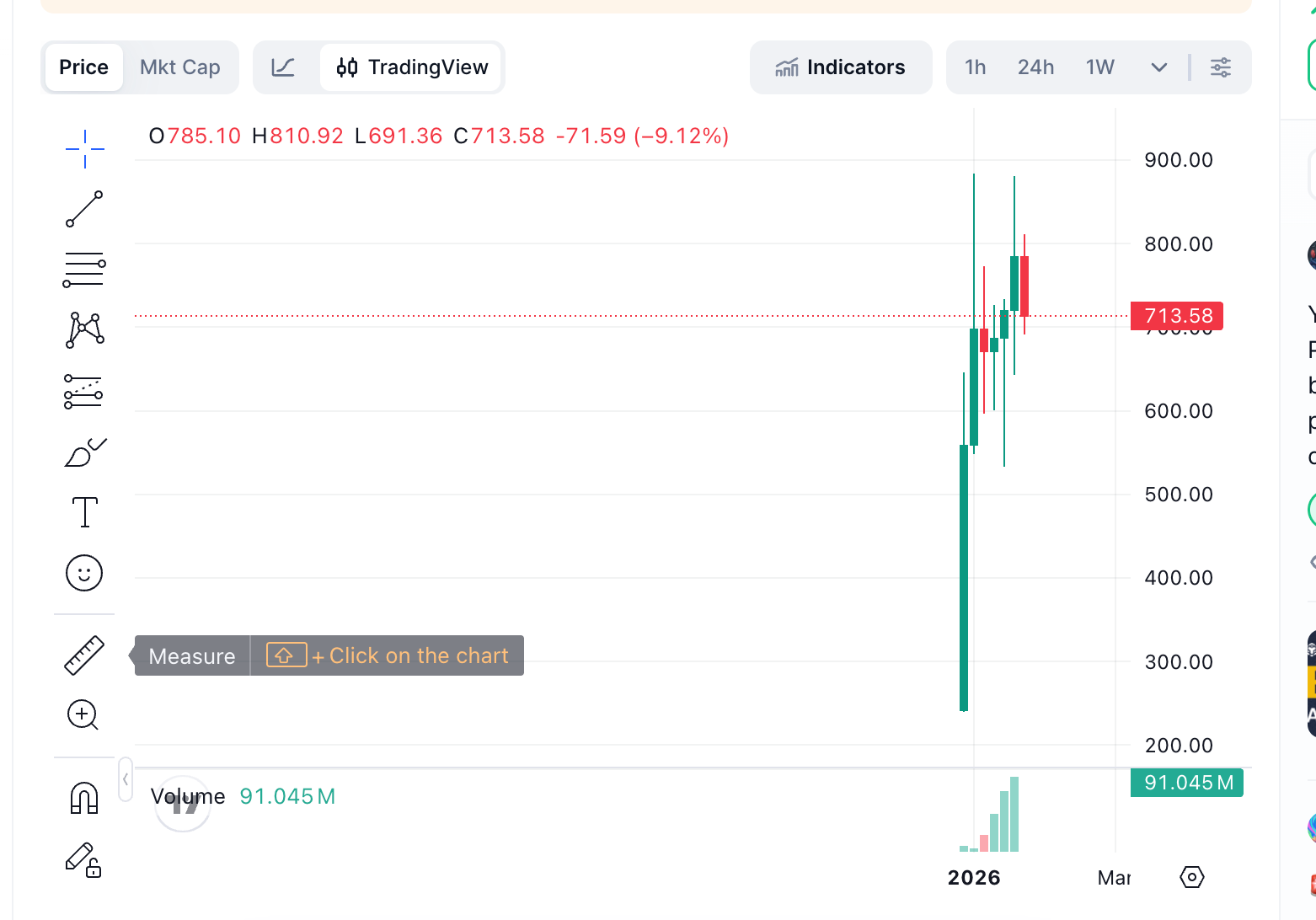
As of June 5, 2026, market data pages show several SpaceX-linked instruments rather than one universal token. Some pages describe tokenized stock-style products, while others may track synthetic or themed exposure. That means traders should not read one price chart and assume it represents direct ownership of SpaceX shares. A token may show a quoted price, 24-hour volume, market capitalization, and supply figures, but those numbers are only useful after investors understand what the product actually claims to represent.
What SpaceX Token Price Means in Practice
The phrase SpaceX token price can describe at least 3 different product types. The first is a tokenized stock-style instrument, which may claim economic exposure to a private or pre-IPO share structure. The second is a synthetic product, which may track an implied price without giving holders ordinary shareholder rights. The third is an unofficial themed token, which may simply use the SpaceX narrative for speculation and may have no formal relationship with the company.
This distinction matters because price is only one part of the story. A trader may see a token priced near several hundred dollars and assume it is comparable to a private-market share or future IPO price. That can be misleading. Supply, liquidity, redemption terms, issuer credibility, and legal documentation can all change how the price should be interpreted. For this reason, SpaceX token price should be treated as a research starting point rather than a buy signal.
SpaceX Token Price Checklist
| Factor | What to Check | Why It Matters |
|---|---|---|
| Issuer | Who created or manages the product? | A known issuer is easier to evaluate than an anonymous token. |
| Contract | Is the contract address clearly listed and consistent? | Wrong contracts can lead to copycat or scam tokens. |
| Liquidity | Are volume, spread, and order depth strong enough? | Thin liquidity can turn a small order into a large price move. |
| Rights | Does the token provide equity exposure, redemption, or only price tracking? | Rights determine whether holders own a claim or only speculation. |
| Valuation | How does the price compare with expected IPO or private-market discussion? | A large gap may signal premium pricing or weak price discovery. |
A simple rule is to verify at least 5 items before trading: issuer, contract address, liquidity, documentation, and rights. If even 2 of those items are unclear, the risk level rises sharply. This is especially true for assets connected to famous company names, because brand recognition can attract both legitimate products and low-quality imitations.
Why Prices Can Differ Across Platforms
Different SpaceX-linked products can show different prices because they are not always interchangeable. One product may have a small circulating supply, another may use a different pricing model, and another may trade mainly through limited liquidity pools. Even if 2 products both reference SpaceX, they may not have the same issuer, token economics, or holder rights.
Liquidity is one of the biggest reasons for price differences. If a token has only a shallow market, a single large buy or sell order can move the chart by 5%, 10%, or more in a short period. A token may also show a market capitalization that looks impressive while still having limited real trading depth. For active traders, this makes position sizing important. A small test position may reveal execution quality better than a full-size entry.
Is There an Official SpaceX Crypto Token?
Traders should be careful with this question. Public crypto data pages may list SpaceX-related tokenized products, but that does not prove SpaceX itself has issued a native cryptocurrency. Unless a claim is supported by SpaceX's official communications, regulatory filings, or product legal documents, investors should treat the token as third-party exposure.
The safest research process is to start with reputable data pages, then verify the product terms before considering any trade. If the token claims stock-linked exposure, read how the underlying asset is held, whether redemption is possible, and which jurisdictions are eligible. If the token is only a price-tracking product, then the SpaceX token price may behave more like a derivative or synthetic market than a share equivalent. Traders who need help navigating platform tools can use Tapbit support before making operational decisions.
Key Risks Behind SpaceX Token Price Charts
The main risks are confusion, liquidity, valuation gaps, legal uncertainty, and volatility. Confusion appears when traders assume a token is official because the name sounds familiar. Liquidity risk appears when it is hard to enter or exit without moving the market. Valuation risk appears when token prices diverge from private-market expectations or expected IPO pricing. Legal uncertainty appears when holders do not clearly understand whether they own equity-linked exposure, a derivative claim, or only a speculative token.
Risk management should come before excitement. Avoid leverage on unfamiliar products, decide a maximum position size in advance, and do not rely on social media screenshots as proof of legitimacy. If a product's documentation is vague, if the contract is difficult to verify, or if the chart moves sharply without clear news, waiting may be the better decision. In summary, SpaceX token price is useful for market research, but it should not be treated as financial advice or a guaranteed opportunity.


