
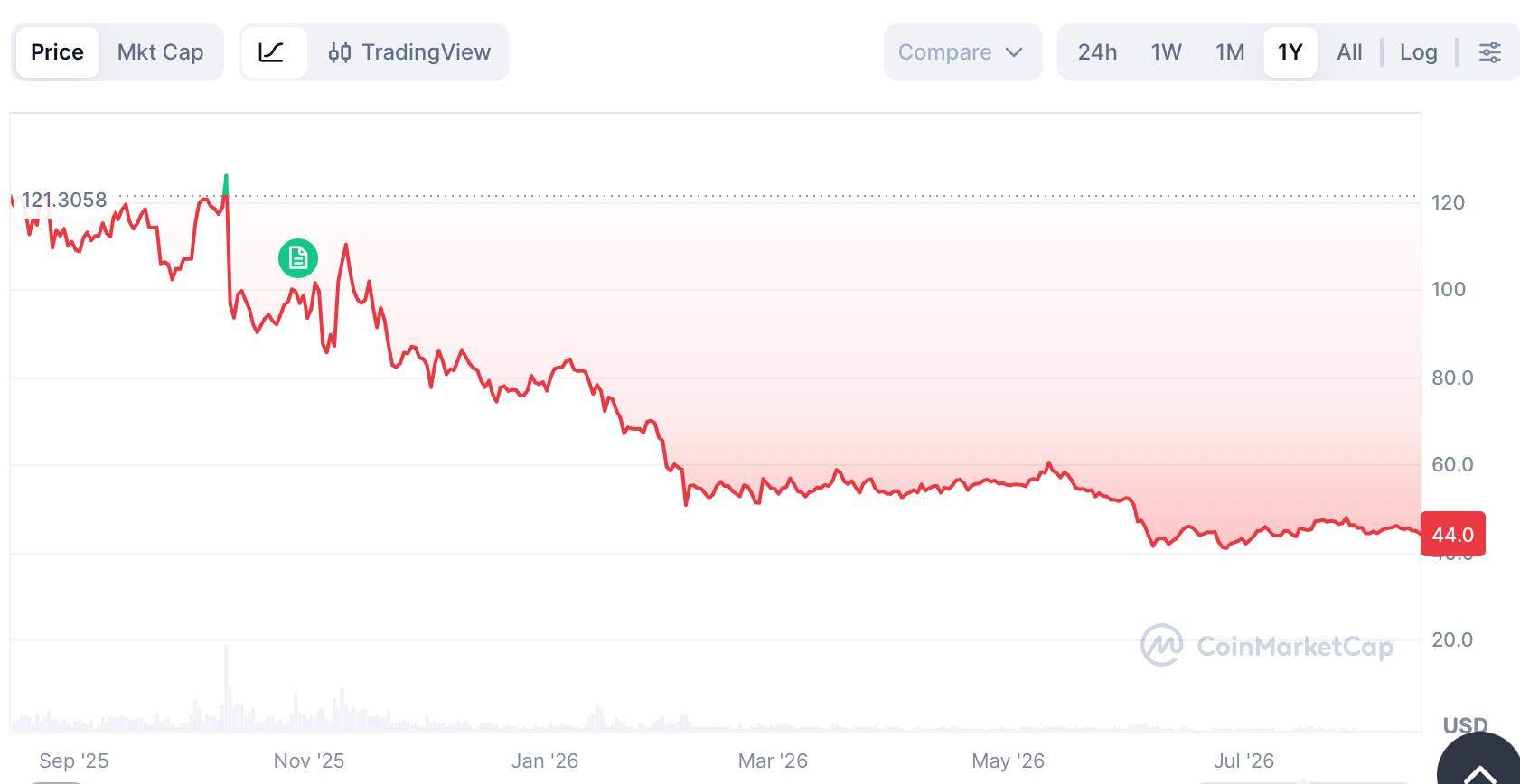
Litecoin has spent much of 2026 hovering around prices that predate the previous crypto bull market. At last check, LTC was trading near $45, with a market cap of about $3.5 billion — roughly 90% below its record high from 2021.
The price weakness, though, doesn't mean the network has been idle. A spot Litecoin ETF is now live in the US. Payment processors continue to report meaningful transaction volume. And developers are working to bring smart contracts to Litecoin via LitVM. The next halving is also less than a year away.
Still, the positives come with asterisks. ETF interest has been modest so far. LitVM is still in development. And earlier this year, a serious vulnerability in MWEB was exploited.
For anyone looking at Litecoin in 2026, the halving isn't the only thing worth watching — these other factors deserve equal attention.
Where Does Litecoin Stand in 2026?
Litecoin was launched in 2011 as a faster, lower-cost alternative to Bitcoin. It uses proof-of-work, has a maximum supply of 84 million LTC and produces a new block roughly every 2.5 minutes.
Its longevity remains one of its strongest qualities. LTC is widely supported by exchanges, wallets and payment services, while its relatively low transaction fees make it practical for smaller transfers. Unlike many older cryptocurrencies, Litecoin still has a recognizable use case: moving value without relying on a smart-contract-heavy ecosystem.
That reliability has not translated into strong recent price performance. LTC trades near $45 at the time of writing, down approximately 89% from its all-time high. The market is therefore placing a much lower value on Litecoin than it did during the speculative peak of 2021.
The question is whether the ETF, payment activity, network development and 2027 halving can change that valuation.
The Litecoin ETF Is Already Trading
The Canary Litecoin ETF began trading on Nasdaq under the ticker LTCC in October 2025. The fund holds LTC and is designed to track its price after fees and expenses.
This gives investors access to Litecoin through conventional brokerage and retirement accounts without requiring them to manage wallets or private keys. It also places Litecoin among the limited number of digital assets available through a standalone US spot ETF.
The existence of an ETF, however, should not be confused with strong ETF demand.
LTCC held approximately $5.85 million in net assets as of July 24, 2026. Its sponsor fee was 0.95%, and its net asset value return was down almost 40% for the year to that date. That is a small asset base compared with the major Bitcoin and Ether funds. The ETF has improved Litecoin’s accessibility, but it has not yet brought enough capital into the market to reshape LTC demand.
The wider ETF picture is also mixed. CoinShares withdrew its proposed Litecoin ETF registration in November 2025, stating that no shares had been sold under the filing. The SEC withdrawal notice confirms that the planned transaction was not completed.
Grayscale Litecoin Trust, traded under the symbol LTCN, remains a separate product.The trust did not operate a redemption program at that time. It should not be described as another functioning spot Litecoin ETF.
For LTC, the important measure from here is not the number of ETF headlines. It is whether LTCC begins attracting sustained net assets and trading activity.
Litecoin Still Has a Place in Crypto Payments
Payments are still the best signal that Litecoin has real utility beyond trading.
A CoinGate report, updated in February 2026, tracked 638,983 LTC payments from 2018 through August 2025. In the first eight months of last year, Litecoin accounted for 13.9% of all CoinGate transactions — ranking third behind Bitcoin and USDT.
The data also showed that LTC usage is concentrated in web hosting, proxy services, and gaming. The average order value was €44.50, which fits the narrative of routine digital purchases rather than large transfers.
It's just one payment processor, so take it for what it is. Still, completed merchant payments tell you more about how people actually use LTC than raw on-chain activity does. Blockchain transactions can be generated for all sorts of reasons — paying for goods and services is a more specific signal.
The payment side is also evolving. In May 2026, Nexus Wallet added gift card purchases alongside Tor and MWEB features, giving users more ways to spend LTC. The actual volume impact isn't clear yet, but it's a step forward.
Litecoin doesn't have to be the king of payments. It just has to show that low fees, broad wallet support, and merchant acceptance keep generating repeat use. So far, that case is still intact.
What Happened to Litecoin MWEB?
MWEB brought confidential transactions and improved fungibility to Litecoin. It was a major technical step forward — but it also turned into the network's most serious security incident to date.
According to the team's postmortem, a critical validation bug was identified in March 2026. The vulnerability allowed a malicious block producer to make a small MWEB input appear to back a much larger withdrawal into the transparent LTC ledger. By the time developers found it, it had already been exploited. An attacker had created an invalid peg-out worth over 85,000 LTC.
The team moved quickly — coordinating with miners, freezing the affected outputs, and contacting the attacker. Most of the funds were eventually returned, with 850 LTC kept as a bug bounty.
A later attempt to reuse the same exploit was rejected by upgraded nodes, but it exposed a secondary issue. Some miners continued building on an invalid chain, leading to a 13-block reorganization and temporary disruptions for several services.
Litecoin Core 0.21.5.4 fixed the initial bug, while 0.21.5.5 added further MWEB validation and reliability improvements. Node operators, miners and wallet users are strongly urged to upgrade.
The recovery prevented permanent losses, but this wasn't just a routine patch. A consensus-level bug was exploited, and resolving it required emergency coordination. Confidence in MWEB from here will depend on stable operation, widespread adoption of patched software, and continued scrutiny of its validation logic.
Can LitVM Give Litecoin a Larger Ecosystem?
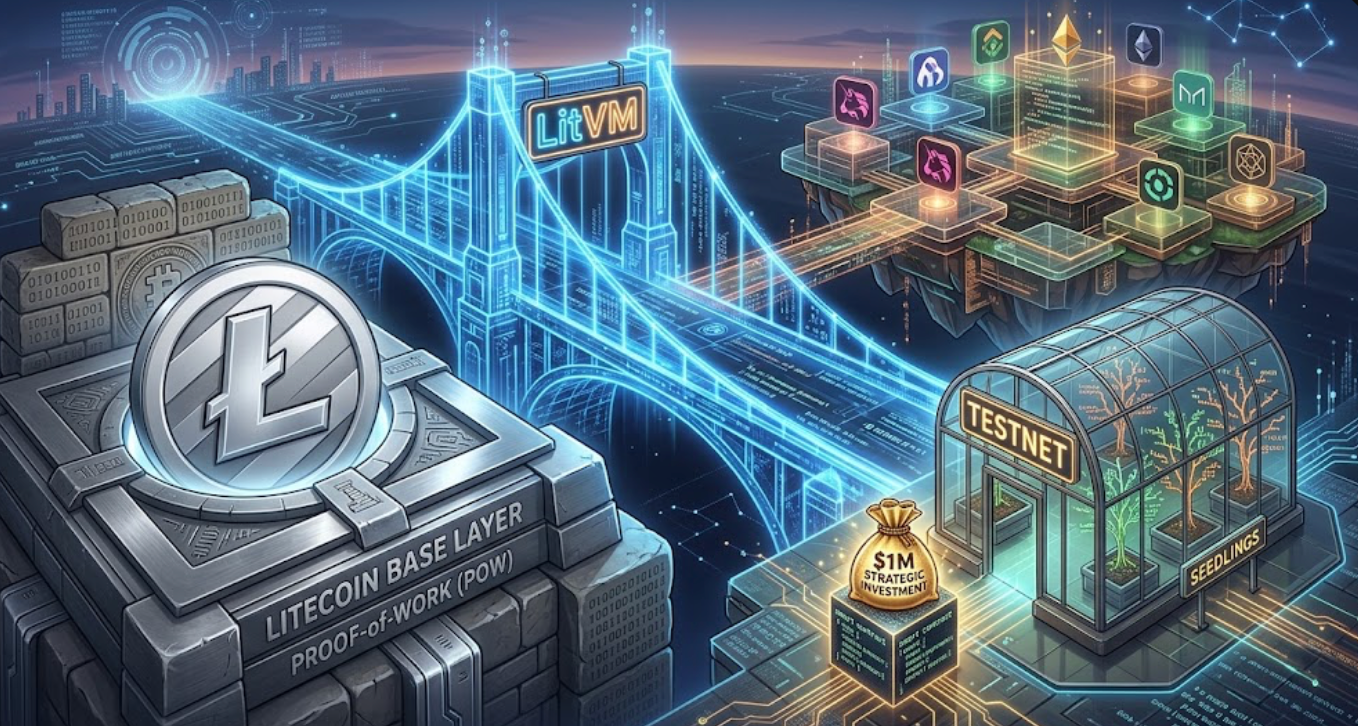
Litecoin has historically focused on payments rather than decentralized applications. LitVM is an attempt to broaden that role by introducing an EVM-compatible environment connected to Litecoin.
The project is designed to support smart contracts and applications without changing Litecoin’s base-layer identity. Potential uses include decentralized finance, tokenized assets and applications that use LTC within programmable financial services.
Progress is visible, but the project remains early. The LitVM development blog has published a LiteForge testnet guide, developer materials and a mainnet rollout plan. Lite Strategy also announced a $1 million strategic investment in LitVM in June 2026.
These developments show that work is taking place. They do not yet demonstrate a mature application ecosystem or durable demand for LTC inside smart contracts. Testnet transactions, funding announcements and developer campaigns are useful milestones, but they are different from mainnet liquidity, active users and recurring fees.
LitVM could expand Litecoin beyond payments. Its significance will become clearer when applications are live, users are committing capital and activity can be measured over time.
What the 2027 Litecoin Halving Changes
Litecoin reduces its mining reward every 840,000 blocks. The next halving is expected at block 3,360,000, when the reward will fall from 6.25 LTC to 3.125 LTC.
Based on current block production, the event is projected for around July 27, 2027. That date is an estimate rather than a fixed appointment because the network does not produce every block at exactly the same speed.
The halving will reduce daily issuance from approximately 3,600 LTC to 1,800 LTC. In dollar terms, the effect depends on the LTC price when the event occurs. A lower issuance rate can reduce potential selling pressure from miners, but only if demand remains stable enough to absorb the available supply.
Previous halvings have attracted speculation well before the event. They have not produced a simple or repeatable price pattern. Traders can anticipate the reduction months in advance, meaning part of the expected effect may be reflected in the market before the reward actually changes.
Mining conditions also matter. A lower reward can pressure miners with high operating costs, particularly if the price and transaction fees do not compensate for the lost subsidy. Hashrate, mining difficulty and miner behavior will therefore be important alongside the LTC price.
What Could Support LTC?
Litecoin has several credible sources of support. Its spot ETF provides a regulated route for US investors, even though the fund is currently small. Payment data shows continued use at merchants, while its established exchange and wallet support makes LTC easier to access than many newer assets.
A successful LitVM launch could give LTC more utility within smart contracts. The 2027 halving will also reduce new supply at a time when most of Litecoin’s maximum supply is already circulating.
None of these developments works in isolation. The more convincing case would combine rising ETF assets, stable payment demand, measurable application activity and continued network reliability. One strong metric would help, but several improving together would provide a clearer change in Litecoin’s market position.
What Will Define Litecoin’s Next Chapter?
Litecoin enters the final year before its next halving with a mixed set of signals.
It now has a US spot ETF, but that fund remains small. Its payment use is supported by merchant data, although stablecoins present stronger competition than they did during earlier market cycles. LitVM offers a possible route into smart contracts, but it has not yet demonstrated broad economic activity. The MWEB exploit was resolved, yet it remains an important test of the network’s technical governance.
The most useful signals to follow are therefore practical ones: changes in LTCC net assets, merchant payment share, LitVM mainnet usage, Litecoin transaction fees, mining activity and adoption of the latest Core software.
LTC does not need another short-lived rally to prove that it remains relevant. It needs evidence that people are holding, using and building with it for reasons that can survive beyond the next market headline.
Readers can follow crypto market research and educational coverage through Tapbit. Existing users can log in here, while new users can create an account.
Frequently Asked Questions
Is Litecoin worth investing in during 2026?
That depends on an individual’s objectives and tolerance for risk. Litecoin has an established payment network, broad market support and a US spot ETF, but it also faces weak price momentum, strong competition and technical risks. The ETF, LitVM and 2027 halving should be evaluated using measurable adoption rather than assumed future returns.
Does Litecoin have a spot ETF?
Yes. The Canary Litecoin ETF trades on Nasdaq under the ticker LTCC. It began trading in October 2025 and holds LTC to provide price exposure after fees and expenses.
Has the Litecoin ETF attracted strong institutional demand?
Not yet. LTCC reported approximately $5.85 million in net assets as of July 24, 2026. The product provides a regulated access route, but its current size is modest compared with major Bitcoin and Ether ETFs.


