

ERC-404 is back on traders’ watchlists as hybrid token standards regain attention across the crypto market. According to CoinGecko category data, ERC-404 remains a small but active niche, while the broader Hybrid Token Standards category has recently seen stronger market interest.
The renewed attention does not mean ERC-404 has become a mainstream Ethereum standard. It is still experimental. But it does point to a bigger conversation in crypto: how can NFTs become more liquid, tradable, and useful without losing their unique digital ownership features?
What Is ERC-404?
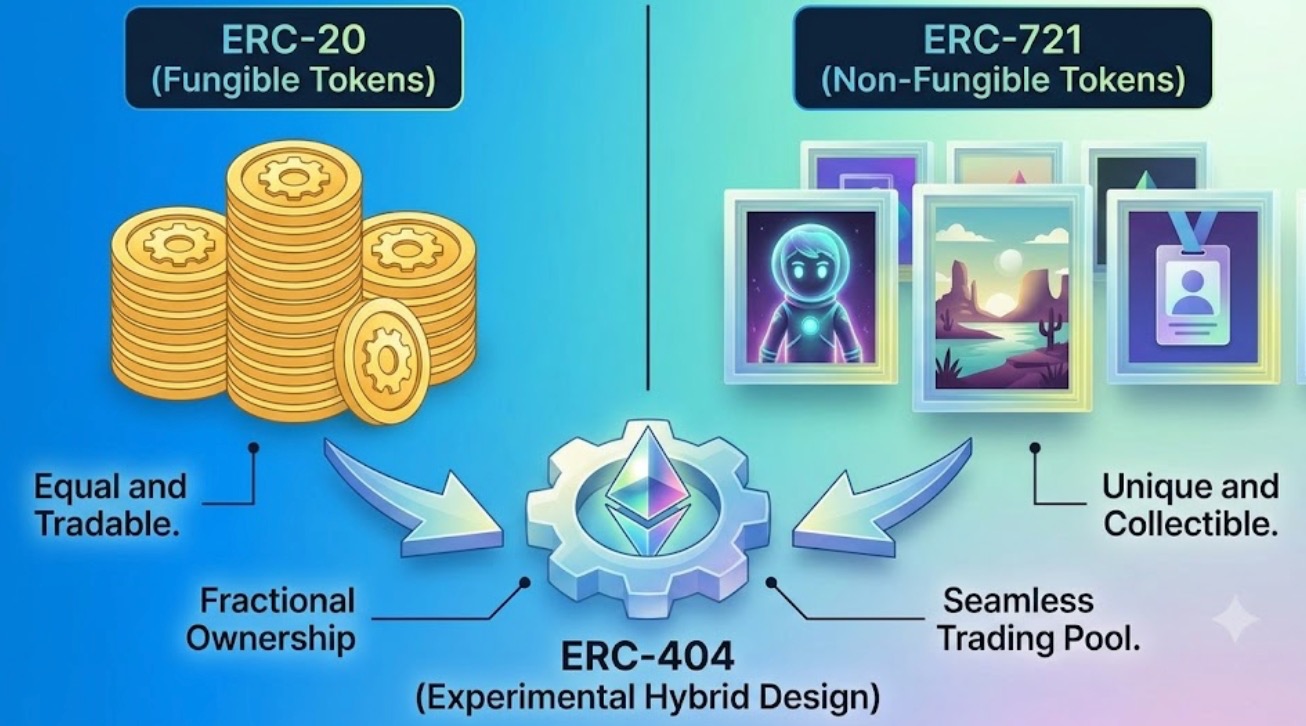
ERC-404 is an experimental token design that combines features of ERC-20 tokens and ERC-721 NFTs.
ERC-20 tokens are fungible. One token is equal to another token of the same type, which makes them easy to trade on exchanges and decentralized markets.
ERC-721 tokens are non-fungible. Each NFT is unique, which makes them useful for digital collectibles, game assets, art, and identity-based ownership.
ERC-404 tries to bring these two models together. In simple terms, it allows a token to behave partly like a tradable coin and partly like an NFT. The goal is to create NFTs that can have better liquidity, fractional ownership, and smoother trading behavior.
That is why ERC-404 is often described as a “hybrid token standard.”
Why Is ERC-404 Getting Attention Again?
The main reason is that NFT liquidity remains one of the hardest problems in the market.
Traditional NFTs can be difficult to sell quickly because each asset is unique. A seller often needs to wait for a buyer who wants that exact NFT at that exact price. By contrast, ERC-20 tokens can usually be traded more easily because they are fungible and can be pooled in liquid markets.
ERC-404 attempts to narrow that gap. It gives NFT-like assets a more liquid structure, which may help traders enter and exit positions more efficiently.
Recent market data also shows renewed interest in hybrid token categories. CoinGecko’s ERC-404 and Hybrid Token Standards pages list projects such as Pandora, DeFrogs, Pundi X PURSE, MYSTCL, and OnChain Pepe 404 among tokens associated with this experimental sector.
For readers tracking emerging crypto narratives, the key takeaway is not that ERC-404 is suddenly risk-free. It is that the market is once again paying attention to token designs that try to solve NFT liquidity.
How ERC-404 Combines ERC-20 and ERC-721
ERC-404 works by linking fungible token balances with NFT ownership behavior.
For example, holding a certain amount of an ERC-404 token may correspond to ownership of an NFT. When token balances change, NFT minting or burning mechanics may also be triggered depending on the specific implementation.
This design creates a more flexible ownership model. Instead of an NFT being a single illiquid asset, ERC-404 can make exposure to that asset more tradable.
That said, the design is complex. Minting, burning, transfers, and liquidity pool behavior all need to work together correctly. If the contract logic is poorly designed, users may face unexpected outcomes, higher costs, or compatibility issues with wallets and marketplaces.
Key ERC-404 Projects to Watch
Pandora is the best-known project associated with ERC-404. It helped bring the concept into wider discussion and remains a reference point for the category.
DeFrogs is another early ERC-404-linked project that gained attention during the first wave of hybrid token interest.
Other projects listed in the ERC-404 category include Pundi X PURSE, MYSTCL, and OnChain Pepe 404. Some of these assets have shown short-term price activity, but liquidity across the category remains relatively small compared with larger crypto sectors.
This is important for traders. A small category can move quickly, but it can also reverse quickly. Thin liquidity may exaggerate both gains and losses.
Users who want to monitor broader crypto market conditions can visit the Tapbit homepage. Existing users can access their accounts through Tapbit login, while new users can start from the Tapbit registration page.
Why Hybrid Token Standards Matter
Hybrid token standards matter because they explore a real market problem.
NFTs introduced digital ownership, but many NFT markets struggled with low liquidity, wide bid-ask spreads, and sharp price volatility. ERC-404 and similar experiments try to make NFT exposure easier to trade by borrowing some features from fungible token markets.
If this design space improves, it could influence several areas of crypto:
-
NFT trading: Hybrid standards may make NFT markets more liquid.
-
Gaming assets: In-game items could become easier to trade or fractionalize.
-
Collectibles: High-value digital collectibles could become more accessible to smaller holders.
-
DeFi integrations: NFT-linked assets may become easier to use in liquidity pools or lending markets.
However, these are possibilities, not guarantees. The category still needs stronger infrastructure, better audits, wider wallet support, and more proven use cases.
The Risks Behind ERC-404
The biggest risk is that ERC-404 is experimental. It is not an official Ethereum token standard in the same way ERC-20 or ERC-721 is widely recognized.
Pandora Labs’ ERC-404 GitHub repository has also warned that the implementation is experimental and not fully tested or audited for production use. That matters. Experimental token contracts can carry smart contract risk, marketplace compatibility issues, and unexpected transfer behavior.
There are also trading risks. ERC-404 tokens often have smaller market caps and lower trading volume than major crypto assets. Lower liquidity can lead to sharp price swings, slippage, and faster drawdowns.
Gas costs are another concern. Because ERC-404 designs may involve both token transfers and NFT minting or burning logic, transactions can become more expensive or complex than standard ERC-20 transfers.
Finally, narrative risk is high. Experimental token standards can attract attention quickly, but attention can fade just as quickly if the market does not see real adoption.
Bottom Line
ERC-404 is gaining attention because it sits at the intersection of two important crypto ideas: NFT ownership and token liquidity. By combining ERC-20-style tradability with ERC-721-style uniqueness, it offers a new way to think about digital assets.
But ERC-404 is still early, experimental, and risky. Its recent market activity should be viewed as a sign of renewed interest in hybrid token design, not as proof that the category has already matured.
For traders and learners, the best approach is to understand the mechanism first, watch liquidity closely, and treat ERC-404 as a high-risk experimental sector within the broader crypto market.
Traders can track live market conditions through the Tapbit homepage. Existing users can access their accounts through Tapbit login, while new users can begin from the Tapbit registration page.
Frequently Asked Questions (FAQ)
What is ERC-404?
ERC-404 is an experimental hybrid token design that combines features of ERC-20 tokens and ERC-721 NFTs. It aims to make NFT-like assets more liquid and tradable by giving them some fungible token behavior.
Is ERC-404 an official Ethereum standard?
No. ERC-404 is not an official Ethereum token standard like ERC-20 or ERC-721. It is an experimental implementation, which means users should pay close attention to smart contract risk, compatibility issues, and project-level audits.
Why is ERC-404 getting attention again?
ERC-404 is gaining attention because traders are looking again at hybrid token standards, NFT liquidity solutions, and experimental token designs. The idea is especially relevant because traditional NFTs can be hard to sell quickly compared with fungible tokens.


