

Cronos has delivered no shortage of announcements in 2026. A new trading app has entered beta, the network has added native stablecoin infrastructure, Crypto.com has secured a major institutional investment, and two proposed U.S. funds are seeking exposure to CRO.
The price has told a less exciting story.
As of August 6, 2026, CRO was trading near $0.0537, down about 1.5% over seven days. Its market capitalization stood at roughly $2.54 billion, while daily trading volume was only around $3.5 million. CRO was also trading about 94% below its record high.
That contrast is the central issue for anyone researching CRO. Cronos is rebuilding its product strategy, but the market has not yet seen enough adoption or revenue to treat that strategy as a completed turnaround.
Where CRO Stands Now
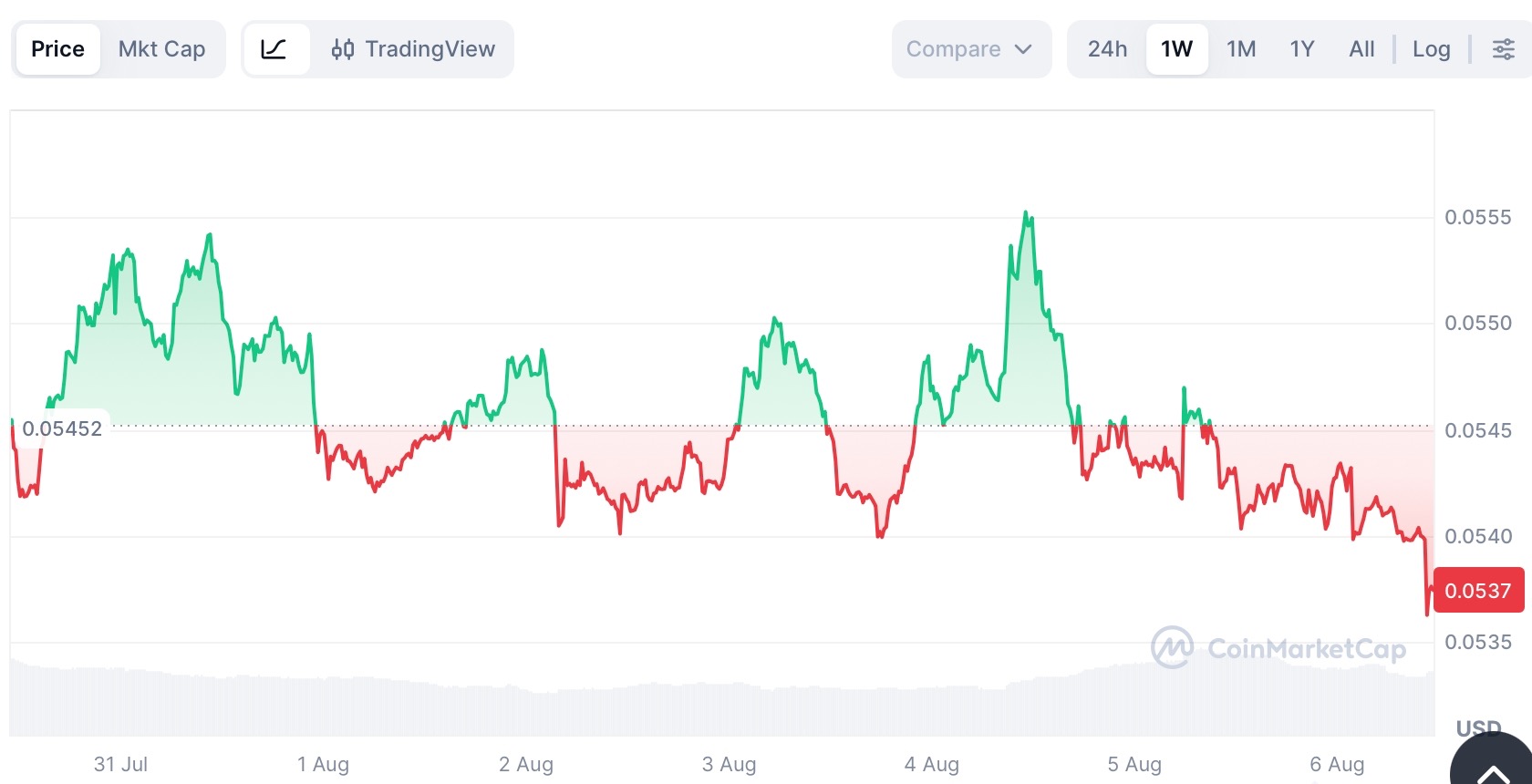
CRO traded near $0.0699 on April 22, when several 2026 price forecasts placed it between $0.07 and $0.15. By early August, the token had fallen roughly 23% from that level and moved below the lower end of those forecasts.
This does not mean a recovery is impossible. It does show why fixed price targets are unreliable. A forecast can quickly become outdated when liquidity weakens, the wider market changes or a product takes longer than expected to attract users.
According to CoinGecko, approximately 47 billion CRO are currently circulating. The token’s fully diluted valuation is about $5.31 billion, more than twice its circulating market capitalization. That difference deserves as much attention as the price chart.
Cronos App Is the Main Product Bet
The most important new development is the Cronos App, which entered beta in July. It is designed as a mobile, self-custody trading platform that brings crypto, stocks and prediction markets into one account. Planned features also include borrowing and yield products, although availability depends on local regulations.
Cronos is placing considerable weight on this product. The app is not being presented as another wallet. It is intended to become the commercial engine behind the network’s next phase.
The reasoning is straightforward. Trading activity can produce fees. Those fees can support operations, user acquisition, staking rewards and CRO buybacks or burns. If the app attracts a meaningful user base, CRO could gain a clearer link to recurring economic activity.
The beta launch is an important step, but there is not yet enough public data to judge the result. Cronos has not disclosed meaningful figures for active users, trading volume, revenue or completed CRO buybacks. Until those numbers appear, the app remains a promising product under development rather than proof of stronger token demand.
What the New CRO Tokenomics Actually Mean
Cronos is also changing how staking rewards are funded.
Under the new model, token emissions are expected to decline by approximately 6.8% each month toward zero. Revenue from the Cronos App and the wider ecosystem is supposed to take over gradually, supporting staking rewards, development, user growth and CRO buybacks or burns.
During the transition, the strategic reserve will continue supplementing staking rewards. Cronos describes this reserve as a bridge between the current emissions-based system and a future model supported by product revenue.
This is a more sustainable idea than relying indefinitely on token issuance. It also creates a test that investors can measure. Cronos App revenue must eventually become large enough to replace the rewards currently supported by emissions and reserve distributions.
If that happens, CRO would have a stronger economic foundation. If app revenue remains limited, the system will continue depending on tokens already held in reserve.
Supply Is Still Part of the Investment Case
CRO has a maximum supply of 100 billion tokens. Cronos states that this hard cap cannot be exceeded and that no additional tokens will be minted beyond it.
A fixed maximum supply does not eliminate dilution risk. With roughly 47 billion CRO currently circulating, a substantial portion of the supply remains outside the market. The strategic reserve follows a multi-year release schedule intended to fund staking, network security, developer activity and ecosystem expansion.
Those releases may support growth, but they can also increase the number of tradable tokens. Their effect will depend on how quickly they enter circulation, whether they are locked or staked, and whether buybacks and burns remove enough CRO to offset them.
For that reason, the market should track circulating supply rather than relying only on the 100 billion hard cap.
Crypto.com’s Institutional Funding Matters, but Not in the Way Some Headlines Suggest

On July 16, Citadel Securities announced a $400 million strategic investment in Crypto.com, valuing the company at $20 billion. Crypto.com said the funding would support its expansion into tokenized securities, derivatives and other global asset classes.
The investment adds institutional credibility and gives Crypto.com more capital to develop its trading infrastructure. It also fits the direction Cronos is pursuing through tokenized markets and round-the-clock settlement.
However, the transaction was an investment in Crypto.com, not a $400 million purchase of CRO. It does not automatically reduce CRO supply or create an equivalent amount of buying pressure.
The connection becomes relevant only if Crypto.com’s expansion produces more users, assets and transactions on Cronos, or if its products create a direct need for CRO. That link should be measured through adoption rather than assumed from the size of the investment.
The Network Has Added Useful Infrastructure
Cronos has made several practical improvements since June. Native USDC and EURC are now available on the network, alongside Circle’s Cross-Chain Transfer Protocol. These integrations can make it easier to move regulated stablecoins between supported chains without relying on wrapped versions.
Cronos also integrated with Dune in July, making transactions, contract activity and settlement flows easier to examine. Alchemy’s RPC infrastructure and gasless transaction tools followed later in the month.
These changes improve the environment for developers and users. Native stablecoins are particularly relevant to the network’s plans for trading and tokenized assets, where settlement liquidity matters.
Infrastructure alone does not create demand, however. Its value will be clearer if it leads to higher stablecoin balances, deeper DEX liquidity and more active users.
Why Cronos Is Closing Its zkEVM Alpha
Cronos announced in June that its zkEVM Alpha network will shut down permanently on June 3, 2027. Applications and users have been given a 12-month period to withdraw or migrate assets, with Cronos EVM identified as the preferred destination.
The official explanation was unusually direct: zkEVM Alpha did not attract enough developers, TVL or users to justify maintaining two separate networks.
Concentrating resources on Cronos EVM and the new app could improve execution. Running fewer networks reduces technical fragmentation and allows the team to focus on products with clearer commercial goals.
The decision also acknowledges that part of Cronos’ previous expansion did not reach the required scale. Users with assets on zkEVM Alpha should follow the official migration and shutdown notice rather than assuming those assets will move automatically.
Are CRO ETFs Coming to the United States?
There are two notable U.S. filings connected to CRO. 21Shares filed a registration statement for a proposed Cronos ETF in March. Truth Social Funds separately filed for a Cronos Yield Maximizer ETF intended to track CRO while incorporating staking rewards.
Neither filing should be described as a completed approval. Registration documents begin a regulatory process; they do not guarantee that a product will launch. The available filings still contain incomplete listing details and language allowing the effective date to be delayed.
The applications may bring greater attention to CRO, but their market impact depends on approval, launch timing and actual investor demand.
What Would Support a CRO Recovery?
A sustainable recovery would require more than additional announcements.
The strongest evidence would be rising Cronos App usage accompanied by published revenue, consistent CRO buybacks or burns, higher stablecoin liquidity and stronger on-chain trading activity. A slower increase in circulating supply would also improve the balance between demand and available tokens.
Growth at Crypto.com could help, particularly if its tokenized asset and derivatives products use Cronos for settlement. That connection must be visible in transaction and revenue data before it can support a stronger valuation argument.
Users following CRO and other digital assets can explore current markets and educational content through Tapbit.
Can CRO Recover in 2026?
CRO has a more focused strategy than it did earlier in the year. Cronos is building a product intended to generate revenue, reducing its reliance on emissions and concentrating development on one EVM network. Crypto.com’s institutional funding and the addition of native stablecoins provide further support.
The missing piece is adoption.
At roughly $0.0537, CRO is trading below many earlier 2026 forecasts. On-chain fees, trading activity and active addresses remain modest, while the fully diluted valuation reflects substantial supply that has not yet entered circulation.
A recovery is possible if the Cronos App turns its beta launch into real volume and revenue. Until then, CRO is better viewed as an execution-dependent ecosystem token than as a confirmed turnaround.
Existing users can log in to Tapbit, while new users can register here to explore the markets available on the platform.
Frequently Asked Questions
What is Cronos (CRO)?
CRO is the native token of the Cronos network. It is used to pay network fees, secure the blockchain through staking and participate in applications built within the Cronos ecosystem. CRO is also closely associated with Crypto.com, although Cronos and Crypto.com are not the same organization.
Why is CRO still attracting attention in 2026?
Interest is being driven by the Cronos App beta, a redesigned tokenomics model, new stablecoin infrastructure and Crypto.com’s expansion into tokenized assets and derivatives. Proposed CRO-related ETFs have also added to the discussion, but none of these developments guarantees higher token prices.
What is the Cronos App?
The Cronos App is a mobile, self-custody platform designed to offer access to crypto, stocks and prediction markets through one account. It entered beta in July 2026. Cronos intends to use revenue generated by the app to support staking, ecosystem development and CRO buybacks or burns.


