

Michael Saylor changed the way public markets talk about Bitcoin. Before Strategy went all in on BTC, most companies treated crypto as something outside the corporate balance sheet. Saylor flipped that conversation. He turned Bitcoin into a treasury strategy, a shareholder story, and eventually, a public-market proxy for investors who wanted leveraged exposure to BTC.
For a long time, the trade worked. When Bitcoin went up, Strategy looked brilliant. The company could raise capital, buy more BTC, and turn its balance sheet into one of the most closely watched Bitcoin positions in the world. Investors who believed in BTC often treated Strategy as more than a software company. It became a Bitcoin vehicle.
But every strategy looks cleaner in a bull market.
Now, with Strategy’s STRC preferred shares trading below their $100 stated amount, the market is asking a more uncomfortable question: what happens when the financing machine behind the Bitcoin trade starts to look stressed?
That is why Ripple CEO Brad Garlinghouse’s comments landed at the right moment. His criticism was not really about whether Bitcoin has a future. It was about the way Strategy keeps building its Bitcoin position through capital markets.
In other words, the debate is no longer just “Do institutions want Bitcoin?” It is becoming “What kind of structure are they using to get it?”
Garlinghouse Is Criticizing the Structure, Not Just the Asset

It would be too simple to frame this as Ripple versus Bitcoin. Garlinghouse has said he remains constructive on Bitcoin. His criticism is aimed more directly at the financial structure around Strategy’s BTC accumulation.
His argument is that using preferred shares, convertibles, common stock issuance, or other financing tools to keep buying Bitcoin does not create crypto utility. It creates more exposure. It adds leverage. It ties a volatile digital asset to corporate funding conditions.
That is a very different issue from whether BTC itself has value. A company using spare cash to buy Bitcoin is one thing. A company repeatedly raising capital to increase a concentrated Bitcoin position is another. The second version depends not only on Bitcoin’s price, but also on investor appetite, equity-market conditions, credit confidence, and whether funding channels remain open.
This is where Garlinghouse sees the problem. To him, long-term crypto value should come from real usage: payments, settlement, financial infrastructure, tokenization, developer activity, and actual demand. From that perspective, financial engineering may create momentum for a while, but it does not solve the deeper question of utility.
Saylor’s view is different. He sees Bitcoin as the asset. The point is to accumulate as much of it as possible, as efficiently as possible, because the long-term monetary thesis is what matters.
Both sides are talking about crypto value. They are just starting from completely different assumptions.
Why STRC Matters
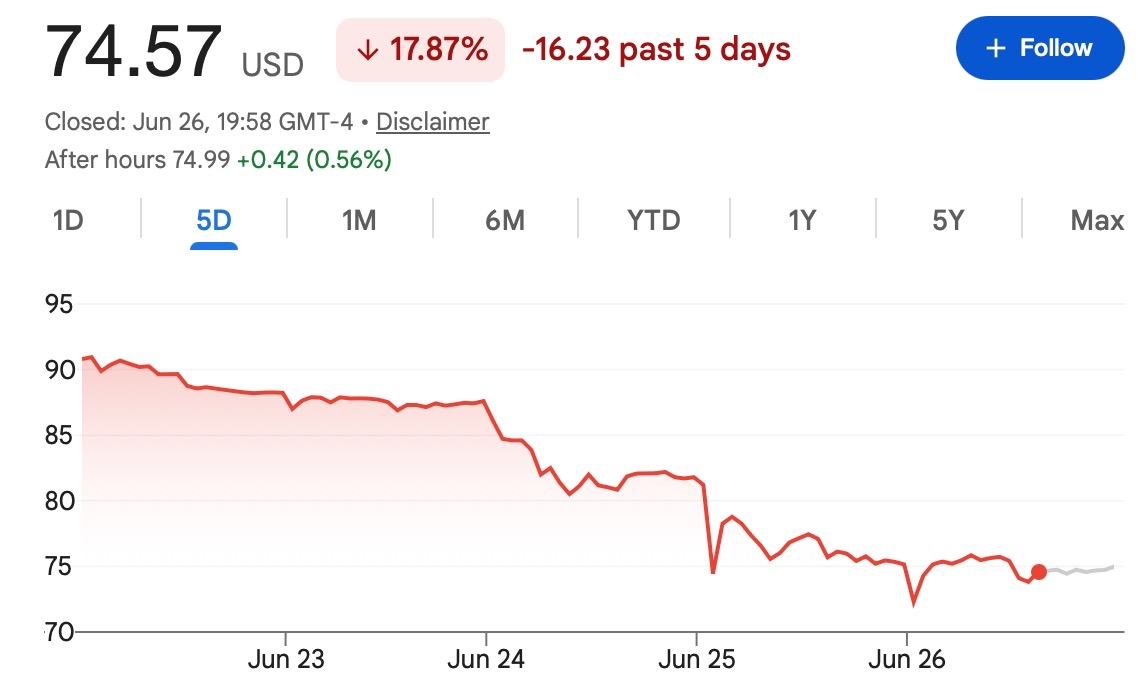
STRC became the center of this debate because it shows how investors are pricing Strategy’s financing model. STRC is a perpetual preferred stock with a stated amount of $100 and a high dividend rate. It was built as part of Strategy’s broader capital-raising toolkit. In simple terms, it gave the company another way to raise money while continuing to support its Bitcoin accumulation strategy.
That works best when the instrument trades close to par or above it. When it trades meaningfully below $100, the message changes. Investors are no longer saying, “We want more of this exposure at full price.” They are saying, “We need a bigger discount for the risk.”
That does not mean Strategy is collapsing. It does not mean the Bitcoin thesis is dead. But it does mean the market is becoming more selective.
A preferred share trading below par can reflect concerns about liquidity, dividend sustainability, balance-sheet pressure, future issuance, or simply the risk of being tied to a volatile Bitcoin-heavy company. Whatever the exact mix, the signal is clear: the funding engine is not as smooth as it looks during a bull run.
And for Strategy, that matters. The company’s ability to keep buying Bitcoin is partly linked to how well its financing tools perform. If those tools weaken, the strategy can still continue, but it becomes more expensive and less efficient.
That is the point traders are watching.
The Debate Is Really About Utility Versus Financial Leverage
Garlinghouse and Saylor represent two very different schools of thought in crypto.
Ripple’s side of the market has always pushed the utility argument. XRP is usually discussed in the context of payments, settlement, banking relationships, and cross-border financial infrastructure. Whether traders agree with that thesis or not, the framework is clear: a digital asset should prove itself through use.
Saylor’s Bitcoin thesis is not built around that kind of utility. It is built around scarcity, monetary premium, and long-term store-of-value demand. Strategy’s role is to turn a public company into a vehicle for accumulating that asset.
The current market tension comes from the fact that Saylor’s model is not just a Bitcoin thesis anymore. It is also a corporate finance thesis.
That is what makes STRC important. It brings traditional market risk into the Bitcoin story: preferred dividends, issuance windows, investor confidence, funding costs, dilution, and balance-sheet pressure.
Bitcoin may be decentralized. Strategy is not. That difference matters more when markets are weak.
Why Crypto Traders Should Care
Some traders may look at this debate and think it only matters to MSTR holders or STRC investors.
That would be a mistake. Strategy has become one of the most visible institutional Bitcoin holders in the market. Its buying activity, capital raises, and public messaging have helped shape the corporate Bitcoin treasury narrative. When Strategy is raising money and buying BTC, the market often treats it as a bullish signal.
When its financing tools come under pressure, the market starts asking whether that steady source of demand could slow. That does not mean Strategy would suddenly sell Bitcoin. It means the pace and efficiency of future accumulation may become less certain.
It also affects the wider corporate treasury trend. Other companies have looked at Strategy as a model. If the market keeps rewarding Bitcoin treasury companies, more firms may copy the playbook. If the market starts punishing the financing structure, some companies may become more cautious.
That is why this is bigger than one executive comment. It is a test of how much leverage the market is willing to tolerate inside the Bitcoin adoption story.
Saylor Still Has a Strong Case
It is also worth being fair to Saylor’s side. Strategy’s Bitcoin strategy has worked well over multiple periods, especially when BTC has moved higher. The company built a massive position before many institutions fully understood the trade. For Bitcoin believers, that conviction is the whole point.
They may argue that short-term weakness in STRC or MSTR does not matter if Bitcoin is much higher years from now. From that view, the market is focusing too much on the financing noise and not enough on the long-term value of the asset.
There is a real argument there. If Bitcoin rises significantly over time, Strategy’s large BTC position could still create major upside. The company may also adapt its financing approach depending on market conditions.
But the risk is just as real. A strategy that depends on capital-market confidence cannot ignore capital-market signals. If investors demand bigger discounts, if preferred shares remain weak, or if Bitcoin continues to trade under pressure, the model becomes harder to scale.
That does not destroy the thesis. It does make the thesis more complicated.
What Traders Should Watch Next
The next signal is not only Bitcoin’s price.
Traders should watch how Strategy-linked instruments behave around Bitcoin. If BTC stabilizes and STRC moves back toward par, confidence in the funding structure may improve. If BTC remains weak and STRC stays deeply discounted, investors may keep questioning the model.
MSTR’s share price also matters. So do future capital raises, preferred dividend updates, new Bitcoin purchase announcements, and any change in Strategy’s financing approach.
The bigger question is whether the market still wants leveraged Bitcoin exposure through corporate structures.
In a strong bull market, the answer is usually yes.
In a weaker market, investors become more careful. They look at dividend obligations. They look at dilution. They look at liquidity. They look at whether the company is still in control of its own strategy or becoming too dependent on market conditions.
That is where the debate stands now.
What This Means for Tapbit Users
Garlinghouse versus Saylor is not just a personality clash. It is a debate about what gives crypto value and how much financial leverage should sit on top of Bitcoin.
Saylor’s Strategy helped turn corporate Bitcoin treasuries into a mainstream market narrative. But STRC trading below par shows that investors are now looking more closely at the cost of that exposure.
Garlinghouse’s point is that financial engineering does not create long-term utility. Saylor’s point is that Bitcoin itself is the utility: a scarce asset worth accumulating.
The market does not have to choose one answer immediately. But it is clearly becoming more demanding. For traders, the takeaway is simple: do not only ask who owns Bitcoin. Ask how they own it, how they financed it, and what happens if market conditions change.
Users can visit Tapbit to follow supported crypto markets and review available trading opportunities. Existing users can log in, while new users can register here.
Frequently Asked Questions (FAQ)
What is the Garlinghouse vs. Saylor debate about?
The debate is about how crypto value should be built. Ripple CEO Brad Garlinghouse argues that long-term value should come from real utility, while Michael Saylor’s Strategy has focused on using capital markets to accumulate more Bitcoin.
Is Garlinghouse criticizing Bitcoin itself?
Not exactly. Garlinghouse has said he remains constructive on Bitcoin. His criticism is mainly about Strategy’s financing model and whether raising capital through financial instruments to buy more BTC creates sustainable value.
Who is Michael Saylor?
Michael Saylor is the co-founder and executive chairman of Strategy, formerly known as MicroStrategy. He is one of the most prominent public supporters of Bitcoin and helped popularize the idea of corporate Bitcoin treasuries.


