
The 2026 World Cup has reached its decisive stage. Only four teams remain: France, Spain, England and Argentina. At this point, football analysis is no longer only about squad strength or historical reputation. Prediction markets and betting odds are also becoming part of the conversation.
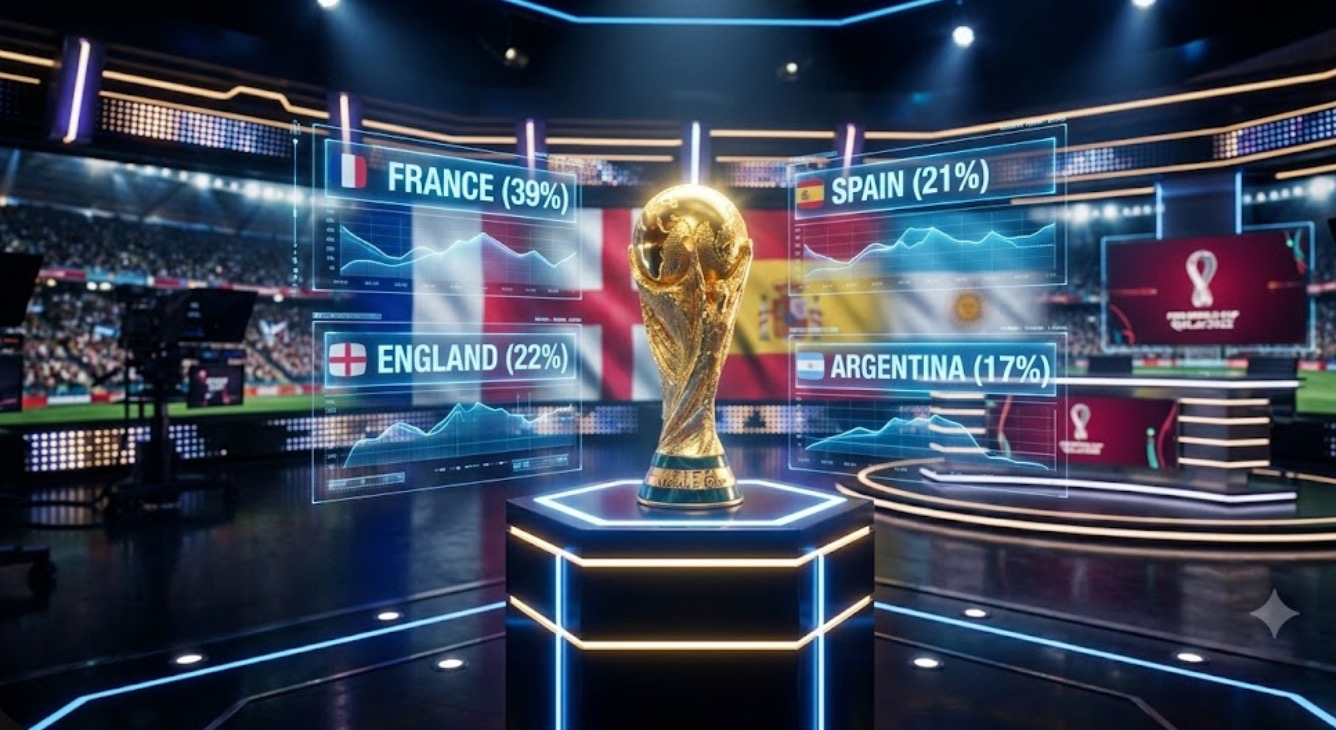
According to New York Post coverage of Polymarket trends, France is currently the leading favorite to win the tournament with a 39% implied chance, followed by England at 22%, Spain at 21%, and Argentina at 17%.
That makes France the market favorite. But 39% is not a guarantee. It also means the market still assigns a combined probability of more than 60% to someone else winning the trophy.
For traders and market watchers, this is exactly why prediction markets are interesting. They turn uncertainty, public information and crowd expectations into live probabilities.
Prediction Market Snapshot
The current prediction market picture is clear:
-
France: 39%
-
England: 22%
-
Spain: 21%
-
Argentina: 17%
These numbers suggest that France has separated from the field, but not enough to be considered a sure winner. England and Spain are almost tied behind France, while Argentina remains the lowest-priced contender among the final four but still very much alive.
This is an important point. A prediction market price should not be read as a prophecy. It is a market-based estimate based on available information, trading demand and shifting expectations.
In simple terms, France is favored, but the tournament is still open.
Why France Leads the Market
France’s position as the top favorite is not surprising.
New York Post’s latest World Cup odds coverage described France as the consensus favorite at around +150, noting that the team had won all six matches without needing extra time and had conceded only two goals so far.
That combination matters in knockout football.
France has attacking quality, defensive control and tournament experience. In a semifinal or final, those factors can be more important than possession numbers or highlight plays.
France also has a major star factor. Kylian Mbappé remains one of the tournament’s most decisive players, and France’s ability to turn small moments into goals is one reason the market continues to price them above the rest.
From a prediction market perspective, France is not leading only because of reputation. The market is responding to performance, consistency and perceived path strength.
Why England Still Has a Strong Case
England sits second in the Polymarket trend snapshot, slightly ahead of Spain.
That reflects several factors. England has reached the semifinals and remains one of the strongest teams on paper. talkSPORT’s World Cup odds guide also describes England as one of the top contenders alongside France, Spain and Argentina, highlighting key players such as Harry Kane and Jude Bellingham.
England’s upside is clear: the squad has elite attacking talent, midfield power and players who can decide tight games.
The question is psychological. The Guardian noted that England’s World Cup history includes painful semifinal memories, including 1990 and 2018. It also pointed out that England vs Argentina carries one of the strongest historical rivalries in international football.
That makes England a high-upside but high-pressure contender. Prediction markets recognize the quality, but the path is emotionally and tactically demanding.
Why Spain Could Be the Value Team
Spain is almost level with England in prediction market probability, sitting around 21% in the Polymarket trend snapshot.
Spain’s case is different from France’s. France looks like the strongest all-around tournament machine. Spain may be viewed as the team with tactical control, defensive structure and upside if its attack reaches another level.
New York Post’s odds analysis even described Spain as a strong value pick at around +340, citing the team’s defense and potential offensive upside.
Spain’s challenge is immediate: they must face France. If Spain beats France, the prediction market could reprice quickly. A France elimination would remove the current favorite and likely push Spain close to the top of the market before the final.
That is why Spain’s current probability may understate their upside if they survive the semifinal.
Why Argentina Cannot Be Ignored
Argentina has the lowest probability among the final four in the Polymarket trend snapshot, at around 17%.
But Argentina should not be dismissed. Knockout football rewards experience, emotional control and the ability to manage pressure. Argentina has recent World Cup-winning experience and remains dangerous in one-match situations.
The market may be discounting Argentina because of path difficulty and squad questions compared with France or England. But a 17% probability is still meaningful. It does not mean Argentina is unlikely in a casual sense. It means the market sees Argentina as the longest shot among elite remaining teams.
That distinction matters. In prediction markets, being fourth does not mean being irrelevant. It means the risk-reward profile is different.
What Prediction Markets Tell Us

Prediction markets are useful because they aggregate expectations.
Instead of relying on one analyst’s opinion, they reflect a live market where participants can express views through prices. If new information appears, such as injuries, tactical news, lineup changes or match results, probabilities can move quickly.
For the World Cup, prediction markets help answer questions like:
-
Which team is favored now?
-
How much confidence does the market have in that favorite?
-
Which team may be undervalued?
-
How quickly does sentiment change after each match?
That makes prediction markets a useful tool for reading sentiment. But they are not perfect.
Prediction Markets Are Not Guarantees
Prediction market prices can be influenced by liquidity, public bias, fan demand and short-term news flow.
Academic research on Polymarket has also highlighted structural issues that can appear in decentralized prediction markets. One 2025 study found that related Polymarket conditions can sometimes be mispriced, creating arbitrage opportunities across markets.
Another 2026 study analyzed Polymarket’s hybrid design, where orders may be matched off-chain but settled on-chain, and identified cases where settlement failures created market consistency issues.
This does not mean prediction markets are useless. It means users should understand their limits. A probability is not the same as truth. It is a market signal.
For football, that signal can be useful, but it must be combined with match context, team news, tactics and risk management.
Final Prediction
Based on the current prediction market data and team performance, the most reasonable title prediction is:
-
Champion: France
-
Main challenger: England
-
Value challenger: Spain
-
Dangerous underdog: Argentina
If France reach the final, they should remain favored against either opponent. But if Spain eliminate France in the semifinal, the entire market structure could change quickly.
That is the nature of prediction markets. They do not only predict the future. They constantly reprice it.
Tapbit View
The current prediction market structure points to France as the leading favorite to win the 2026 World Cup.
That view is supported by France’s tournament performance, defensive record and consensus odds position. England and Spain remain close behind, while Argentina is priced lower but still dangerous because of knockout experience.
For Tapbit users, the bigger lesson goes beyond football. Prediction markets show how digital markets price uncertainty in real time. Whether the event is a World Cup final, an election, an economic data release or a crypto market catalyst, the logic is similar: traders react to information, probabilities move, and market consensus changes as new data arrives.
But prediction market prices should never be treated as certainty. The best way to read them is as a live sentiment indicator.
Users who want to monitor broader market news can visit the Tapbit homepage. Existing users can access their accounts through Tapbit login, while new users can start from the Tapbit registration page.
Frequently Asked Questions (FAQ)
Who is favored to win the 2026 World Cup?
Prediction market trends currently favor France. New York Post coverage of Polymarket trends cited France at 39%, followed by England at 22%, Spain at 21% and Argentina at 17%.
Does a 39% probability mean France will definitely win?
No. A 39% probability means France is the leading favorite, but the market still sees a larger combined chance that another team wins.
Which team is the best challenger to France?
England is currently the second-highest team in the Polymarket trend snapshot, while Spain is very close behind.


