
By 2026, SEC-approved cryptocurrency ETFs have pulled digital assets firmly into the regulated mainstream. What started with spot Bitcoin funds in early 2024 has expanded into a broad lineup covering Ethereum, Solana, Dogecoin, multi-asset baskets, and — critically — XRP. For a token long defined by its cross-border payments narrative and a protracted regulatory battle, the arrival of XRP ETFs marks a clean turning point.
These products let investors gain exposure to XRP's price performance through standard brokerage accounts, without touching wallets, private keys, or crypto exchange onboarding. Shares trade on traditional exchanges throughout the day, sitting comfortably in portfolios alongside equities, bonds, and commodity funds. As part of a wider wave of crypto ETF approvals, XRP funds show what regulatory clarity can unlock — and how quickly market structure can shift when it arrives.
This article examines how SEC-approved XRP ETFs fit into the broader crypto ETF ecosystem as of 2026: their regulatory journey, market impact, the trade-offs investors face, and how XRP stacks up against Bitcoin, Ethereum, and Solana in the ETF universe.
From Litigation to Listings: How XRP Reached ETF Status
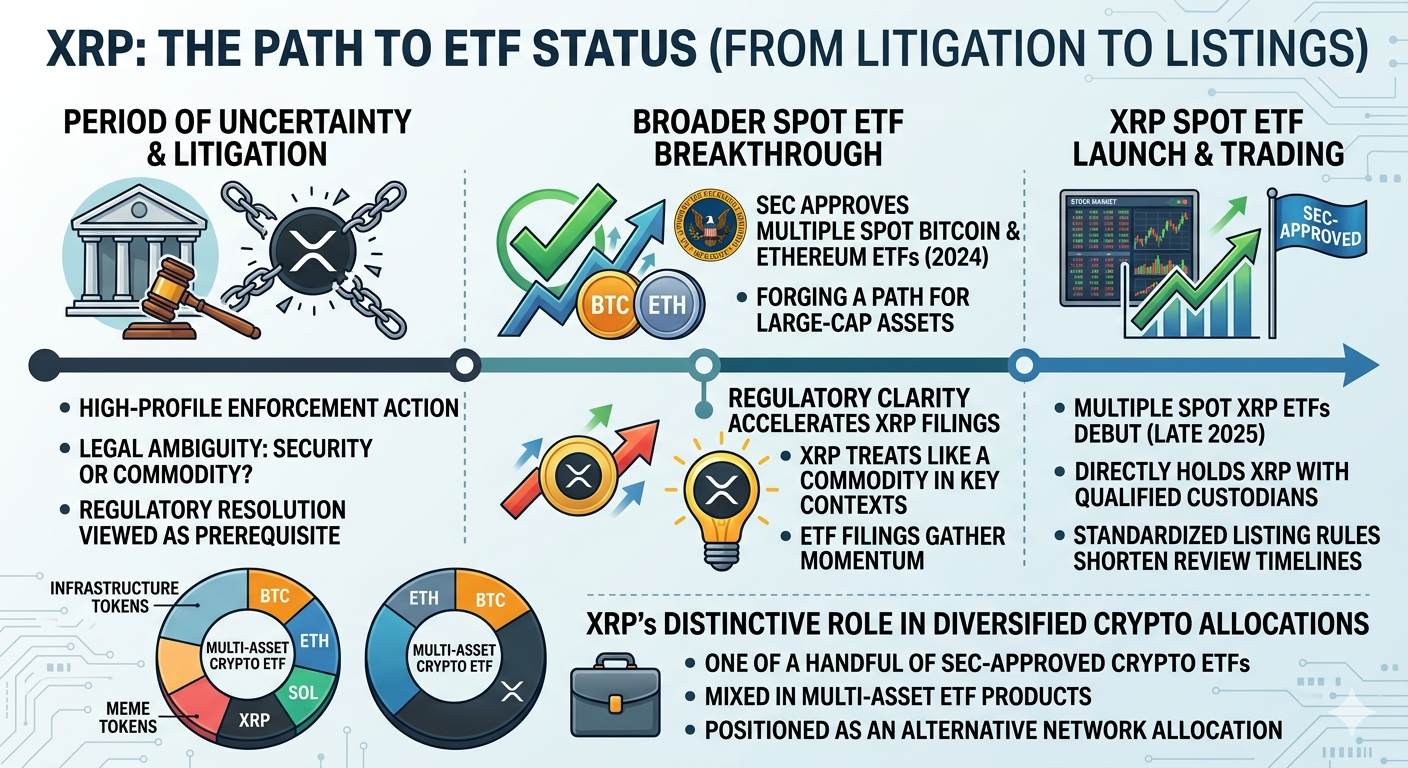
The path to SEC‑approved XRP ETFs began with the broader spot ETF breakthrough. After more than a decade of rejections citing concerns over market manipulation and investor protection, the SEC approved multiple spot Bitcoin ETFs in January 2024. Ethereum followed in 2024 as well, setting a clear precedent for additional large‑cap assets.
XRP’s situation was more complex. For years it was entangled in a high‑profile enforcement action and legal uncertainty over whether the asset should be treated as a security or a commodity. Market participants widely viewed regulatory resolution as a prerequisite for ETF approval. Once that clarity arrived and XRP was treated more like a commodity in key contexts, ETF filings gathered momentum.
By late 2025, several spot XRP ETFs had cleared the SEC’s review process and begun trading. These funds typically hold XRP directly with qualified custodians, issuing redeemable shares that track the token’s market price. In parallel, the SEC’s adoption of more standardized listing rules for crypto products shortened review timelines, allowing XRP issuers to move from filing to launch much more quickly than earlier Bitcoin applicants had experienced.
Alongside Bitcoin, Ethereum, Solana, and a small number of meme and infrastructure tokens, XRP has become one of a handful of cryptocurrencies available through SEC‑approved spot ETFs. That positioning gives it a distinctive role within diversified crypto allocations and multi‑asset ETF products that mix Bitcoin, Ethereum, and a smaller allocation to alternative networks.
Market Impact of XRP ETFs
The launch of XRP ETFs has had both direct and indirect effects on the digital asset market. While it is difficult to isolate the impact of any single product, several patterns have emerged since XRP joined the ETF lineup.
Capital Flows and Liquidity Effects
Spot XRP funds have attracted meaningful, if more modest, inflows compared with Bitcoin and Ethereum. Cumulative flows have been spread across several issuers, with assets under management building steadily as financial advisors, multi‑asset managers, and self‑directed investors added small XRP allocations to broader crypto and alternative‑asset sleeves.
These flows have contributed to:
- Improved secondary‑market liquidity for XRP, particularly during U.S. trading hours.
- Tighter bid‑ask spreads on major regulated venues relative to the pre‑ETF era.
- Greater integration of XRP pricing into traditional market data feeds and portfolio analytics tools.
Because creation and redemption of ETF shares involve large blocks of XRP moving between custodians and issuers, on‑chain transaction volumes can also show periodic spikes around major inflow or outflow days.
Credibility and Positioning Within the Crypto Landscape
For many institutional allocators, the existence of an SEC‑approved ETF is an informal threshold for taking an asset seriously. XRP’s addition to the ETF universe followed a period in which legal questions had limited its inclusion in professionally managed portfolios. With that overhang reduced and regulated products available, several dynamics have shifted:
- Asset managers that previously avoided XRP due to regulatory ambiguity are now able to consider it within formal investment policies.
- Research coverage has broadened, with more sell‑side and independent analysts evaluating XRP’s role in cross‑border settlement and liquidity provision.
- Multi‑asset crypto ETFs and index‑style products increasingly allocate a defined percentage to XRP alongside Bitcoin, Ethereum, and Solana.
This combination of regulated access and clearer legal standing has strengthened XRP’s position as a payments‑oriented complement to store‑of‑value and smart‑contract assets in diversified crypto strategies.
Why Investors Are Paying Attention to XRP ETFs
For investors already familiar with Bitcoin and Ethereum ETFs, XRP funds offer a different set of potential benefits and use‑case exposure. The appeal centers on simplicity, differentiation, and portfolio design rather than speculative leverage.
Access to a Distinct Payments Narrative
XRP’s core thesis focuses on fast, low‑cost cross‑border transfers and liquidity for payment networks and financial institutions. ETF wrappers allow investors to express a view on this specific segment of the crypto market—global value transfer—without managing direct token holdings.
In multi‑asset portfolios, XRP ETFs can sit alongside Bitcoin’s “digital store of value” profile and Ethereum or Solana’s “programmable finance” role. This functional diversification across narratives—store of value, smart‑contract platforms, and payments infrastructure—can be attractive to allocators building thesis‑driven exposures.
Simplicity, Custody, and Operational Efficiency
As with other spot crypto ETFs, XRP funds remove several operational hurdles. Investors can buy or sell shares during market hours through existing brokerage accounts, hold positions in tax‑advantaged retirement vehicles where permitted, and integrate XRP exposure into model portfolios and risk systems that already account for ETF characteristics.
This structure particularly appeals to institutions and advisors that must work within strict compliance, reporting, and custody requirements. For such users, adding XRP via an ETF is far simpler than onboarding directly to multiple crypto trading venues. For those who prefer trading the underlying market themselves, centralized exchanges such as Tapbit still provide direct spot and derivatives access, supported by a transparent pricing structure and institutional‑style risk controls.
Integration Into Diversified Crypto and Multi‑Asset Strategies
In practice, XRP ETFs are often used as a satellite position within broader portfolios.
- Advisors may allocate a small percentage of a client’s alternatives bucket to a blend of Bitcoin, Ethereum, and select altcoin ETFs, including XRP.
- Multi‑asset managers might hold XRP funds opportunistically when relative valuations, sentiment, or macro conditions appear favorable for cross‑border payment themes.
- Index‑style products that track digital‑asset baskets can incorporate XRP to better reflect market capitalization and sector composition.
These roles mean XRP exposure increasingly sits inside managed portfolios rather than being limited to speculative trading accounts. For traders and investors who still want the flexibility of direct token positions and higher‑frequency strategies, it remains straightforward to start trading XRP pairs on specialized crypto platforms in parallel with ETF holdings.
Risks and Trade‑Offs Specific to XRP ETFs
Despite regulatory oversight and operational conveniences, XRP ETFs share many of the same risks as other crypto products, alongside a few that are more specific to the asset’s market structure and history.
Volatility and Regulatory Overhang
XRP remains a volatile digital asset. While ETFs provide a regulated wrapper, they do not dampen underlying price swings. Sharp moves driven by macro conditions, changes in liquidity, or shifts in sentiment around cross‑border payment adoption can translate directly into ETF share performance.
Although key legal hurdles have been addressed, regulatory evolution is ongoing. Future policy decisions—whether around bank use of stablecoins, cross‑border settlement standards, or disclosure rules for digital‑asset products—could affect demand for XRP and, by extension, the ETFs that hold it. Investors should approach XRP allocations with the understanding that the regulatory landscape is more mature than it once was but not static.
Liquidity, Spreads, and Premium/Discount Risk
XRP ETFs are generally smaller and less actively traded than the largest Bitcoin or Ethereum products. In normal conditions, this may simply mean slightly wider bid‑ask spreads and lower average daily volume. However, during periods of market stress or heavy flows, thinner liquidity can contribute to:
- Temporarily larger premiums or discounts to the net asset value (NAV) of the underlying XRP holdings.
- More noticeable impact from large creation or redemption orders.
- Greater slippage for investors placing market orders in less liquid trading sessions.
These effects are not unique to XRP; they are common in smaller or newer ETFs across asset classes. Still, they are an important consideration when comparing XRP funds with high‑liquidity flagship Bitcoin or Ethereum ETFs.
Concentration and Thematic Risk
By design, single‑asset XRP ETFs concentrate exposure in one network, one use‑case thesis, and one regulatory story. If adoption of XRP in cross‑border flows underperforms expectations, or if competing technologies gain ground among financial institutions, that thematic risk may weigh on long‑term performance.
Investors can mitigate this concentration by:
- Holding XRP ETFs as part of a diversified mix including Bitcoin, Ethereum, Solana, and broad crypto index products.
- Limiting position sizes relative to overall portfolio risk tolerance.
- Reviewing prospectuses to understand whether a fund holds only XRP or can rotate among multiple assets.
For users who prefer to manage this thematic risk actively, direct exchange trading can be paired with ETF positions, allowing tactical shifts while using regulated funds for core exposure. Platforms that provide both spot markets and robust derivatives—supported by strong proof of reserves and asset security reporting—can help bridge these two approaches.
How XRP Compares With Other SEC‑Approved Crypto ETFs
Understanding XRP’s place in the ETF universe is easier when it is viewed alongside Bitcoin, Ethereum, Solana, and other listed assets.
Bitcoin and Ethereum: The Core Pillars
Spot Bitcoin ETFs remain the largest category by far. They attract substantial daily flows, have some of the tightest spreads, and often charge expense ratios that have trended lower as competition intensifies. Their primary narrative focuses on digital scarcity and macro‑hedging characteristics.
Ethereum ETFs, including products that incorporate staking rewards where permitted, occupy the second‑largest share of crypto ETF assets. They appeal to investors interested in decentralized finance, tokenization, and smart‑contract infrastructure. Staking‑enabled variants can distribute yield on top of price exposure, though they also introduce protocol‑level and regulatory considerations.
Solana and Other High‑Throughput Networks
Solana ETFs extend ETF coverage into high‑throughput, low‑fee smart‑contract platforms. Some of these funds also use staking to capture on‑chain yields, distributing them to shareholders after expenses. While smaller than Bitcoin and Ethereum ETFs, they illustrate growing institutional interest in alternative layer‑1 ecosystems and support a broader conversation about performance, cost, and developer activity.
XRP’s Distinct Role
In this lineup, XRP ETFs stand out as payment‑focused instruments. They provide:
- Exposure to a network optimized for fast settlement and low‑friction value transfer.
- A differentiated risk and use‑case profile compared with store‑of‑value or generalized smart‑contract platforms.
- A regulated way for investors to participate in potential growth of cross‑border payment rails that leverage XRP as a bridge asset.
For investors seeking to construct a more nuanced digital‑asset allocation, XRP ETFs can therefore act as a targeted satellite holding, complementing core positions in Bitcoin and Ethereum rather than replacing them.
Practical Considerations for XRP ETF Investors
As with any investment decision, using XRP ETFs effectively requires a combination of product knowledge, risk awareness, and alignment with broader portfolio goals.
- Understand the product structure. Review how each ETF sources and custodies XRP, how creation and redemption work, and whether there are any embedded yield‑generation or derivative strategies.
- Compare costs and liquidity. Expense ratios, bid‑ask spreads, and average trading volumes can differ meaningfully across issuers, affecting long‑term net returns and execution quality.
- Assess portfolio fit. Determine whether XRP exposure is intended as a speculative satellite position, a thematic payments bet, or a modest diversifier within an alternatives allocation.
- Plan for volatility. Use position sizing, dollar‑cost averaging, and multi‑year time horizons where appropriate, rather than relying on short‑term price predictions.
- Stay current on regulation and industry developments. Monitor changes in cross‑border payments infrastructure, central bank initiatives, and digital‑asset policy that could influence XRP demand.
Investors who prefer more hands‑on control may combine ETFs with direct XRP holdings on exchanges that provide derivatives, margin, and yield products. On Tapbit, users can access your account to manage spot XRP positions, hedge with futures, or participate in structured products, while still keeping a portion of exposure in regulated ETF vehicles held at traditional brokerages.
Conclusion: XRP ETFs as Part of a Broader Shift
By 2026, SEC‑approved XRP ETFs have become an established part of the digital‑asset landscape. They emerged only after critical questions about XRP’s regulatory treatment were addressed, highlighting how legal clarity and product design go hand in hand. Alongside Bitcoin, Ethereum, Solana, and a growing list of other tokens, XRP funds demonstrate how crypto exposure can be integrated into mainstream portfolios through familiar, regulated instruments.
These products offer practical advantages—simplicity, institutional‑grade custody, standardized reporting—while preserving the underlying asset’s volatility and thematic risk. For investors who see long‑term potential in XRP’s cross‑border payments use case, ETFs provide a structured on‑ramp. For the broader ecosystem, they mark another step in the ongoing convergence between traditional finance and blockchain‑based infrastructure.
Anyone considering XRP ETFs should evaluate them in the context of overall objectives, risk tolerance, and time horizon, and where appropriate, consult qualified professionals. For those looking to complement ETF holdings with direct market access, Tapbit offers a straightforward way to begin your journey in spot and derivatives trading, underpinned by robust security and transparent trading fees.


