
Let’s be honest: the last few months have been brutal.
A year ago, the market was running on pure adrenaline. Bitcoin had smashed through every model to hit an all-time high of $126,000. Institutional money was pouring in blindly, and a $4 trillion total market cap felt inevitable.
Now, Q1 2026 is in the rearview mirror, and the hangover is real. After a grinding, multi-month drawdown, Bitcoin is currently chopping around the $68,092 mark. It’s fighting a trench war to flip the old $69,000–$70,000 ceiling back into solid support. Retail sentiment is entirely wrecked, with the Fear and Greed Index pinned in the red.
Everyone is asking the same thing: Is the bleeding finally over, or is the floor about to fall out again?
At Tapbit, we tune out the Twitter panic and look at the actual market structure. Here is what the data is telling us about this 46% correction, and why smart money is treating this as a massive setup.
The Hangover: Why We Actually Dumped
If we want to figure out if the bottom is in, we first have to admit why we crashed. This wasn’t just retail traders getting spooked; this was a systemic, macro-driven de-leveraging event.
-
The Macro Squeeze: Geopolitical escalations in the Middle East and the Federal Reserve playing hardball with interest rates sucked the oxygen out of risk assets. When the cost of capital stays high, institutions take liquidity off the table. Crypto is always the first to feel that squeeze.
-
The ETF Faucet Turned Off: Spot Bitcoin ETFs carried the 2025 bull run. But by the end of Q1 2026, that momentum hit a wall. As institutional positioning shifted risk-off, U.S.-listed spot Bitcoin ETFs suffered a severe multi-week outflow streak totaling nearly $3.8 billion, draining the passive bid that was supporting the market.
-
Whales Distributed into the Rally: On-chain data doesn't lie. The exchange whale ratio spiked from 0.34 in January to 0.79 in March. Translation: the early buyers who rode BTC to six figures moved their massive bags onto exchanges to cash out, creating a wall of sell pressure that broke the market's back.

The Alpha: Watch What They Build, Not What They Say
Here is the divergence that matters. While retail investors are capitulating and staring at red hourly candles, traditional finance (TradFi) giants are quietly buying up the crypto infrastructure. Q1 2026 was arguably the most aggressively productive quarter for institutional adoption in history.
-
Mastercard Bought the Rails: Mastercard didn't just write a research report; they dropped up to $1.8 billion to acquire stablecoin infrastructure firm BVNK. They are actively integrating stablecoins into their global fiat settlement network.
-
Nasdaq is Putting Stocks on Chain: Nasdaq recently secured SEC approval to pilot tokenized securities trading in live markets. Real-world asset (RWA) tokenization is no longer a buzzword; it’s literally entering the plumbing of Wall Street.
-
Solana Went Corporate: Major networks are pivoting to enterprise clients. The Solana Foundation just launched its API-based Developer Platform for institutions, and it is already being adopted by heavyweights like Worldpay and Western Union.
Prices are down, but the foundation is cementing. The institutions aren't fleeing the crypto market—they are buying the dip on the infrastructure that runs it.
The Chart: Where Do We Go From Here?
Technically, we are sitting on a knife's edge. The cost basis for short-term holders (people who bought in the last 155 days) has plunged from $124,752 down to roughly $68,032. The market has repriced significantly lower.
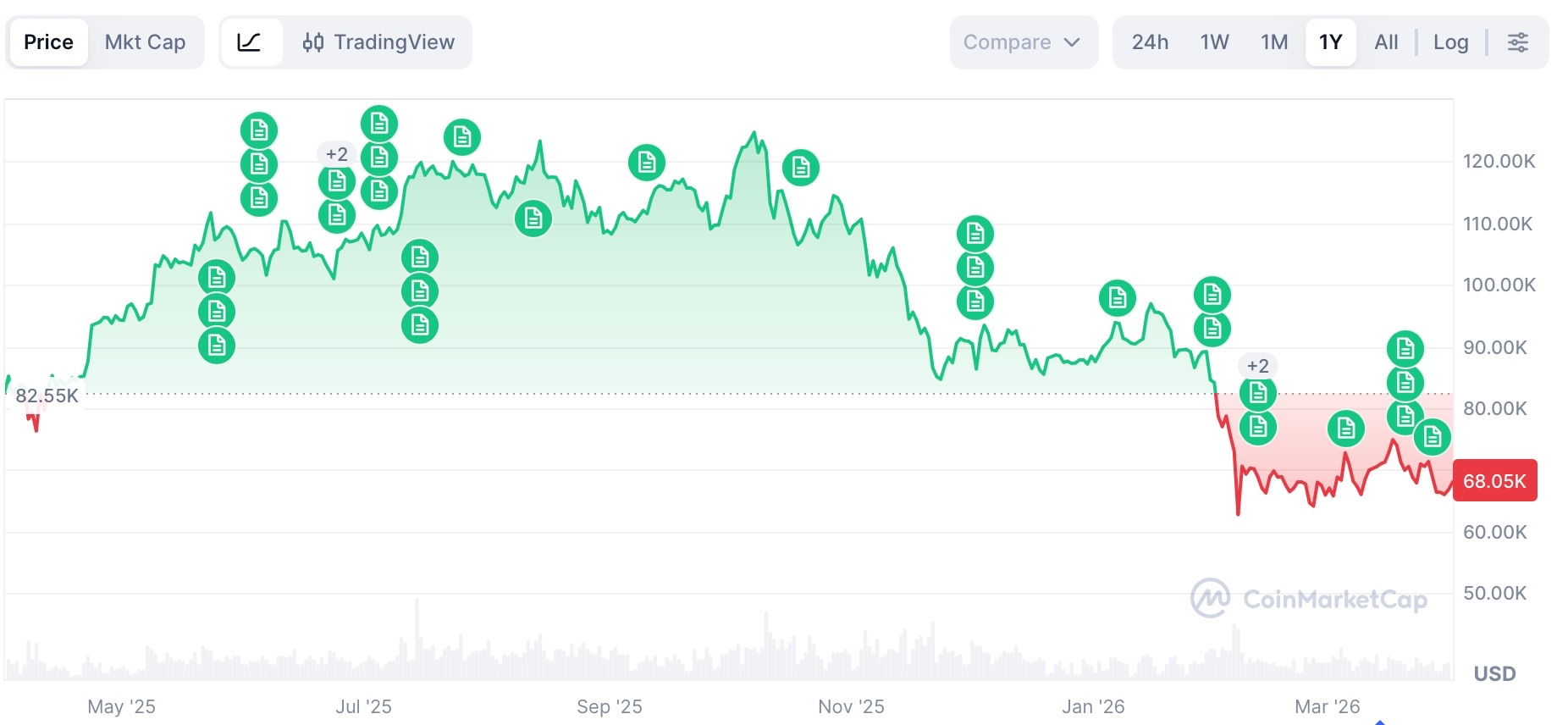
Right now, BTC is trying to decide its next macro trend. There are two realistic scenarios from here:
-
The Flush ($40K – $50K): If BTC can't catch a bid and cleanly reclaim the $70,000 level, gravity will take over. The order books are heavy with shorts. If support breaks, we could see a final, violent capitulation wick down to the $46,000 area (or even lower into the $39K-$41K zone) to completely liquidate late longs before V-shaping back up.
-
The Reclaim ($71K+ Confirmation): For the bulls to actually prove they are back in the driver's seat, we need a high-volume daily close above $71,000. If we get that, the Q1 correction is officially over, and the market will start looking back toward the $150,000 macro targets set by the major asset managers.
The Trader's Takeaway
Trying to catch the exact bottom in crypto is a great way to blow up your portfolio. But structurally, we are deep in the value zone.
April is historically a very strong month for Bitcoin, but you have to trade the reality in front of you. The Q1 washout did exactly what it was supposed to do: it flushed out the absurd leverage and tourist money from the 2025 peak.
Whether the absolute bottom is $65,000 or we get a nasty wick down to $45,000, professional capital is treating this fear as an accumulation phase. Manage your risk, keep your leverage low, and don't get shaken out before the macro trend resumes.
If you're sitting on the sidelines, now is the time to prepare. Register your Tapbit account to get your portfolio ready for the next cycle. Already with us? Log in to the Tapbit Trading Terminal to take advantage of institutional-grade liquidity and zero-latency matching when the volatility hits.
Frequently Asked Questions (FAQ)
Why did spot Bitcoin ETFs see massive outflows in late Q1 if institutions are supposedly still bullish?
You have to separate passive market flow from structural investment. The ETF outflows in late March were driven by macro de-risking—hedge funds and retail investors pulling capital out of risk assets because of rising interest rates and geopolitical fears. However, the builders (like Mastercard, Nasdaq, and major banks) do not trade weekly price action. They are spending billions to acquire infrastructure during this dip. ETF flows show you what short-term speculators are doing; M&A activity shows you what the long-term smart money is doing.
What exactly would trigger the $40K–$50K "flush" scenario mentioned in the report?
A "flush" or capitulation event is a purely technical phenomenon driven by leverage. Right now, there is a massive amount of open interest (borrowed money) betting that the $68,000–$69,000 support will hold. If macroeconomic news pushes the price below that structural floor, those long positions will be forcibly liquidated by exchanges. This triggers a cascading chain reaction of automatic selling, driving the price down violently—often resulting in a steep "wick" down to the $40K–$50K range to clear out the leverage before the market violently rebounds.
Retail sentiment is in "Extreme Fear." How should a professional trader interpret this?
In institutional trading, "Extreme Fear" is rarely a signal to sell; it is a contrarian indicator to start scaling in. Retail traders are driven by emotion and past performance, buying at the top ($126K) out of FOMO and selling at the bottom out of panic. Professional capital uses these exact windows of maximum public pessimism to accumulate high-quality assets at a discount.


