
Spot trading is great for accumulating assets, but what happens when the market bleeds? Or when you urgently need to hedge your long-term Bitcoin stack against a sudden drop? This is where futures trading becomes your most valuable tool. (New to derivatives? Before executing your first trade, read our foundational breakdown: ‘Spot Trading vs. Futures: The Guide for Crypto Beginners’.)
Trading crypto futures allows you to speculate on price movements—both up and down—without actually owning the underlying asset. It offers massive capital efficiency through leverage, but it also introduces the very real risk of liquidation.
If you are transitioning from the spot market to derivatives, you need to understand exactly how the execution mechanics work before risking live capital. Here is the Tapbit trading desk’s straightforward, step-by-step guide to executing your first futures trade safely.
The Reality Check: Spot vs. Futures
Before clicking any buttons, you need to understand what you are actually trading.
When you buy Ethereum on the Spot market (as detailed in our Getting Started With Spot Trading guide), you own the actual ETH. If the price drops 50%, you are down in fiat value, but you still own the exact same amount of ETH. You can hold it forever.
When you trade USDT Perpetual Futures on Tapbit, you are trading a contract that tracks the price of Ethereum. You do not own the ETH. Because you are trading contracts using borrowed capital (leverage), if the price moves too far against your position, the exchange will forcefully close your trade to prevent the account from going into negative equity. This is called a liquidation.
To survive in futures, you must master the platform controls.
Step-by-Step: Executing Your First Futures Trade
Step 1: Access the Derivatives Desk
First, log in to your Tapbit account on your desktop or mobile app.
-
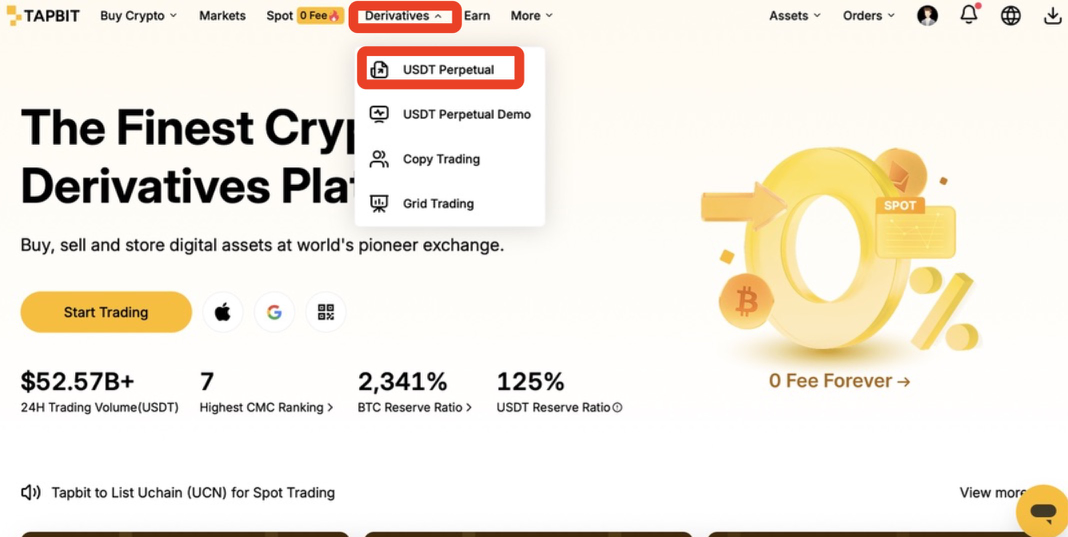
Look at the top navigation bar.
-
Hover over the Derivatives tab.
-
Select USDT Perpetual. (These are contracts settled in USDT, meaning your profits, losses, and margin are all calculated in Tether).
Step 2: Select Your Trading Pair
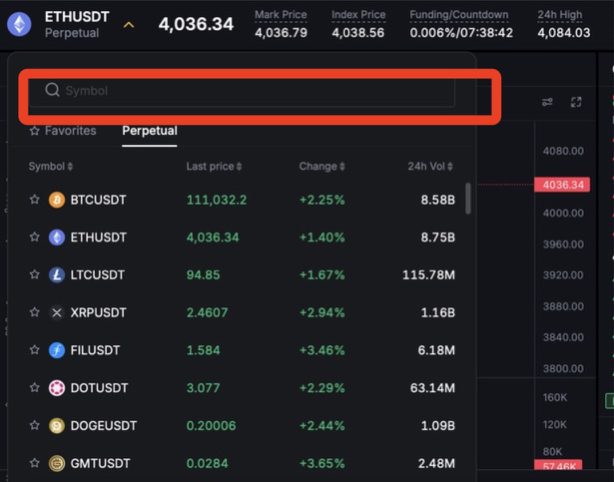
On the top left of the trading interface, you will see the default ticker (usually BTC/USDT). Click on it to open the search menu and select the specific asset you want to trade. For this example, let's say you want to trade Ethereum, so you would select ETH/USDT.
Step 3: Configure Your Risk Parameters (Crucial Step)
This is where most beginners make their first mistake. Before you enter an order size, you must configure your margin and leverage settings on the right-hand side of the screen.
1. Set Your Margin Mode:
-
Isolated Margin: This restricts your risk to the exact amount of capital you allocate to the specific trade. If your ETH trade goes horribly wrong and gets liquidated, you only lose the margin assigned to that one position. The rest of your account balance is safe. (Highly recommended for beginners).
-
Cross Margin: This uses your entire available futures account balance as collateral to keep a losing trade open. It gives your position more breathing room before liquidation, but if the market violently crashes, a single bad trade can wipe out your entire account.
2. Adjust Your Leverage: Tapbit allows you to use a slider or input box to set a multiplier on your capital. If you have $100 and use 10x leverage, you are trading with a $,1000 position.
-
Trading Desk Tip: Leverage magnifies your profits, but it equally magnifies your losses and pulls your liquidation price much closer to your entry. Do not start with 50x or 100x leverage. Keep it low (2x to 5x) while you learn the mechanics.
3. Choose Your Order Type:
-
Limit Order: You specify the exact price at which you want to enter the market. Your order goes into the order book and waits for the price to hit it. This is cheaper (Maker fee) but doesn't guarantee entry.
-
Market Order: You execute immediately at the current live market price. This guarantees entry but charges a slightly higher fee (Taker fee) and can be subject to slippage if the market is highly volatile. (See our guide: Market Orders vs. Limit Orders on Tapbit).
4. Set Your Take-Profit and Stop-Loss (Mandatory Habit): Never open a leveraged position without an exit plan. Use the TP/SL toggle to pre-define your risk.
-
Take-Profit (TP): Automatically closes your trade in profit when the asset hits your target price.
-
Stop-Loss (SL): Automatically cuts your position if the market moves against you, saving you from a total liquidation.
Step 4: Pull the Trigger
Once your margin mode is set to Isolated, your leverage is low, and your Stop-Loss is keyed in, it is time to execute based on your market bias:
-
Click Open Long (Buy) if your technical analysis suggests the asset's price is going to rise.
-
Click Open Short (Sell) if your analysis suggests the asset's price is going to fall.
Start Small, Survive Long
Futures trading is the ultimate tool for capital efficiency and hedging, but it requires strict discipline. The Tapbit trading engine is built to handle institutional-grade order flow, meaning your trades will execute instantly. Your job is to ensure those trades are calculated and protected.
Start with small position sizes, rigorously enforce your stop-losses, and focus on surviving your first few months of derivatives trading rather than trying to double your account overnight.
If you haven't funded your futures wallet yet, you can register or log in here to transfer USDT from your Spot account and get your charts set up.
Frequently Asked Questions (FAQ)
What is the core difference between Spot and Futures trading?
When you trade on the Spot market, you are buying and taking true ownership of the underlying asset (like holding physical ETH in a wallet). If the price dips, you still hold the exact same amount of coins. In Futures trading, you are trading a contract that simply tracks the price of the asset. Because you are using borrowed capital (leverage), your position can be forcefully closed (liquidated) if the market moves too far against you.
Should a beginner use Isolated or Cross Margin?
Always start with Isolated Margin. This setting builds a firewall around your trade, meaning the absolute maximum you can lose is the specific amount of USDT you allocated to that single position. Cross Margin uses your entire futures wallet balance to keep a losing trade breathing. While advanced traders use this for complex hedging, it can easily wipe out a beginner’s entire account in a single flash crash.
Does high leverage guarantee higher profits?
Absolutely not. Leverage is a double-edged sword: it multiplies your profits, but it equally magnifies your losses. More importantly, cranking your leverage up to 50x or 100x drags your liquidation price extremely close to your entry point. A tiny, normal market fluctuation can instantly wipe out your position. We strongly advise keeping your leverage between 2x and 5x while learning the mechanics.
Why should I care about Maker vs. Taker fees?
It impacts your bottom line. When you use a Limit Order, you are adding liquidity to the exchange's order book (you are a "Maker"), which rewards you with a lower trading fee. When you use a Market Order, you are taking liquidity away by demanding an instant fill (you are a "Taker"), which incurs a slightly higher fee.


